
New method filters false signals from the Sun’s hidden side to build fuller magnetic maps
A new method for identifying magnetic activity on the far side of the Sun rejects about 90% of false helioseismic detections before they enter solar magnetic-field simulations. Tests found that conventional near-side-driven simulations underestimated the Sun’s total unsigned magnetic flux by roughly 10–20%, showing how much magnetic activity can be missing while active regions develop beyond direct Earth view.

Image credit: NASA
Scientists have long been able to reconstruct magnetic maps of the full Sun, but the hidden hemisphere remains a fundamental weakness. Surface flux transport models evolve magnetic fields measured on the Earth-facing side as the Sun rotates, yet they cannot directly capture an active region that emerges or continues growing out of view. The resulting maps provide boundary conditions for models of the corona and heliosphere, so missing far-side magnetic flux can propagate into calculations of the solar environment.
Bibhuti Kumar Jha and colleagues developed a probabilistic system for deciding which far-side helioseismic detections are credible enough to add to an Advective Flux Transport (AFT) simulation. Helioseismology does not photograph the magnetic field itself. It measures changes in acoustic waves traveling through the Sun; magnetic active regions alter those travel times, allowing activity on the hidden hemisphere to be inferred indirectly.
That indirect measurement comes with noise. Far-side helioseismic maps can contain signals that resemble active regions but have no corresponding region in extreme-ultraviolet observations. The researchers refer to these false detections as ghost active regions. Their goal was not simply to add more far-side information, but to determine which inferred regions were sufficiently reliable to insert into a magnetic-field model.
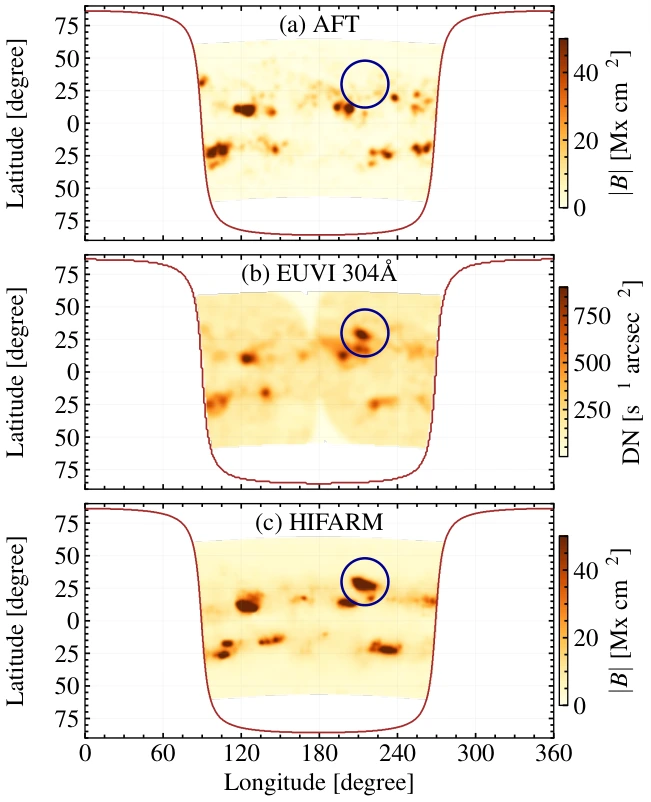
The study compared helioseismic far-side magnetic-flux maps with Solar Terrestrial Relations Observatory (STEREO) Extreme Ultraviolet Imager observations at 304 Å from May 13, 2010 through August 18, 2014, when STEREO provided substantial coverage of the Sun’s hidden hemisphere. The researchers also used AFT simulations informed by 304 Å observations as a comparison for estimating how much magnetic flux should be assigned to far-side detections.
A logistic-regression classifier evaluated candidate active regions using their inferred magnetic flux, average magnetic-field strength and latitude. The model was trained on 8 181 detections and evaluated on an independent set of 2 046. At the adopted probability threshold of 0.73, it achieved a precision of 0.93 for predicted true active regions while rejecting approximately 90% of ghost detections.
That high precision comes with a substantial trade-off. The same threshold retained only about 52% of the true active regions in the test sample, meaning roughly 48% were missed. The authors deliberately chose the threshold to limit false detections, rather than maximize the number of real regions recovered. The paper notes that the omitted true regions generally carried less magnetic flux, but improving this balance remains an unresolved part of the method.
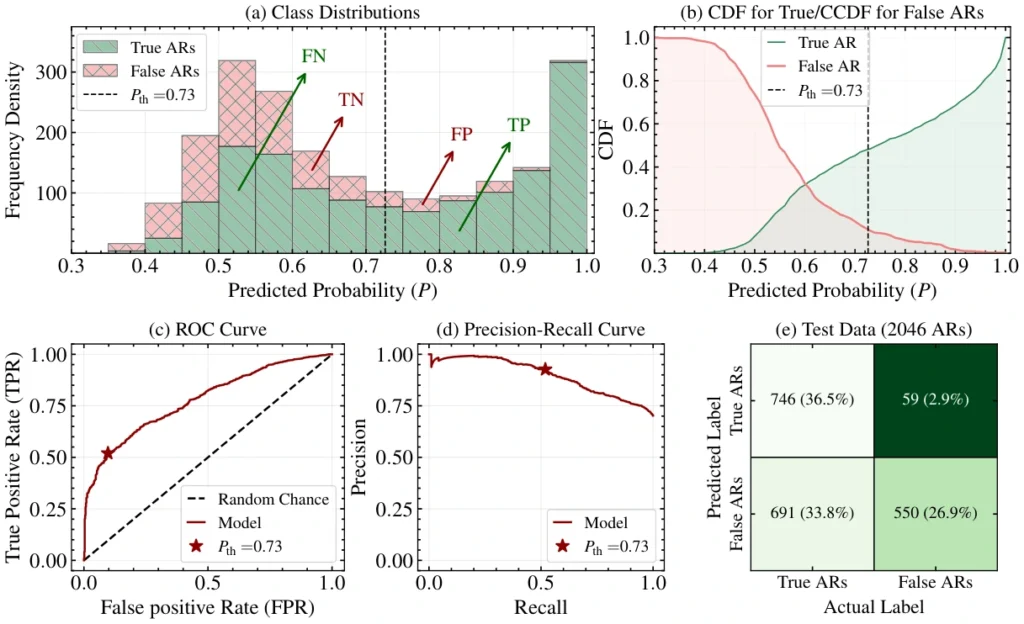
Magnetic flux was the strongest of the three predictors. Regions with larger, more coherent concentrations of inferred flux were more reliably associated with real active regions, while average field strength contributed less and latitude provided only a secondary constraint. The classifier’s overall area under the receiver-operating-characteristic curve was 0.77, showing useful but imperfect separation between genuine and ghost detections.
Detection alone was not enough. Magnetic flux inferred from helioseismic maps could not be inserted directly into AFT because its scale did not reliably match the amount needed to reproduce an active region once it rotated into direct view. The researchers therefore derived an empirical correction relating inferred far-side flux to the flux represented in simulations constrained by extreme-ultraviolet observations.
The corrected regions were inserted as idealized bipolar magnetic regions only when the baseline AFT simulation contained less flux than the far-side estimate. In physical terms, the model adds only the magnetic flux judged to be missing rather than replacing an active region already represented in the simulation.
Tests of individual regions showed how the approach changes the modeled Sun. One active region detected in 2011 continued to grow while crossing the far side in the helioseismology-informed simulation, while that development disappeared from the baseline model after the region rotated out of direct view. When the region returned to the visible hemisphere, direct magnetic observations again took over through data assimilation.
Two representative active regions followed across multiple rotations showed broadly consistent evolution between the helioseismology-informed simulations and simulations using 304 Å information, although differences remained during some intervals. The paper attributes those discrepancies to uncertainties in both the conversion of extreme-ultraviolet brightness into magnetic flux and the correction applied to helioseismic flux estimates. Direct near-side magnetic measurements were still required to correct accumulated errors.
At the scale of the entire Sun, the difference was larger than the individual examples alone suggest. The baseline near-side-driven AFT simulation underestimated total unsigned magnetic flux by approximately 10–20% relative to the far-side-informed simulation. The result represents a modeled comparison within the study’s AFT framework, not a measurement that all existing solar models systematically miss the same fraction of flux.
The finding matters because photospheric magnetic maps feed models of the corona and heliosphere, including systems used in space-weather research and forecasting. Earlier work has produced conflicting results: some studies found that adding far-side active regions improved solar-wind forecasts, while others found little effect on coronal or heliospheric modeling. Jha and colleagues argue that resolving that disagreement requires more realistic far-side magnetic information.
The new framework therefore addresses an upstream problem rather than demonstrating a new operational solar-storm prediction capability. It produces a more complete representation of emerging magnetic activity and can supply improved boundary conditions for coronal and heliospheric models, but the study does not report a quantified improvement in operational flare, coronal mass ejection or geomagnetic-storm forecast skill.
The approach also remains constrained by the physics of helioseismic reconstruction. Acoustic travel-time signatures have limited spatial resolution, are affected by viewing geometry, and do not provide a direct measurement of the underlying magnetic field. The physical relationship between the measured phase shifts and magnetic flux remains incompletely constrained, which is why the study relies on empirical calibration against other observations.
The authors propose several ways to reduce the classifier’s false negatives, including incorporating the changing sensitivity of helioseismic measurements across the far-side disk, additional information about the shape and concentration of magnetic flux, and knowledge of active regions before they rotate out of Earth view. They also note that the influence of far-side regions on longer-term global and polar magnetic-field evolution will require a longer dataset.
The work establishes a practical method for deciding when far-side helioseismic information is reliable enough to alter a solar magnetic-field simulation, while quantifying what is sacrificed by using a conservative threshold. The next scientific test is not simply whether still more far-side regions can be inserted, but whether improved full-Sun maps measurably improve the coronal, solar-wind and space-weather forecasts that depend on them.
References
1 Jha, B. K., Upton, L. A., Leka, K. D., Chen, R., Zhao, J., Hess Webber, S., Ugarte-Urra, I., & Jain, K. (2026). A probabilistic framework for incorporating helioseismic far-side active regions into SFT models. The Astrophysical Journal Supplement Series. https://doi.org/10.3847/1538-4365/aea139
2 SwRI-led team develops improved model for mapping the Sun – Southwest Research Institute – October 13, 2026

I’m a science journalist and researcher at The Watchers, contributing to the Epicenter edition, where I cover peer-reviewed scientific research and emerging discoveries across Earth and space sciences. With a background in astronomy and a passion for environmental science, I’ve worked in shark and coral conservation in Fiji, conducting reef and shark-behavior research, contributing to mangrove restoration, and earning PADI Open Water and Coral Reef Certifications. I bring a blend of scientific rigor and storytelling to illuminate the discoveries shaping our planet and beyond.
