
NASA deliberately smashed Apollo 12’s empty lunar lander into the Moon at about 3,750 mph in 1969, and a seismometer the crew had set up on 19 November before leaving recorded the Moon ringing like a bell for nearly an hour.
NASA used Apollo 12’s uncrewed lunar module ascent stage as a controlled seismic source on November 20, 1969, allowing scientists to compare a known impact with the Moon’s response. The signal built for about seven minutes before slowly fading for nearly an hour, exposing an unusual style of seismic propagation that researchers are still using to investigate the Moon’s impact-shattered outer layers.
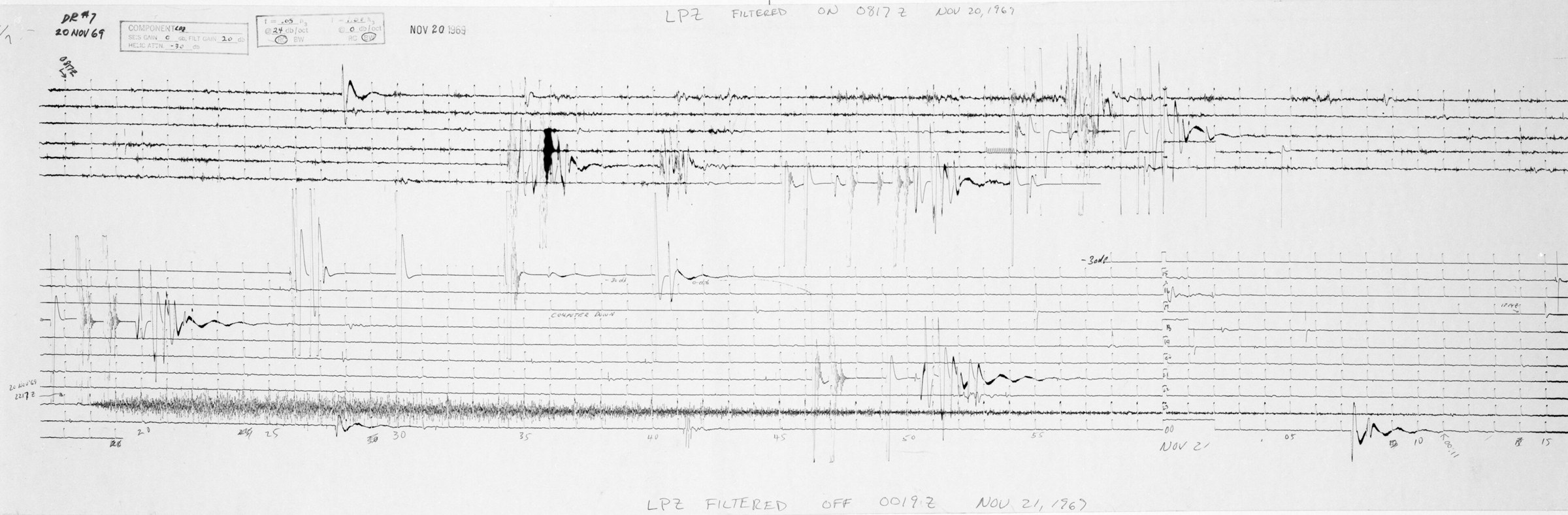
Seismometer record of the Apollo 12 lunar module ascent stage striking the Moon on 20 November 1969. Credit: NASA Johnson Space Center (public domain), via Wikimedia Commons.
The impact was not an improvised disposal maneuver. Apollo 12’s flight plan called for the lunar module ascent stage to provide a controlled seismic source after Charles Conrad Jr. and Alan Bean returned to Richard Gordon in the command module Yankee Clipper. The ascent stage of Intrepid was jettisoned, remotely deorbited and sent toward the lunar surface; its descent stage remained at the Apollo 12 landing site.
The experiment mattered because scientists knew the source. Natural moonquakes and meteoroid impacts can be recorded seismically, but important properties of those sources have to be reconstructed from the signals themselves. For Intrepid, NASA knew the event timing and had tightly constrained the spacecraft’s trajectory and impact conditions, giving the Passive Seismic Experiment a calibration event for examining how seismic energy moved through lunar material.
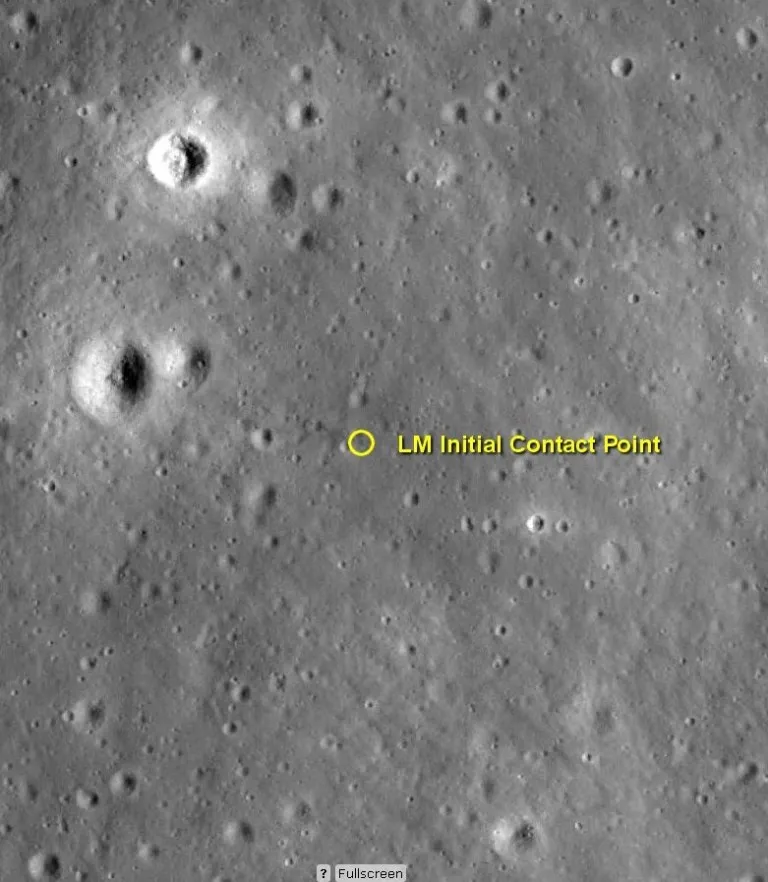
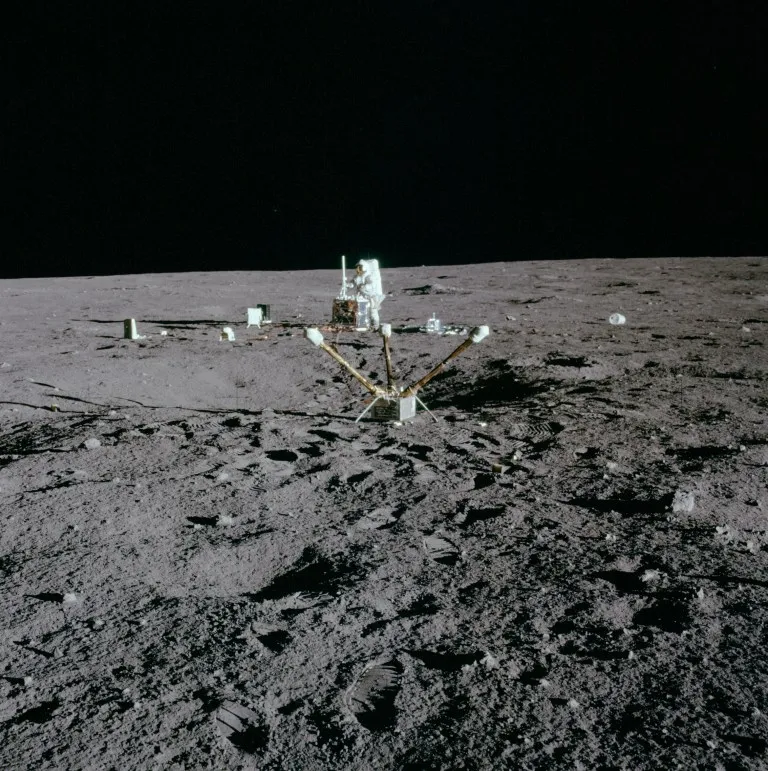
NASA’s National Space Science Data Center lists the impact at 22:17:17.7 UTC on November 20, 1969, with a velocity of 1.68 km/s (3 760 mph) and a trajectory 3.7° above the local horizontal. The Apollo 12 Preliminary Science Report placed the source 75.9 km (47.2 miles) from the seismic station. Conrad and Bean had deployed the Apollo Lunar Surface Experiments Package, including its Passive Seismic Experiment, during their first moonwalk on November 19.
A controlled seismic experiment on the Moon
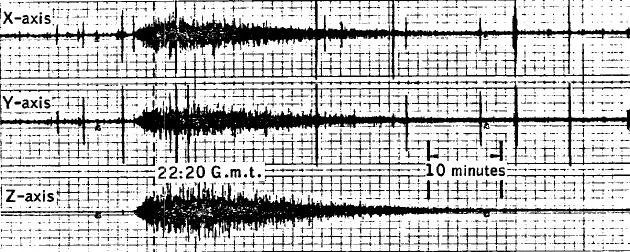
The seismogram did not behave like a simple pulse followed by rapid decay. All three long-period components recorded the impact, and the signal rose gradually to a peak-to-peak amplitude of about 10 nm over approximately seven minutes before declining slowly into the background. NASA’s Preliminary Science Report put the total duration at about 55 minutes; the Apollo 12 Mission Report used approximately 50 minutes, while later NASA historical accounts summarize the response as lasting nearly one hour.
The seven-minute buildup is physically important. The collision occurred on a much shorter timescale, so the delayed maximum belongs to the seismic wavefield recorded after the impact rather than to a seven-minute collision process. Distinct seismic phases were difficult to identify after the beginning of the record, leaving a prolonged wave train in which energy arrived over an extended interval.
Apollo investigators considered whether debris thrown from the impact might produce enough secondary impacts to explain the long disturbance. The Preliminary Science Report found that the first seismic arrival was too fast for nearby ejecta to account for the onset and shifted attention to propagation through the Moon. The investigators did not, however, establish one unique propagation mechanism from the Apollo 12 recording.
Why the signal lasted nearly an hour
One early interpretation centered on weak intrinsic attenuation. Attenuation is the loss of seismic-wave energy as a wave travels through material. Apollo investigators expressed that behavior partly through the seismic quality factor, Q: higher Q corresponds to less energy lost during each cycle. Under the assumptions used in their preliminary analysis, they estimated Q values of roughly 3 000–5 000 for the material sampled by the signal, compared with values of 10–300 that the report cited for most terrestrial crustal materials. The values were preliminary model-dependent estimates, not a direct measurement of a single universal lunar Q.
Scattering offered another part of the explanation. When a seismic wave encounters strong changes in rock properties, part of its energy is redirected rather than continuing along one simple path. In a highly heterogeneous medium, many redirected portions of the same event can reach a detector at different times. Seismologists call the prolonged tail of arrivals the seismic coda.
The original Apollo team treated that interpretation cautiously. A diffusion calculation reproduced aspects of the slow decay but did not verify the scattering hypothesis, and the investigators also considered a near-surface waveguide associated with seismic velocity increasing with depth. Apollo 12 therefore established the unusual waveform much more securely than it established a unique explanation for the waveform.
What later research revealed about lunar scattering
Later analysis placed stronger quantitative constraints on the problem. Blanchette-Guertin, Johnson and Lawrence (2012) examined 369 higher-quality lunar seismograms from 72 events using characteristic rise and decay times. They found that intrinsic attenuation, scattering and possible focusing of energy in a near-surface low-velocity layer all contribute to lunar coda decay and stated that their exact individual contributions could not be uniquely quantified. For shallow events, their results supported scattering in a global near-surface layer as the dominant contribution under particular frequency and distance conditions.
The authors proposed the megaregolith as that major scattering layer. The megaregolith is the heavily impact-processed upper lunar material, including fragmented ejecta over fractured crust. Physically, such heterogeneity gives seismic waves many interfaces at which their direction can change, spreading the energy from one impulsive event across many paths and arrival times rather than producing only a few clean phases.
Onodera, Kawamura, Tanaka, Ishihara and Maeda (2022) tested lunar scattering with full three-dimensional seismic-wave simulations. Their simulated Apollo signals reproduced the strongly scattered character of the observations, and the model yielded a lunar scattering intensity about 10 times that of the heterogeneous terrestrial region used for comparison. The factor is a model-derived comparison, not a direct measurement of the whole Moon against the whole Earth, and the authors identified the detailed heterogeneous structure of the lunar subsurface as an unresolved problem.
How Apollo impacts became probes of the lunar interior
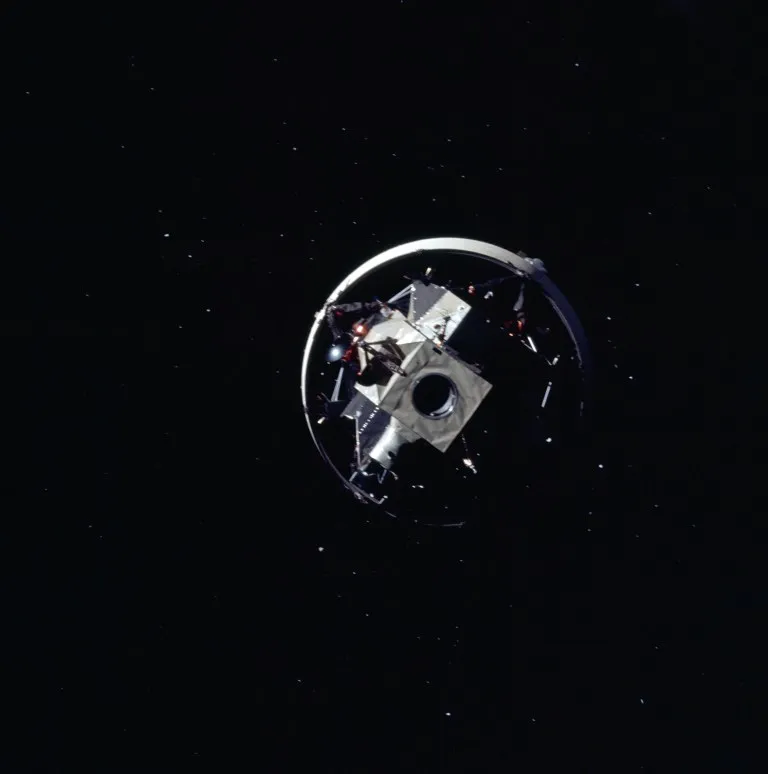
 During Transposition and Docking, the LM Intrepid still attached to the S-IVB third stage. Credit: NASA
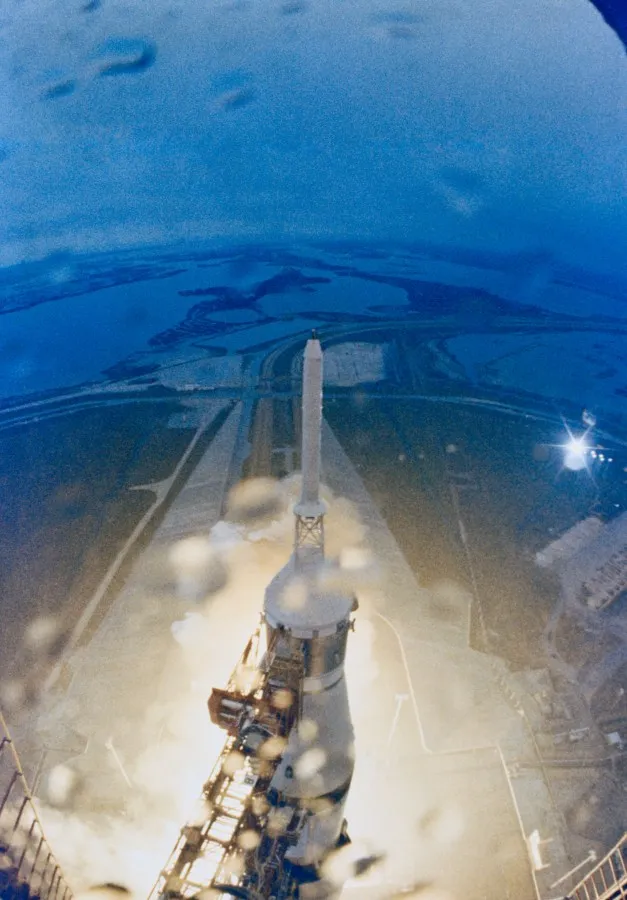
- Apollo 12, moments before liftoff into rainy skies. Credit: NASA
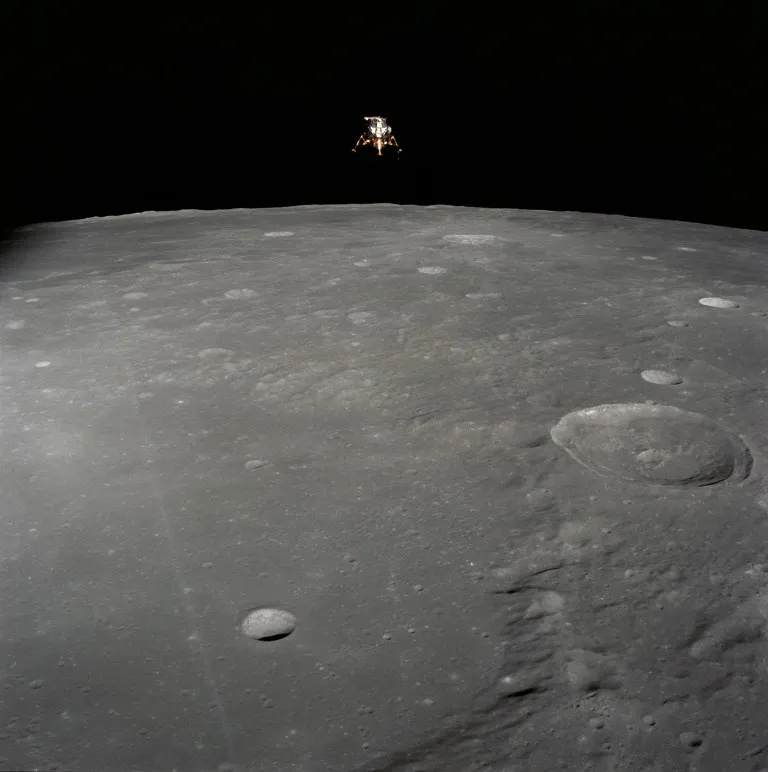
- The Lunar Module Intrepid as seen from the Command Module Yankee Clipper shortly after undocking. Credit: NASA
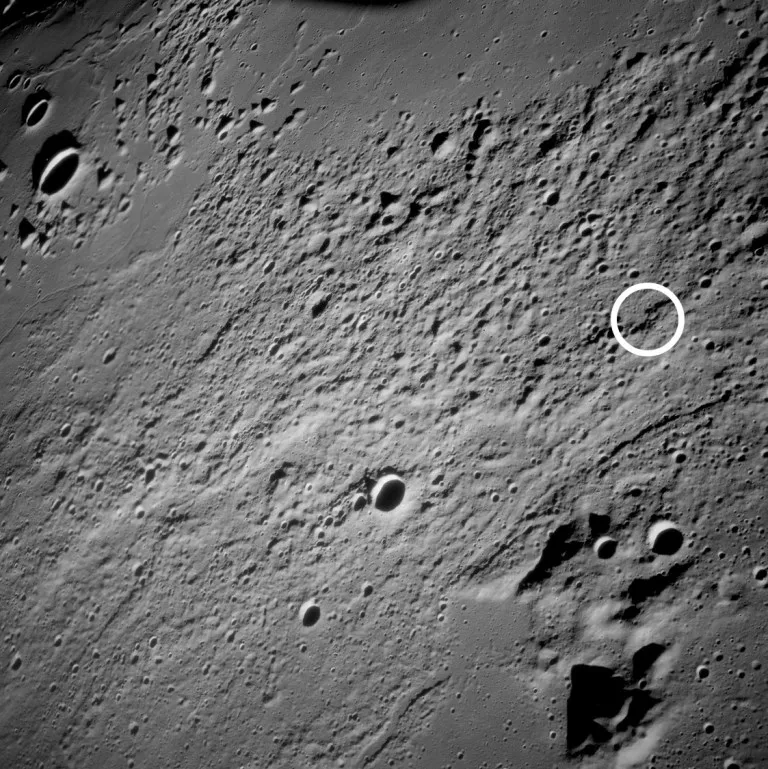
- Image from lunar orbit of the Fra Mauro highlands, the proposed landing site for Apollo 13 (inside white circle). Credit: NASA
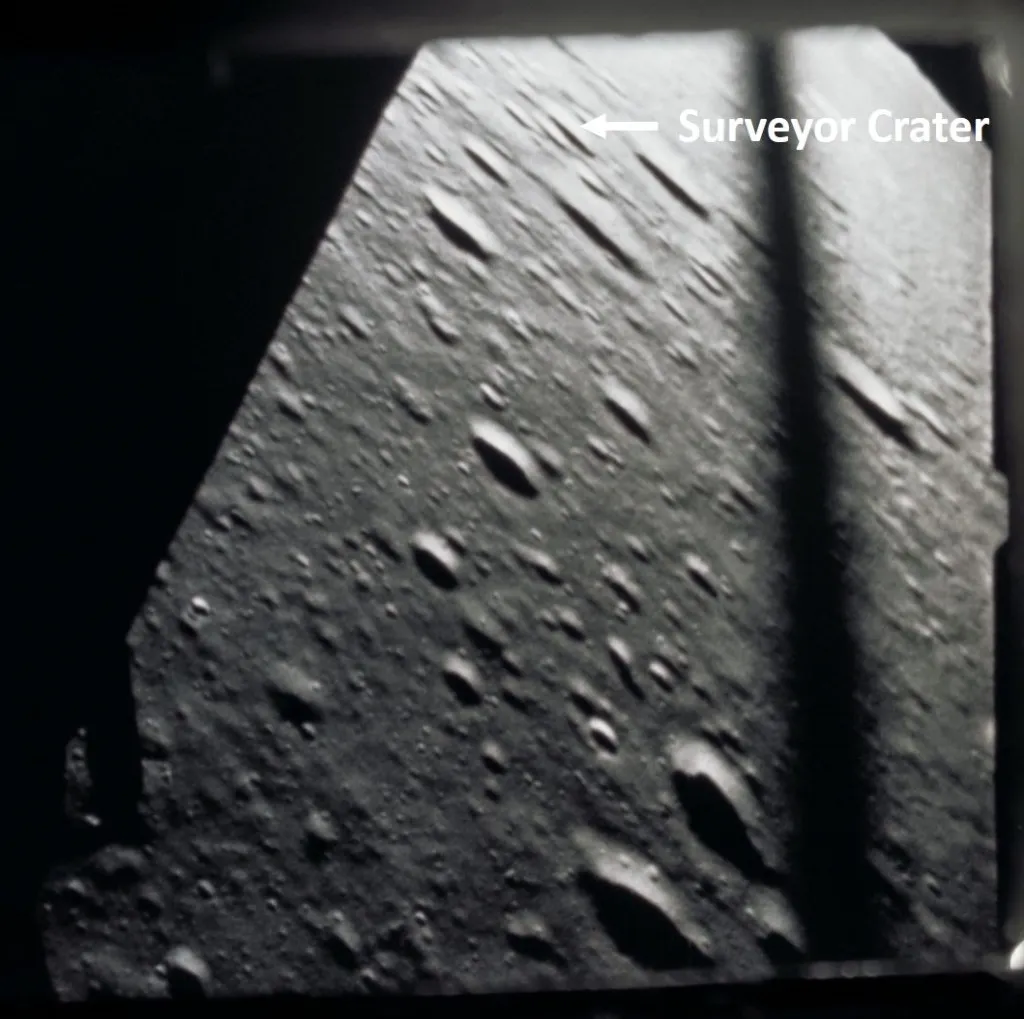
- Still from 16 mm film recorded through Alan L. Bean’s window at an altitude of about 1 070 m (3 500 feet) during Apollo 12’s lunar descent, showing Surveyor Crater and the mission’s landing site. Credit: NASA
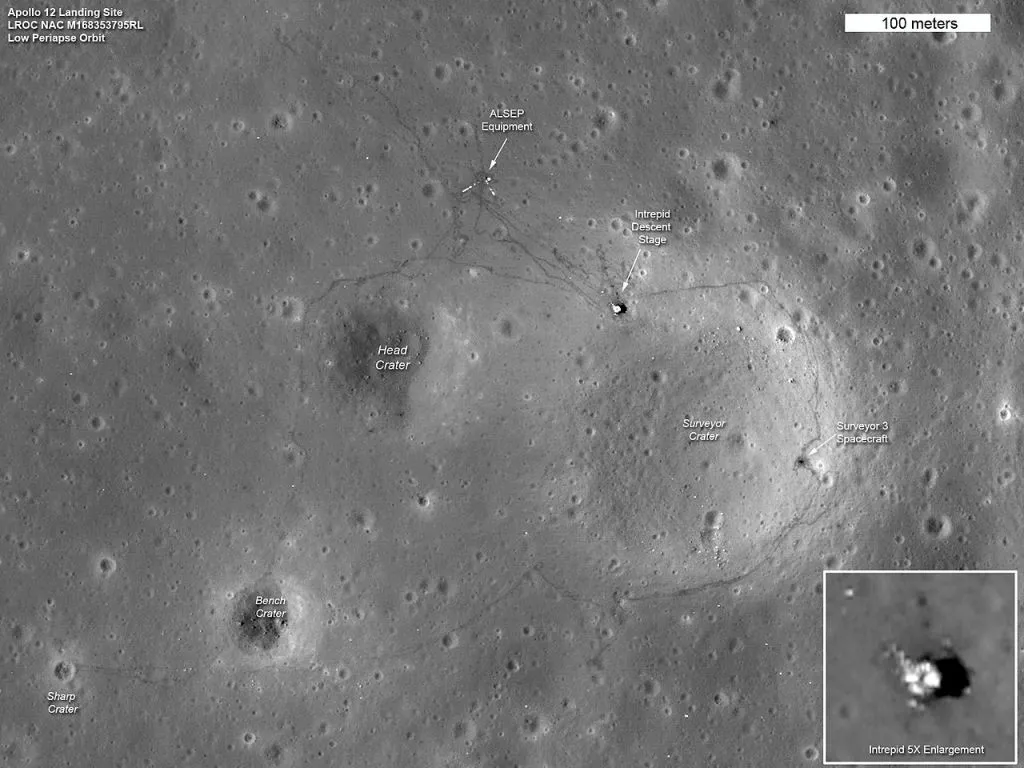
- The Apollo 12 landing site photographed by the Lunar Reconnaissance Orbiter in 2011, the inset showing the Lunar Module Intrepid’s descent stage. Credit: NASA
- The Apollo 12 crew of Charles “Pete” Conrad, center, Richard F. Gordon, and Alan L. Bean, facing them, at the traditional prelaunch breakfast, with their mascot “Irving” behind Conrad.
- The Apollo 12 crew patch. Credit: NASA
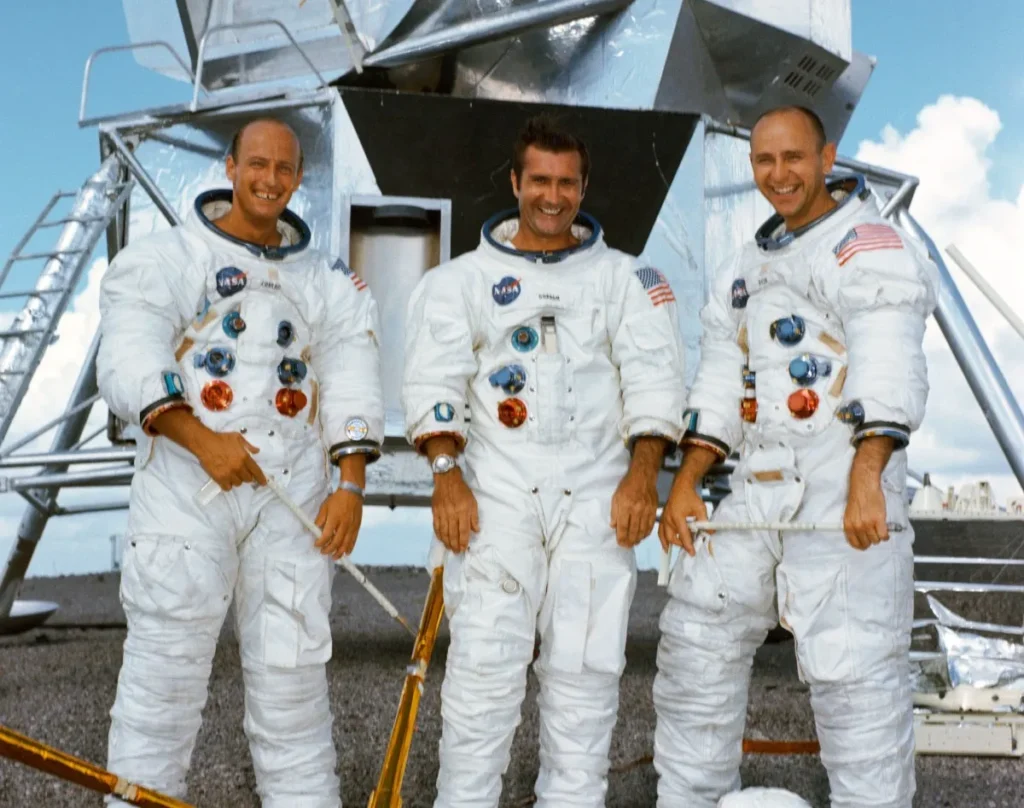
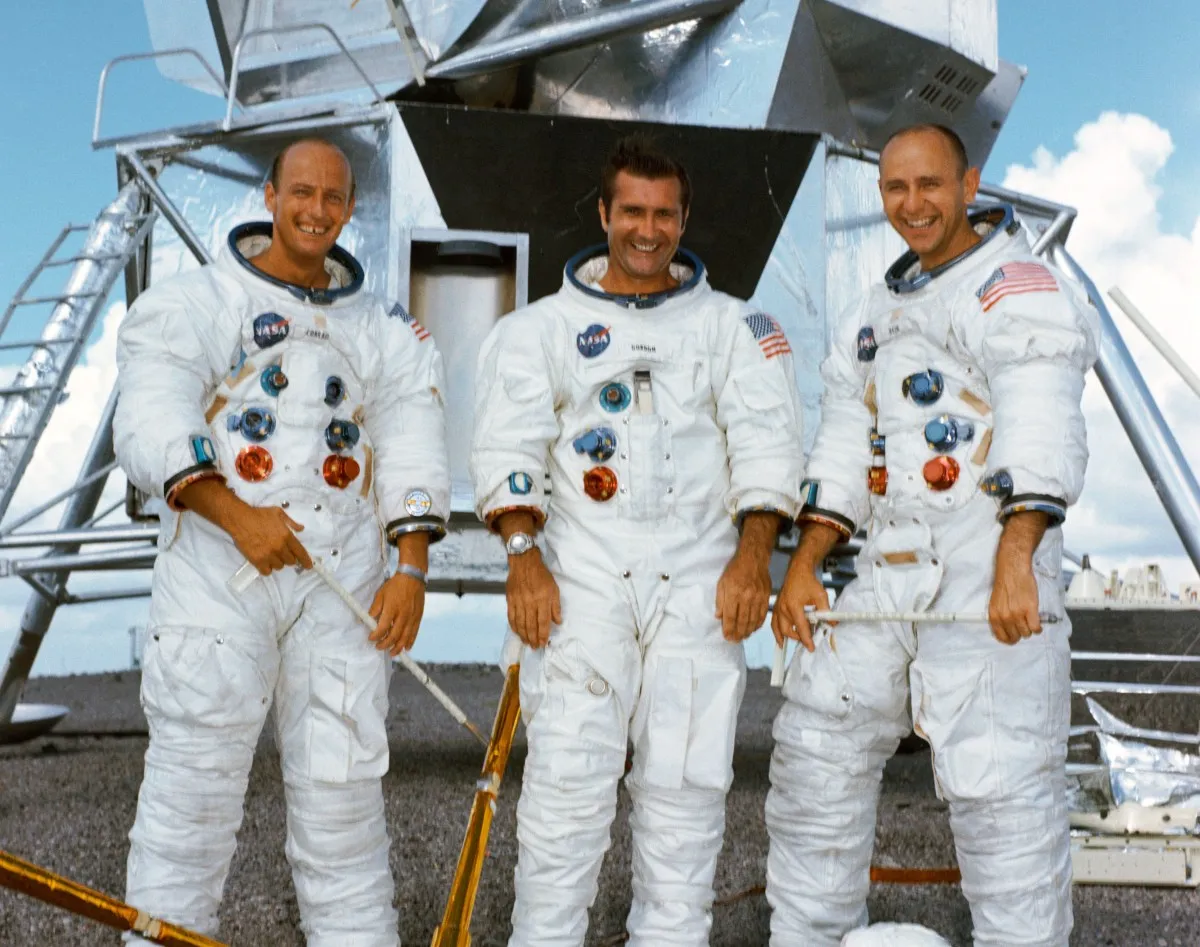
- The crew of Apollo 12 – Charles “Pete” Conrad, left, Richard F. Gordon, and Alan L. Bean. Credit: NASA
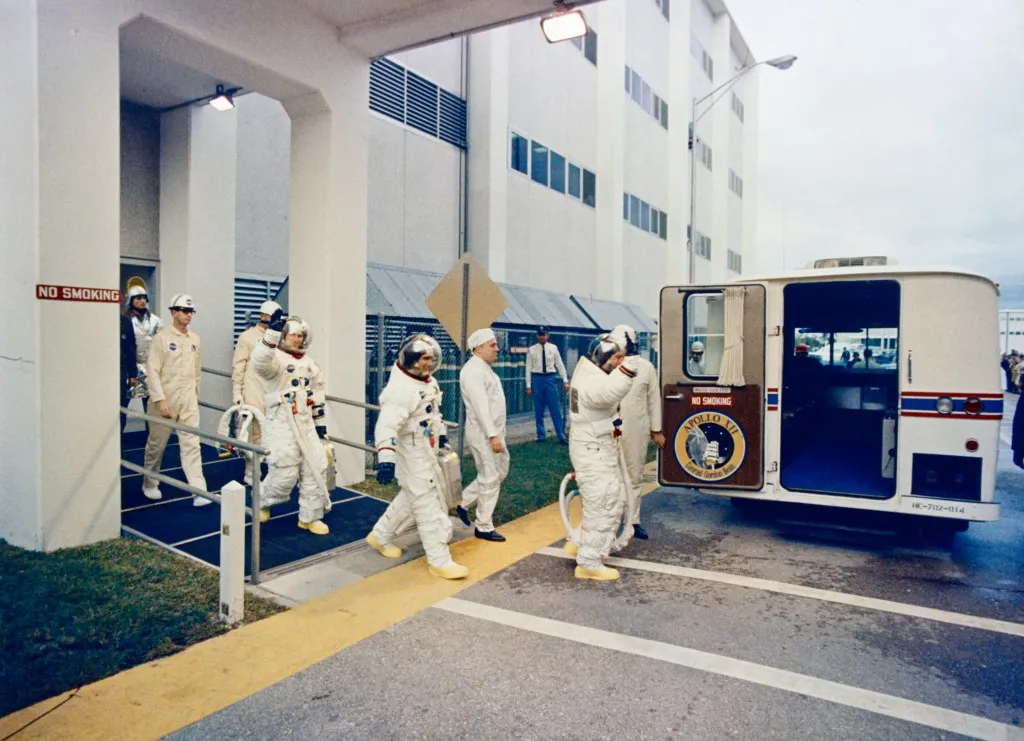
- Conrad leads Gordon and Bean onto the astronaut van for the ride to Launch Pad 39A. Credit: NASA


The familiar description that the Moon “rang like a bell” refers to the prolonged seismic coda. It describes ground motion that continued to arrive at the seismometer long after the initial impact; it does not describe an audible bell-like sound. Modern work also makes the physical explanation more complex than the shorthand that the Moon simply kept vibrating because it is dry. Intrinsic attenuation, strong scattering, near-surface velocity structure and possible focusing all affect the recorded coda.
Apollo 12 also established a controlled-impact technique that NASA used again. NSSDC records later deliberate impacts by Saturn S-IVB stages and by several lunar module ascent stages. As additional passive seismic stations were deployed by Apollo 14, 15 and 16, artificial impacts with constrained source properties could be examined alongside natural moonquakes and meteoroid impacts.
The Apollo passive seismic network continued operating until 1977. Long codas and poorly separated seismic phases complicated conventional analysis, but their rise, decay, frequency dependence and change with source distance carry information about attenuation and heterogeneity in the lunar crust. Researchers can therefore use the same waveform characteristics that puzzled Apollo-era scientists as constraints on modern models of the Moon’s impact-processed near surface.
Important limits remain. The Apollo network occupied a restricted part of the lunar near side, the instruments had limited bandwidth compared with modern seismic systems, and analyses of the existing records still cannot uniquely divide every long coda into contributions from intrinsic attenuation, scattering and focusing. Broader modern lunar seismic coverage would provide a direct test of how much of the Apollo-derived picture is global and how much reflects the particular crustal structure sampled by the original stations.
References:
1 NASA. (1970). Apollo 12 preliminary science report (NASA SP-235). NASA SP-235
2 Blanchette-Guertin, J.-F., Johnson, C. L., & Lawrence, J. F. (2012). Investigation of scattering in lunar seismic coda. Journal of Geophysical Research: Planets, 117(E6), E06003. https://doi.org/10.1029/2011JE004042
3 Onodera, K., Kawamura, T., Tanaka, S., Ishihara, Y., & Maeda, T. (2022). Quantitative evaluation of the lunar seismic scattering and comparison between the Earth, Mars, and the Moon. Journal of Geophysical Research: Planets, 127(12), e2022JE007558. https://doi.org/10.1029/2022JE007558
Featured image: Seismometer record of the Apollo 12 lunar module ascent stage striking the Moon on 20 November 1969. Credit: NASA Johnson Space Center (public domain), via Wikimedia Commons.

I’m a science journalist and researcher at The Watchers, contributing to the Epicenter edition, where I cover peer-reviewed scientific research and emerging discoveries across Earth and space sciences. With a background in astronomy and a passion for environmental science, I’ve worked in shark and coral conservation in Fiji, conducting reef and shark-behavior research, contributing to mangrove restoration, and earning PADI Open Water and Coral Reef Certifications. I bring a blend of scientific rigor and storytelling to illuminate the discoveries shaping our planet and beyond.
