
Inouye Solar Telescope reveals ubiquitous Kelvin–Helmholtz vortices across solar photosphere
The U.S. National Science Foundation’s Daniel K. Inouye Solar Telescope has provided the first experimental confirmation of magnetized Kelvin–Helmholtz instabilities in the solar photosphere, resolving vortex structures at about 19 km (12 miles) in observations near NOAA active region 14060 on April 14, 2025. The Nature study, published August 5, 2026, analyzed 47 vortices with a characteristic wavelength of 65 km (40 miles), sizes of 25–170 km (16–106 miles) and apparent horizontal speeds of 0.67–3.0 km/s (0.42–1.86 miles/s).
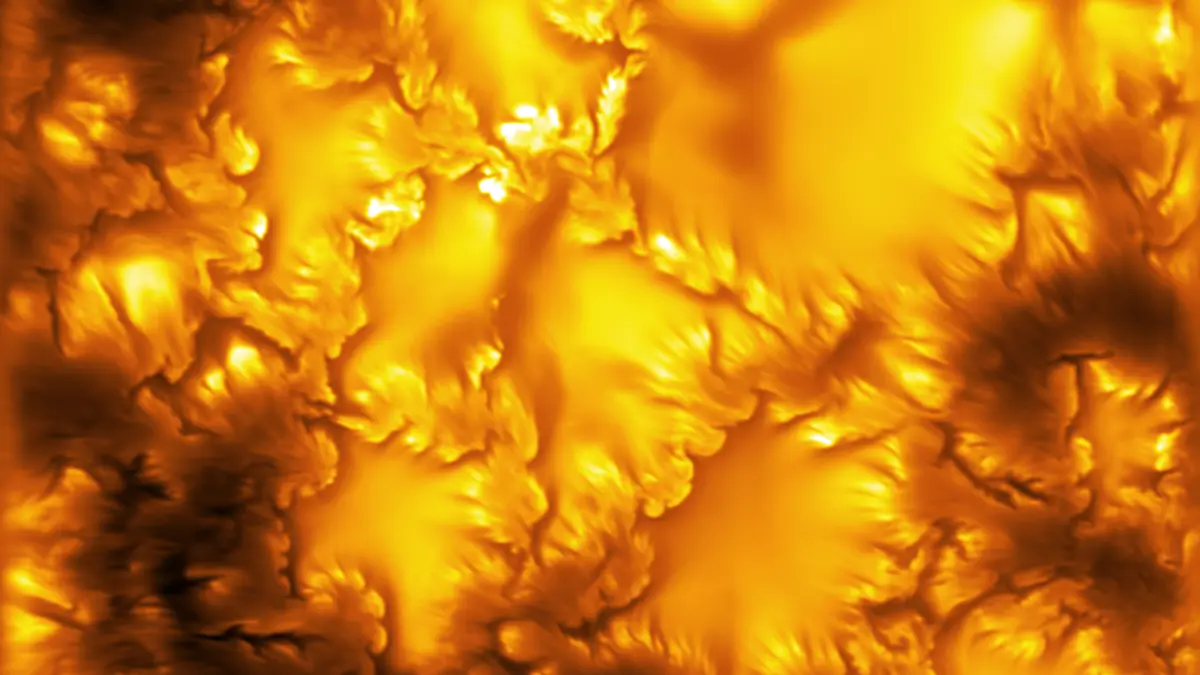
The highest-resolution image of the Sun’s surface (photosphere) ever captured, taken at 416 nm by the Inouye Solar Telescope. It reveals deformed boundaries of magnetic elements and ultra-fine scale stripes, both associated with Kelvin-Helmholtz instability. Credit: NSF/NSO/AURA/MPS
Kuridze et al. (2026) based the analysis on observations acquired between 21:38 and 21:41 UTC on April 14, 2025, using a diagnostic FastCam system on the Daniel K. Inouye Solar Telescope (DKIST). The telescope observed at 416 nm close to disk center in a region containing pores near NOAA active region 14060. At approximately 19 km (12 miles) spatial resolution, boundaries between solar granulation and magnetic-flux concentrations resolved into corrugated interfaces, dark striations and repeated vortex-like structures.
The National Solar Observatory described the 416 nm data as the highest-resolution view of the solar photosphere yet captured. Structures close to the telescope’s diffraction limit became visible around magnetic concentrations where earlier photospheric observations had lacked sufficient spatial resolution.
Researchers identified 47 vortices in the DKIST sequence. Their wavelength distribution was centered at 65 km (40 miles), measured as the spacing between neighboring vortices along an unstable magnetic boundary, while individual structures ranged from 25 to 170 km (16 to 106 miles). Measurements of prominent examples produced growth rates of 0.014–0.054 s⁻¹ and apparent horizontal propagation speeds of 0.67–3.0 km/s (0.42–1.86 miles/s).

The interfaces were identified manually in the observed and synthetic images, with each selected boundary containing at least two Kelvin–Helmholtz-like vortices. Vortex spacing was measured from intensity variations along those interfaces, allowing the observed wavelength distribution to be compared with the simulations and linear instability theory.
Kelvin–Helmholtz instability (KHI) develops when neighboring flows move at different velocities and sufficient velocity shear forms along their interface. In the MURaM simulations used for the study, granular flows converged toward magnetic-flux concentrations and formed strong horizontal velocity gradients around their boundaries. The magnetic field in the simulated plage was predominantly vertical near the photosphere, placing much of the horizontal shear perpendicular to the local field orientation associated with the unstable interfaces.
The FastCam observations recorded intensity structure at very high spatial resolution. Horizontal plasma velocities and the detailed magnetic-field configuration at the unstable boundaries came from MURaM radiation-magnetohydrodynamic simulations, allowing the researchers to test whether the observed morphology followed the dynamics expected from KHI.

The simulations used a plage configuration based on the magnetic structure of the observed region and reached a finest grid spacing of 3.2 km (2.0 miles). Synthetic filtergrams were generated from the calculations and degraded to match the 416 nm DKIST observations and instrumental resolution. Vortices, boundary corrugation and dark striations formed at the same type of magnetic interfaces seen in the telescope data.
Researchers identified 94 instability occurrences in the synthetic dataset. The simulated wavelength distribution peaked at 49 km (30 miles), compared with 65 km (40 miles) in the observations. Synthetic growth rates ranged from 0.027 to 0.059 s⁻¹, overlapping the observed 0.014–0.054 s⁻¹ range, while apparent simulated vortex speeds of 1.6–2.8 km/s (1.0–1.7 miles/s) fell within the observed 0.67–3.0 km/s (0.42–1.86 miles/s) range.
The simulations placed the velocity shear-layer thickness near 12 km (7.5 miles). Linear Kelvin–Helmholtz theory applied to the simulated plasma conditions gave fastest-growing wavelengths of roughly 60–100 km (37–62 miles), encompassing the 65 km (40 miles) characteristic scale measured in the DKIST sequence. Growth rates and phase speeds derived from the observations and simulations were consistent with the linear instability calculations.

Larger vortices merged after the instability entered its nonlinear stage in the simulations, while smaller secondary vortices formed along developed structures. Kelvin–Helmholtz rolls extended through multiple horizontal layers, from roughly 100 km (62 miles) above the mean visible-surface reference level to about 400 km (249 miles) below it. Vortex amplitudes increased with depth as magnetic stabilization weakened and gas pressure became larger relative to magnetic pressure.
The modeled vortices changed the magnetic structures around them. Below the visible surface, KHI fragmented magnetic elements into smaller strands beneath concentrations that appeared more coherent in photospheric intensity images. The simulations support a configuration in which a magnetic feature that appears monolithic at the visible surface connects to several separated magnetic strands at greater depth.
Turbulent transport produced by the unstable boundary layers provides another measure of the process. Using a characteristic Kelvin–Helmholtz wavelength near 65 km (40 miles) and an average shear velocity near 3 km/s (1.9 miles/s), the study estimated turbulent magnetic diffusivity of about 6.5 × 10⁷ m²/s (0.65 × 10¹² cm²/s) in strong-field regions. The simulated vortices mixed magnetized and mostly unmagnetized plasma, allowing low-entropy material from granule edges to enter magnetic structures and alter downflows and convective energy transport beneath the photosphere.

Fine dark striations around photospheric magnetic elements had been recorded in earlier high-resolution observations and associated with spatial and temporal variations in the magnetic field. The physical process producing those variations remained unresolved. The DKIST sequence and synthetic filtergrams associate the changing striation pattern with Kelvin–Helmholtz vortices corrugating magnetic-flux boundaries.
Photospheric magnetic structures anchor magnetic fields that extend into the upper solar atmosphere. Motions at their footpoints supply free magnetic energy to configurations associated with energetic brightenings, flares, jets and coronal mass ejections. The authors describe the newly resolved vortices as a candidate source of small-scale, widespread magnetic-flux braiding, in which photospheric motions interlace magnetic field lines and build free magnetic energy that can later dissipate through current sheets and magnetic reconnection.
The paper places that process within broader work on the magnetic-energy reservoir involved in solar and stellar coronal heating. Resolving a widespread source of small-scale footpoint motion adds an observational constraint to models of how magnetic structure and energy are transported from the photosphere into higher layers of the solar atmosphere.

DKIST recorded the sequence at 416 nm with pixels corresponding to about 6 km (3.7 miles) on the solar surface and an effective spatial resolution near 19 km (12 miles). The 4 m (13 feet) telescope reached scales where the observed and simulated wavelength distributions still change close to the instrumental resolution limit. Smaller characteristic Kelvin–Helmholtz scales therefore remain possible below the structures resolved in the sequence.
The DKIST observations and MURaM data used in the study are openly available. The National Solar Observatory distributes the simulation dataset, while the paper provides access information for the observations, MURaM source code and radiative-transfer tools used to generate the synthetic observables.
References:
1 Kuridze, D., Wöger, F., van Noort, M., Rempel, M., Cameron, R., Rimmele, T., Solanki, S. K., Jaeggli, S. A., Tritschler, A., Uitenbroek, H., Przybylski, D., & Boboltz, D. A. (2026). Ubiquitous Kelvin–Helmholtz instabilities driving plasma mixing on the Sun. Nature, 656, 595–601. https://doi.org/10.1038/s41586-026-10871-3
2 NSF Inouye Solar Telescope enables major discovery of a hidden solar process – NSF National Solar Observatory – August 5, 2026
3 Scientists announce discovery of hidden solar process – NSF National Center for Atmospheric Research – August 11, 2026

I’m a science journalist and researcher at The Watchers, contributing to the Epicenter edition, where I cover peer-reviewed scientific research and emerging discoveries across Earth and space sciences. With a background in astronomy and a passion for environmental science, I’ve worked in shark and coral conservation in Fiji, conducting reef and shark-behavior research, contributing to mangrove restoration, and earning PADI Open Water and Coral Reef Certifications. I bring a blend of scientific rigor and storytelling to illuminate the discoveries shaping our planet and beyond.

Commenting rules and guidelines
We value the thoughts and opinions of our readers and welcome healthy discussions on our website. In order to maintain a respectful and positive community, we ask that all commenters follow these rules.