
Gulf Stream shifted north during abrupt Ice Age cold snap, offering clues to future climate tipping points
During one of the most dramatic climate reversals of the last Ice Age, the Gulf Stream shifted hundreds of kilometers northward, warming waters off Nova Scotia by about 4-5°C (7.2-9°F) and likely disrupting marine ecosystems along eastern Canada, according to a study published in Nature Communications.
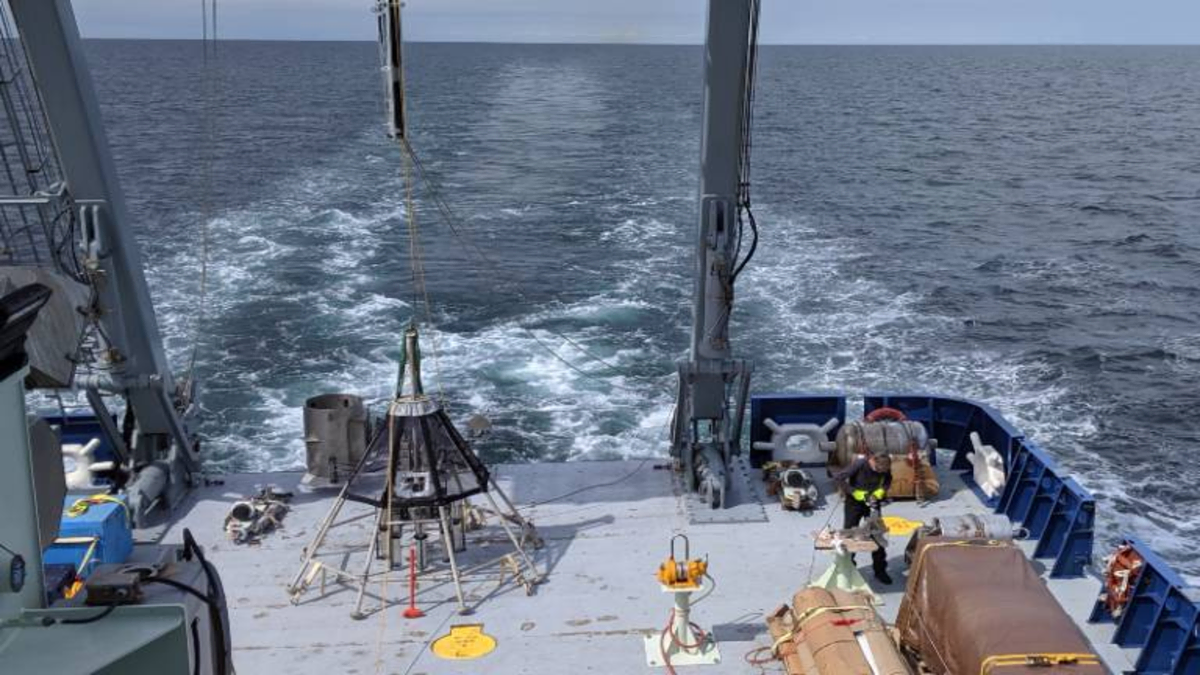
Multi-coring device on the back of the R/V Neil Armstrong, used to collect sediment samples from the ocean floor. Credit: Alice Carter-Champion, UCL
The shift occurred at the onset of the Younger Dryas, an abrupt cold period that began about 12 900 years ago while Earth was emerging from the last Ice Age. Global temperatures fell by about 0.6°C (1.1°F) in less than a century, while parts of the Northern Hemisphere cooled by as much as 10°C (18°F).
That contrast is one of the study’s most striking findings. While much of the North Atlantic region cooled rapidly, waters near Nova Scotia warmed as the Gulf Stream moved closer to the coast.
Climate models have long suggested that a weakening Atlantic circulation could push the Gulf Stream farther north. Sediment records recovered from the seafloor off eastern Canada now show that a similar shift occurred during one of the most abrupt climate events of the last deglaciation, providing the first geological evidence for the process.
“Our research shows how the many different components of the Atlantic circulation system are all interconnected and can be abruptly altered during climate change,” said lead author Fangjingcheng Zhu, who conducted the research at University College London and is now based at the University of Southampton.
“This is the first geological evidence that the Gulf Stream moved northward when the deep currents of the Atlantic weakened and is likely to do so again in the future.”
The Gulf Stream is part of the Atlantic Meridional Overturning Circulation (AMOC), a system of currents that transports heat northward and helps regulate climate across the North Atlantic. Previous modeling studies suggested that weakening deep Atlantic circulation could trigger a chain reaction that shifts the Gulf Stream northward. The new reconstruction suggests that the process unfolded during the Younger Dryas.
Researchers reconstructed ancient ocean conditions using sediment cores containing microscopic fossil shells preserved beneath the Northwest Atlantic seafloor. The chemical composition of the fossils recorded the temperature and salinity of the water in which they lived, allowing the team to build a detailed timeline of ocean changes during the onset of the Younger Dryas.
The reconstruction points to a coordinated reorganization of Atlantic circulation. Deep Atlantic circulation weakened first, followed by a northward shift of the Gulf Stream. Upper Atlantic circulation strengthened about 58 ±38 years later, while broader atmospheric reorganization followed about 84 ±51 years after the onset of the shift.
The findings provide one of the clearest timelines yet of how an abrupt climate tipping point unfolded in the North Atlantic.
“This study improves our understanding of how different parts of the North Atlantic circulation system interact during abrupt climate change,” said senior author Prof. David Thornalley of UCL Geography.
“It’s likely that ocean currents are facing more disruption in the future, and with a more detailed picture of what happened in the past, we can know what kind of changes to expect in the future.”
The northward migration initially brought warmer waters closer to Nova Scotia, raising ocean temperatures by about 4–5°C (7.2–9°F). The researchers say the shift likely disrupted regional marine ecosystems and altered conditions across the Northwest Atlantic shelf region.
As sea ice expanded and increasing amounts of freshwater spread southward from higher latitudes, the warm Gulf Stream waters became trapped beneath a cold, fresh surface layer. Surface conditions cooled again even as warmer water continued flowing below, creating a layered ocean structure that persisted through much of the Younger Dryas.
The study also has implications beyond past climate change. The position of the Gulf Stream influences the distribution of commercially important fish populations in the Northwest Atlantic, and future shifts could reshape marine ecosystems and fisheries throughout the region.
According to co-author Dr. Alice Carter-Champion of Royal Holloway, University of London, combining multiple marine records allowed researchers to reconstruct the timing of circulation changes in unprecedented detail.
“This work shows the value of combining multiple marine records. By reconstructing the timing of ocean circulation changes in such detail, we can begin to better understand the chain of processes that drive abrupt climate change.”
Scientists consider the findings particularly relevant because modern climate models project continued weakening of parts of the Atlantic circulation system as the ocean warms. The geological record suggests that such changes may not occur as isolated events, but as part of a broader sequence of interconnected shifts involving ocean circulation, sea ice, and atmospheric patterns.
For researchers studying future climate tipping points, the Younger Dryas offers a rare natural experiment. The new evidence suggests that a weakening of deep Atlantic circulation can trigger rapid and far-reaching changes across the North Atlantic, including a northward shift of the Gulf Stream and major reorganizations of both the ocean and atmosphere.
References:
1 Co-ordinated shifts in deep-water formation and Gulf Stream migration during abrupt climate changes – Fangjingcheng Zhu et al. – Nature Communications – June 11, 2026 – https://doi.org/10.1038/s41467-026-73832-4 – OPEN ACCESS
2 Gulf Stream shifted north during ancient cold snap – UCL News – June 11, 2026

I’m a science journalist and researcher at The Watchers, contributing to the Epicenter edition, where I cover peer-reviewed scientific research and emerging discoveries across Earth and space sciences. With a background in astronomy and a passion for environmental science, I’ve worked in shark and coral conservation in Fiji, conducting reef and shark-behavior research, contributing to mangrove restoration, and earning PADI Open Water and Coral Reef Certifications. I bring a blend of scientific rigor and storytelling to illuminate the discoveries shaping our planet and beyond.

Commenting rules and guidelines
We value the thoughts and opinions of our readers and welcome healthy discussions on our website. In order to maintain a respectful and positive community, we ask that all commenters follow these rules.