
Astronomers find possible habitable-zone planet around the hottest star yet
Astronomers have found a possible planet in the habitable zone of HD 156295, a hot A-type star about 2 000 K (2 000 °C, 3 600 °F) hotter than the Sun, according to a new study published in The Astrophysical Journal. If confirmed, HD 156295 would become the hottest star known to host a habitable-zone planet.
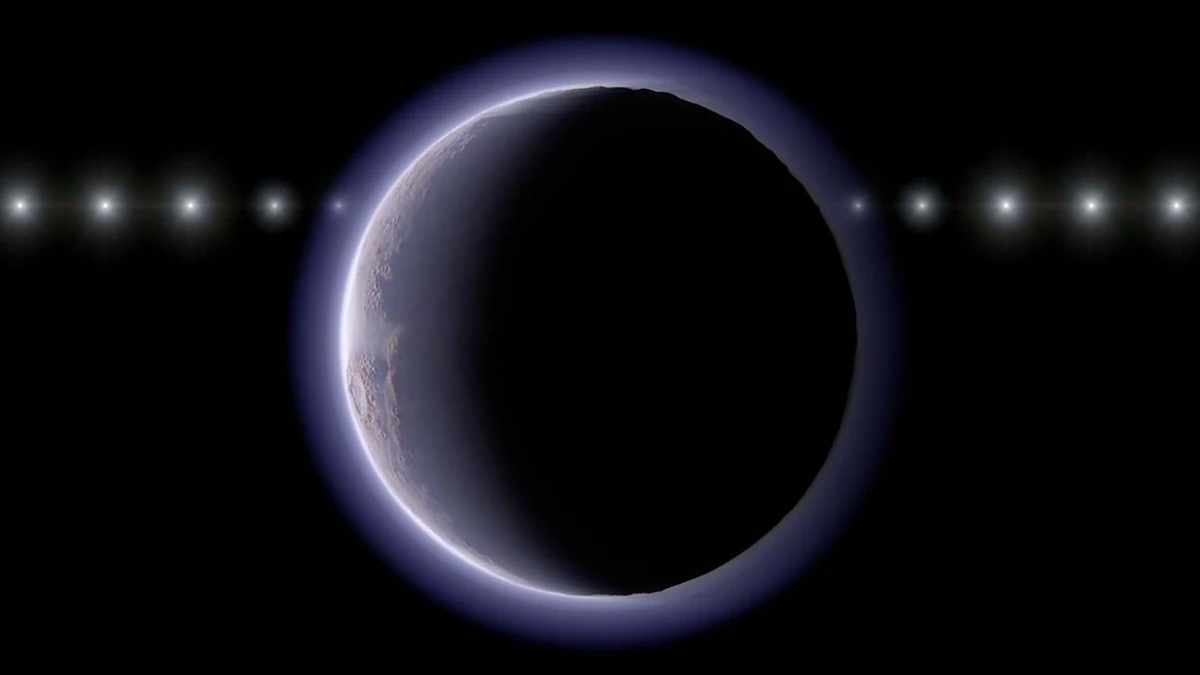
Image credit: NAOJ
The candidate planet, named HD 156295 b, has a minimum mass of about 6.3 Jupiter masses, or roughly 2 000 times the mass of Earth. It orbits its star once every 2 200 days (about 6 years) at a distance of 3.9 au (583 million km, 363 million miles).
At that distance, the planet receives about 60 percent of the starlight Earth receives from the Sun, placing it on the cooler side of the star’s habitable zone, the researchers said. The zone is the range of orbits where liquid water could remain stable on the surface of a rocky world.
The planet itself is a gas giant, so the habitable-zone location does not mean it is habitable. The designation indicates that a rocky moon orbiting the planet could potentially hold liquid water.

HD 156295 is a naked-eye star, visible without binoculars at magnitude 5.5 in the constellation Draco. It lies 43.9 pc (143 light-years) from Earth and has about 1.67 times the mass and 9.16 times the luminosity of the Sun.
The star has an effective temperature of 7 767 ± 300 K, compared with about 5 772 K for the Sun. At an estimated 700 million years old, it is much younger than the 4.6-billion-year-old Sun.
The discovery comes from a survey of 16 440 δ Scuti stars using data from NASA’s Transiting Exoplanet Survey Satellite (TESS), said the team led by Logan G. Wilson of the Harvard-Smithsonian Center for Astrophysics and the University of Hawai’i. δ Scuti stars pulse rhythmically, and the team used those pulses as natural clocks.

A companion’s gravity makes the host star wobble, changing how long its light takes to reach Earth and shifting the timing of its pulses. This technique, called pulsation timing, measured a wobble of about 25 m/s — a signal far too small for standard methods because the star itself spins at about 100 km/s.
The authors caution that the planet is a candidate, not a confirmed discovery. They estimate the signal has just over a 50 percent chance of being real, since intrinsic variations in the star’s pulsations could mimic an orbital companion.

Independent data support the interpretation. A Hipparcos–Gaia astrometric analysis places a 2σ upper limit of 10.5 Jupiter masses on the companion, consistent with the 6.3 Jupiter-mass estimate.
The detection is also the first planet candidate ever found using pulsation timing. A previous pulsation-timing planet, KIC 7917485 b, was later shown by Gaia data to be a star, the team noted.
Based on this candidate, the study estimates that about 10 percent of A-type stars host planets of 5 to 10 Jupiter masses with orbital periods of 1 900 to 2 600 days, with a 68 percent range of 2 to 31 percent. The team also identified eight brown dwarf candidates, objects between planets and stars, with masses of 25 to 59 Jupiter masses.
“While the detection is intriguing, it should be treated as a possible, but unconfirmed, planetary companion,” the authors wrote.
Additional TESS observations scheduled for mid-2027 will extend the monitoring baseline to about 3 000 days, covering roughly one full orbit. Further data from Gaia DR4 and the upcoming PLATO mission could help confirm or refute the candidate.
References:
1 Wilson, L. G., Hey, D., Shappee, B. J., et al. (2026). A Search for Substellar Companions around A-type Stars: Pulsation Timing Detection of Eight Brown Dwarf Candidates and a Possible Habitable-zone Planet. The Astrophysical Journal, 1009, 78. DOI: 10.3847/1538-4357/ae93a0

I am an Assistant Editor and Severe Weather & Science Journalist at The Watchers, specializing in real-time severe weather coverage, geophysical event reporting, and research-driven scientific analysis. You can reach me at rishav(at)watchers(.)news.

Commenting rules and guidelines
We value the thoughts and opinions of our readers and welcome healthy discussions on our website. In order to maintain a respectful and positive community, we ask that all commenters follow these rules.