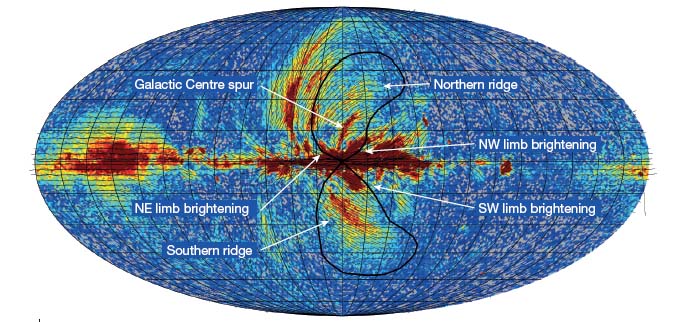
• Giant magnetized outflows from our Galactic Center

    Two years ago, CfA astronomers reported the discovery of giant, twin lobes of gamma-ray emission protruding about 50,000 light-years above and below the plane of our Milky Way galaxy, and centered on the supermassive black hole at our galaxy’s core.The scientists

  • Sizes of planets and stars

    This few animations show the relative sizes of some planets and stars in our known Universe with VY Canis Majoris as the biggest known

  • Earth Gamma-Ray Blasters

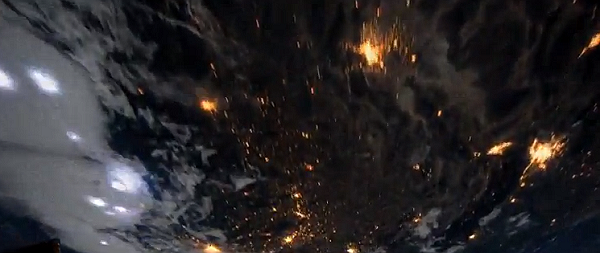
    From NASA Goddard Space Flight Center. NASA’s The Fermi Gamma-ray Space Telescope has been catching brief outbursts of high-energy light that are mysteriously produced above thunderstorms. The outbursts, known as terrestrial gamma-ray flashes (TGFs), last only a few

  • A day in the life of Venus

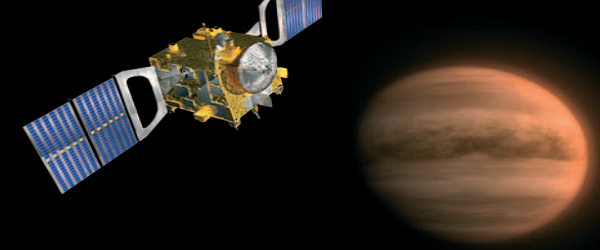
    ESA’s Venus Express spacecraft orbited at 66 000 km above the Venus south pole and captured bright and dark cloud bands wind around the poles of Venus, staring down into the south polar vortex. Venus Express has been orbiting the planet since 2006. It carries seven

  • Meteosat-10 takes over from Meteosat-9

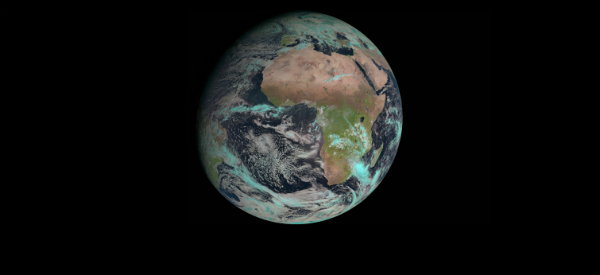
    Launched on 5 July, Meteosat-10 is the latest satellite in the Meteosat Second Generation (MSG) series, which provides operational weather and climate monitoring services over Europe and Africa.In April 2013, Meteosat-9 will take over the Rapid Scanning Service (RSS)

  • The Quantum Guide – Pulsars

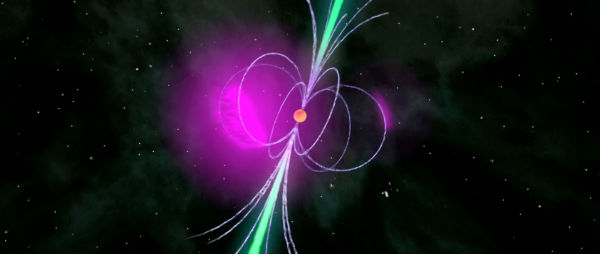
    A pulsar is a neutron star that emits beams of radiation that sweep through Earth’s line of sight. Like a black hole, it is an endpoint to stellar evolution. The “pulses” of high-energy radiation we see from a pulsar are due to a misalignment of the neutron star’s

  • How to get to Mars?

    Spirit, MER-A (Mars Exploration Rover – A), is a robotic rover on Mars, active from 2004 to 2010. It was one of two rovers of NASA’s ongoing Mars Exploration Rover Mission. It landed successfully on Mars at 04:35 Ground UTC on January 4, 2004, three weeks before its

  • Mars in a minute: How do rovers drive on Mars?

    The “keys” to NASA’s Mars rovers are in the capable hands of the official rover drivers. Learn how they operate the vehicles from millions of miles away in this 60-second video from NASA’s Jet Propulsion Laboratory.Source: