I'm a dedicated researcher, journalist, and editor at The Watchers. With over 20 years of experience in the media industry, I specialize in hard science news, focusing on extreme weather, seismic and volcanic activity, space weather, and astronomy, including near-Earth objects and planetary defense strategies. You can reach me at teo /at/ watchers.news.

  • Polar vortex disrupted as major sudden stratospheric warming develops over the Arctic

    Multiple atmospheric diagnostics show that a major sudden stratospheric warming is underway over the Arctic, with strong planetary wave activity, rapid polar warming, and reversal of the stratospheric jet indicating a significant disruption of the polar vortex circulation. This type of stratospheric disruption can influence atmospheric circulation patterns in the coming weeks, sometimes increasing the likelihood of cold air outbreaks across parts of North America, Europe, and Asia.

  • Strong and shallow M6.4 earthquake hits Rat Islands, Aleutian Islands, Alaska

    A strong and shallow earthquake registered by the USGS as M6.4 hit near the Rat Islands, Aleutian Islands, Alaska at 17:54 UTC on March 4, 2026. The agency is reporting a depth of 10 km (6.2 miles). EMSC is reporting the same magnitude and depth. According to the National Tsunami Warning Center (NTWC), there is no tsunami danger from this event.

  • Earthquake swarm near Tonopah, Nevada

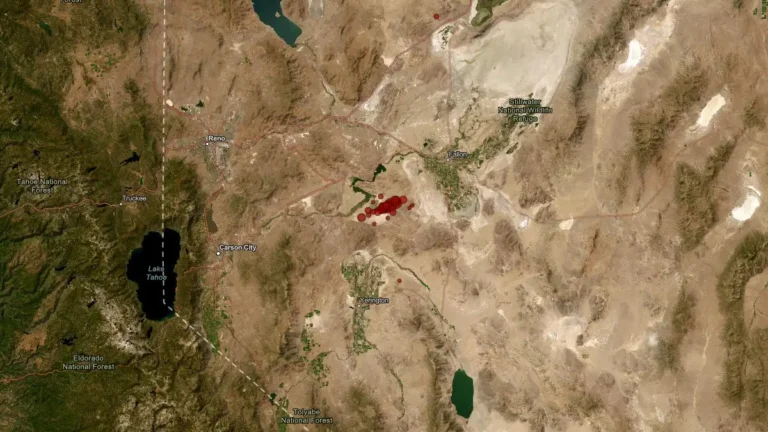
    A swarm of small earthquakes has been shaking the desert northeast of Tonopah, Nevada, since late February 2026, with nearly a hundred shallow events recorded by the U.S. Geological Survey through 17:00 UTC on March 4.

  • How disruption in the Strait of Hormuz threatens fertilizer supply and global food prices

    Shipping through the Strait of Hormuz sharply declined in early March after escalating conflict in the Gulf disrupted commercial navigation through the narrow corridor between Iran and Oman. While the strait is widely known as one of the world’s most important oil routes, it also connects natural gas exports from Gulf producers to global fertilizer production and agricultural supply chains. Disruptions affecting this corridor can therefore propagate beyond energy markets and influence fertilizer availability, agricultural input costs, and ultimately food prices worldwide.

  • Impulsive explosion produces brief ash emission at Mount Etna hours after M4.5 earthquake, Italy

    An impulsive explosion from the Bocca Nuova crater at Mount Etna, Italy, generated a short-lived ash emission at 13:12 LT (12:12 UTC) on March 4, 2026. Surveillance cameras recorded the ash plume dispersing quickly toward the eastern side of the volcano. The eruption followed an earthquake swarm on Mount Etna’s southwestern flank earlier in the day, which included a notable ML4.5 earthquake.

  • Strong M6.1 earthquake hits near Simeulue, Indonesia

    A strong and shallow earthquake registered by the USGS as M6.1 hit near Simeulue, Indonesia, at 04:56 UTC (11:56 local time) on March 3, 2026. The agency is reporting a depth of 26.2 km (16 miles). EMSC is reporting the same magnitude and depth.

  • Deep M6.3 earthquake hits Fiji region

    A deep earthquake registered by the USGS as M6.3 hit the Fiji region at 05:44 UTC on March 1, 2026. The agency is reporting a depth of 596 km (370 miles). EMSC is reporting the same magnitude and depth.

  • Floods in Evros River basin damage over 60 000 ha (150 000 acres) of farmland, threaten 2026 planting season, Greece

    Prolonged rainfall and cross-border inflows have triggered a state of emergency across northeastern Greece, where severe flooding along the Evros River in February 2026 submerged tens of thousands of acres of farmland and destroyed wheat, barley, lentil, and alfalfa crops. No fatalities have been confirmed, but authorities warn of extensive economic losses for the region’s farm sector.