
Hurricane Vance continues strengthening south of Mexico, forecast to reach Category 3
Hurricane Vance continued strengthening far south of Mexico on October 23, 2026, with maximum sustained winds reaching 150 km/h (90 mph) at 09:00 LT (15:00 UTC). The National Hurricane Center (NHC) forecast Vance to briefly reach Category 3 intensity Saturday morning but said the intensity forecast had low confidence because cooler water and increasing wind shear could limit further strengthening.
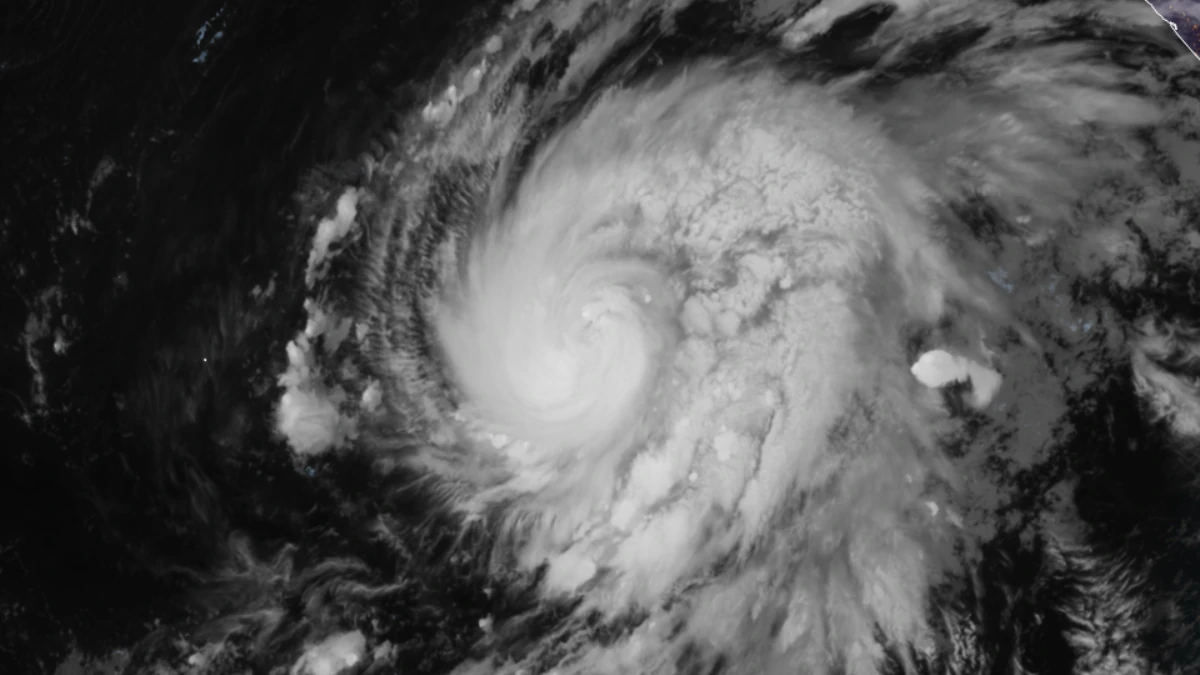
Satellite image of Hurricane Vance at 12:10 UTC on October 23, 2026. Credit: NOAA/GOES-19, RAAMB/CIRA, The Watchers
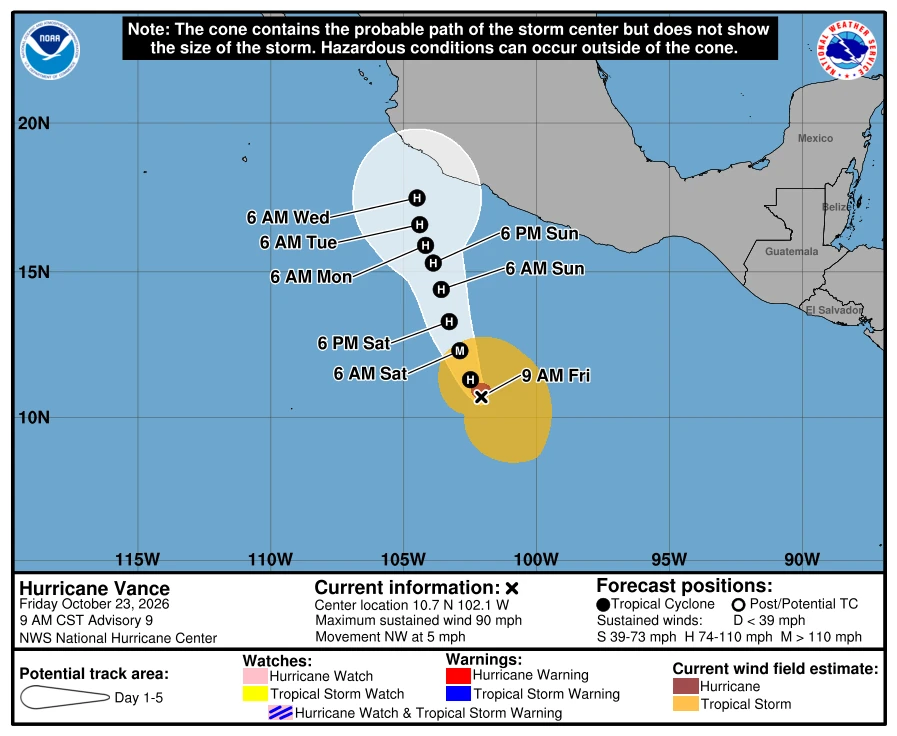
At 15:00 UTC, Vance was centered approximately 730 km (455 miles) south-southwest of Acapulco and 950 km (590 miles) south-southeast of Manzanillo. The hurricane was moving northwest at 7 km/h (5 mph), with an estimated minimum central pressure of 979 hPa.
Hurricane-force winds extended up to 55 km (35 miles) from the center, while tropical-storm-force winds reached outward as far as 335 km (205 miles). No coastal tropical cyclone watches or warnings were in effect.
Vance’s maximum sustained winds increased from 95 km/h (60 mph) at 15:00 UTC on October 22 to 150 km/h (90 mph) 24 hours later. Minimum central pressure fell from 997 to 979 hPa during the same period.
Satellite imagery showed a well-defined central dense overcast, very cold cloud tops around the center and occasional indications of an eye. An extensive band of thunderstorms remained northeast of the hurricane.
NHC forecast Vance to strengthen to approximately 175 km/h (110 mph) by 00:00 UTC on October 24 and briefly reach Category 3 intensity with winds near 185 km/h (115 mph) around 12:00 UTC. Weakening to Category 2 intensity was forecast by early October 25.
The latest intensity forecast carries greater uncertainty than the previous advisory. A NOAA drifting buoy that passed near the center measured a minimum pressure of 988.5 hPa several hours before the advisory, while nearby sea-surface temperatures were below 28°C (82°F).
NHC said Vance was approaching a pool of cooler water, possibly produced by upwelling from recent tropical cyclones. Increasing southwesterly to westerly wind shear is also forecast during the next 24 hours, potentially interrupting the current strengthening cycle.
Some modest re-intensification may occur after Vance moves beyond the cold-water pool, but NHC described confidence in the intensity forecast as low. The hurricane is forecast to move slowly northwest or north-northwest through the weekend, with track uncertainty increasing after approximately two to three days.
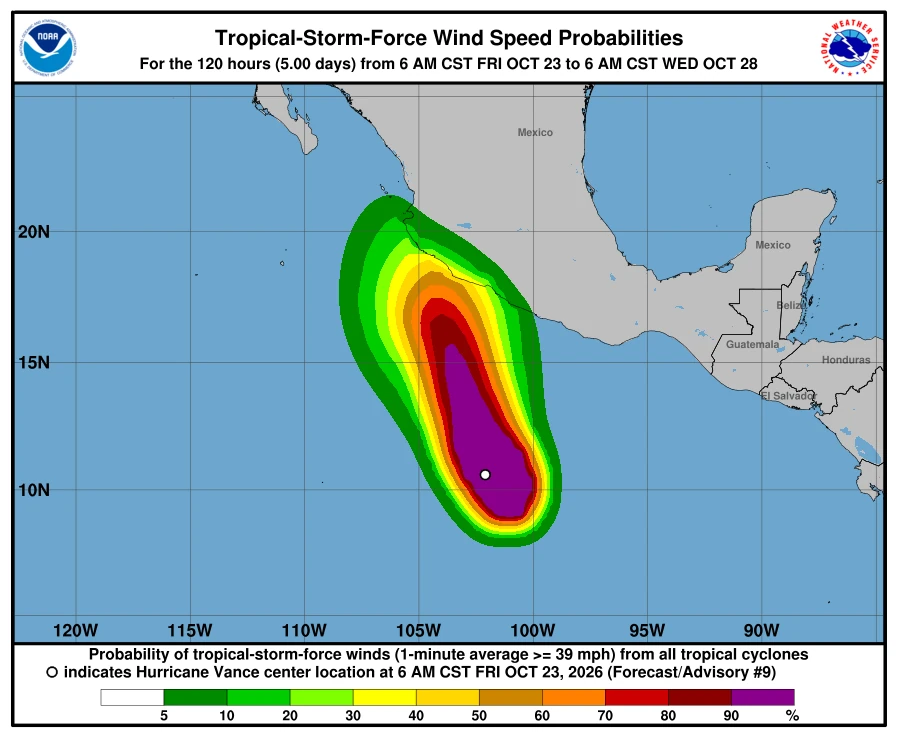
Swells generated by Vance are expected to begin affecting southern and southwestern Mexico during the weekend and continue into the following week. NHC warned that the swells are likely to produce life-threatening surf and rip-current conditions.
Mexico’s Servicio Meteorológico Nacional (SMN) forecast locally heavy rainfall of 25–50 mm (1–2 inches) across central and southwestern Michoacán and coastal Guerrero. Showers producing 5–25 mm (0.2–1 inch) were forecast in Oaxaca.
SMN also forecast waves of 2–3 m (7–10 feet) along the Guerrero coast, with wind gusts of 30–50 km/h (19–31 mph). The agency advised residents and maritime operators to monitor official Civil Protection guidance.
References:
1 Hurricane Vance Public Advisory Number 9 – NOAA/NHC – October 23, 2026
2 Hurricane Vance Forecast Discussion Number 9 – NOAA/NHC – October 23, 2026

Rishav Kothari is Editor-in-Chief of The Watchers, where he runs the newsroom and covers earthquakes, volcanoes, severe weather and space weather.
Published in the last 24 hours
- A 19-year-old Nebraska teacher reportedly tied her pupils together with twine and led them to safety through a blizzard in January 1888 Epicenter
- NASA built the Opportunity rover to last 90 days on Mars, and Martian winds helped keep it alive for nearly 15 years by blowing dust off its solar panels, until a planet-wide dust storm in 2018 blocked sunlight and silenced the rover Epicenter
- In the winter of 1811–12, earthquakes near New Madrid, Missouri, shook so hard that witnesses saw the Mississippi River flow backward, and the shaking left a brand-new lake in Tennessee Epicenter
- On 28 August 1859 a solar storm shocked telegraph operators and threw sparks on other lines, and on 2 September Boston to Portland clerks unhooked their batteries and kept sending for more than two hours on the aurora's current alone. Epicenter
