
1 dead as Hurricane Lowell passes west of Niʻihau, knocks out power to 90% of Kauaʻi, Hawaii
One person died on Oʻahu as Hurricane Lowell passed the Hawaiian Islands late on September 7, 2026 (local time), while the storm’s core passed near Niʻihau with maximum sustained winds of 175 km/h (110 mph). Approximately 90% of Kauaʻi Island Utility Cooperative customers were without power the following morning, while numerous roads and Port Allen Small-Boat Harbor sustained severe damage. Preliminary National Weather Service (NWS) observations included a gust of approximately 150 km/h (92 mph) at Puʻu Lua and a 72-hour rainfall total of 536.2 mm (21.11 inches) at Kilohana.

Damage left behind on North Kihei Road on September 8, 2026 following Hurricane Lowell's close approach to Hawaii. Credit: HIDOT
- Lowell passed just west of Niʻihau late on September 7 (HST) with maximum sustained winds of 175 km/h (110 mph)
- One person died on Oʻahu after a tree fell on a man at Sherwood Beach in Waimānalo, Governor Josh Green confirmed
- Approximately 90% of Kauaʻi utility customers lost power as downed trees, poles, and electrical lines caused widespread grid damage
- Roads, harbors and schools sustained significant disruption, including destroyed piers and sunken vessels at Port Allen Small-Boat Harbor
- Kauaʻi recorded gusts near 150 km/h (92 mph) and 536.2 mm (21.11 inches) of rain at Kilohana before Lowell weakened to a tropical storm
At 23:00 HST on Monday, September 7 (09:00 UTC on Tuesday, September 8), the National Hurricane Center (NHC) placed Lowell’s center approximately 145 km (90 miles) west of Līhuʻe. Maximum sustained winds were 175 km/h (110 mph), minimum central pressure was 963 hPa, and the hurricane was moving north-northeast at 30 km/h (18 mph).
Lowell’s core was passing near Niʻihau at the time. Barking Sands and Līhuʻe Airport had already recorded hurricane-force gusts.
The Hawaiʻi Joint Information Center reported widespread damage to Kauaʻi’s electrical system, including downed trees, utility poles and power lines. Approximately 90% of Kauaʻi Island Utility Cooperative customers were without power early Tuesday morning.

Governor Josh Green said a man died at Sherwood Beach in Waimānalo, Oʻahu, after a large tree trunk fell on his tent on September 7. Police responded at approximately 20:35 HST and classified the incident as an unattended death.
“That individual was a homeless individual living in a tent, and a tree fell on him,” Governor Green said. “We’re doing what we can to recover, but this was a very serious storm.”
Preliminary National Weather Service (NWS) observations show that the strongest gust reached approximately 150 km/h (92 mph) at Puʻu Lua at 23:35 HST on Monday. Nāwiliwili recorded 140 km/h (87 mph), while Waimea measured approximately 135 km/h (85 mph); Barking Sands and Līhuʻe Airport each recorded approximately 135 km/h (84 mph).

During the 72 hours ending at 13:00 HST on Tuesday, NWS recorded 536.2 mm (21.11 inches) at Kilohana, 473.2 mm (18.63 inches) at Mount Waiʻaleʻale and 449.6 mm (17.70 inches) at Mohihi Crossing. Hanalei received 260.1 mm (10.24 inches).
The Hawaiʻi Department of Transportation reported widespread travel disruption from storm damage, debris, and utility failures. Route 50 was closed between Kala Road and Akialoa Road, while utility poles affected sections of Routes 50 and 56.
Route 560 was closed near Hanalei by downed utility poles, trees, and elevated stream levels, and at Waikoko Point by a landslide. Fallen trees or utility lines also affected Routes 550, 570 and 580, while many traffic signals across Kauaʻi were not operating.
The Hawaiʻi Department of Land and Natural Resources reported severe damage at Port Allen Small-Boat Harbor, including destroyed piers, several sunken vessels and damage to the access roadway. Several roofs were damaged at Nāwiliwili Small-Boat Harbor, which remained without electricity, while Waimea State Recreational Pier sustained significant damage.
Port Allen and Nāwiliwili were closed to commercial traffic under U.S. Coast Guard Heavy Weather Port Condition Zulu on Tuesday. A later Hawaiʻi Department of Transportation operational update listed Port Allen as remaining under Condition Zulu and said Nāwiliwili had reopened before 17:00 HST on Tuesday (03:00 UTC on Wednesday).
Līhuʻe Airport reopened at 11:15 HST (21:15 UTC) on Tuesday. The airport sustained no significant damage, although operations could remain limited because of staffing.
Public schools on Kauaʻi and Niʻihau High & Elementary School were to remain closed to students through Friday, while facilities were assessed and power was restored. Kauaʻi Community College and state and county offices were also to remain closed through the end of the week.
Preliminary damage was reported at Kauaʻi High School and Kekaha Elementary School. Kanuikapono Public Charter School reported severe damage to its main utility pole and damage to several roofs.
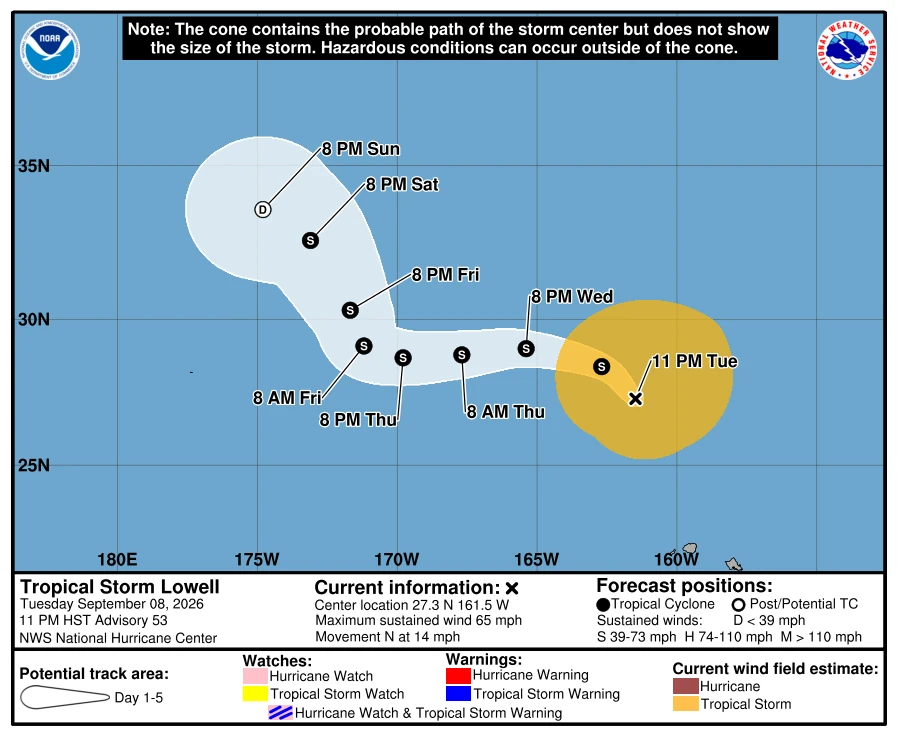
By 23:00 HST on Tuesday (09:00 UTC on Wednesday), Lowell was a tropical storm centered approximately 625 km (390 miles) north-northwest of Līhuʻe. Maximum sustained winds had decreased to 100 km/h (65 mph), with a minimum central pressure of 981 hPa. Lowell was moving north at 22 km/h (14 mph).
Tropical-storm-force winds extended outward up to 405 km (255 miles) from the center. No coastal watches or warnings were in effect.
NHC forecast Lowell to turn slowly toward the northwest and then west from Wednesday into Thursday, followed by a reduction in forward speed later Thursday and Friday. Gradual weakening was forecast during the following several days.
Swells generated by Lowell were expected to continue producing life-threatening surf and rip-current conditions along exposed Hawaiian coasts during the following day or so.
References:
1 State of Hawaiʻi on Hurricane Lowell State Departments Continue to Support Residents – Hawaiʻi Emergency Management Agency – September 8, 2026
2 Kauaʻi County public schools to remain closed to students through Friday following Hurricane Lowell – Hawaiʻi State Department of Education – September 8, 2026
3 Tropical Storm Lowell Advisory Number 53 – NOAA/NHC — September 9, 2026

Rishav Kothari is Editor-in-Chief of The Watchers, where he runs the newsroom and covers earthquakes, volcanoes, severe weather and space weather.
Published in the last 24 hours
- A 19-year-old Nebraska teacher reportedly tied her pupils together with twine and led them to safety through a blizzard in January 1888 Epicenter
- NASA built the Opportunity rover to last 90 days on Mars, and Martian winds helped keep it alive for nearly 15 years by blowing dust off its solar panels, until a planet-wide dust storm in 2018 blocked sunlight and silenced the rover Epicenter
- In the winter of 1811–12, earthquakes near New Madrid, Missouri, shook so hard that witnesses saw the Mississippi River flow backward, and the shaking left a brand-new lake in Tennessee Epicenter
- On 28 August 1859 a solar storm shocked telegraph operators and threw sparks on other lines, and on 2 September Boston to Portland clerks unhooked their batteries and kept sending for more than two hours on the aurora's current alone. Epicenter
