
Strong M9.4 solar flare erupts from Region 3889, CME produced
A strong solar flare measuring M9.4 erupted from Active Region 3889 at 12:06 UTC on November 10, 2024. The event started at 11:51 and ended at 12:14 UTC.

M9.4 solar flare on November 10, 2024. Credit: NASA SDO/AIA 304, Helioviewer, The Watchers
This event was associated with a Type II Radio Emission with an estimated velocity of 928 km/h, suggesting a coronal mass ejection (CME) was produced.
Additionally, a 10cm Radio Burst (tenflare) lasting 2 minutes and with a peak flux of 400 sfu was associated with the flare event.
A 10cm radio burst indicates that the electromagnetic burst associated with a solar flare at the 10cm wavelength was double or greater than the initial 10cm radio background. This can be indicative of significant radio noise in association with a solar flare. This noise is generally short-lived but can cause interference for sensitive receivers including radar, GPS, and satellite communications.
Radio frequencies were forecast to be most degraded over the South Atlantic Ocean and Africa at the time of the flare.
Coronagraph imagery was not available at the time of press. However, a CME was produced and there is a possibility at least part of it is Earth-directed.
Region 3889 has a ‘beta-gamma-delta’ magnetic configuration and is capable of producing more strong to major eruptions on the Sun. The chances for Earth-directed CMEs will rise as the region rotates toward to center of the solar disk in the days ahead.
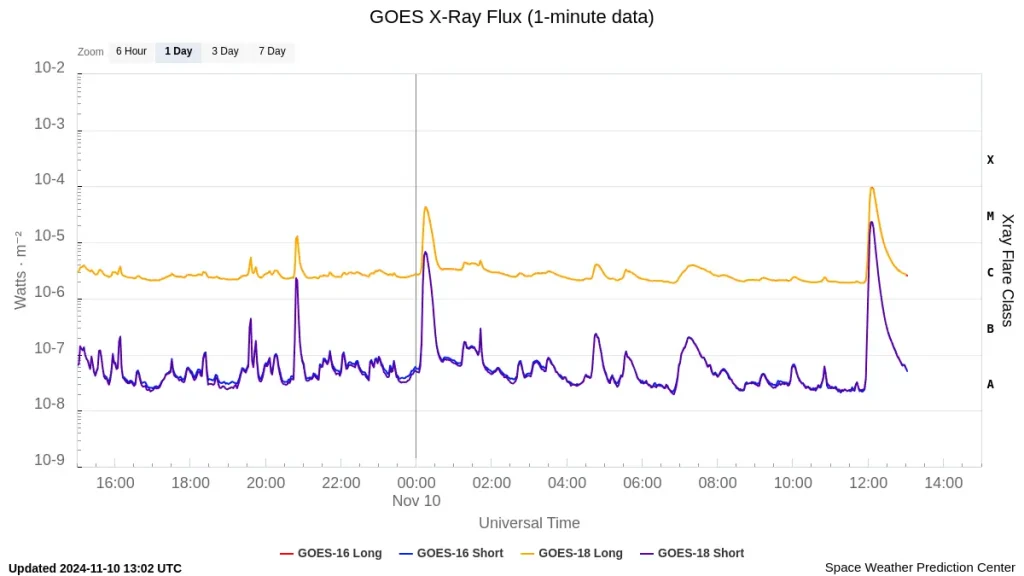


Today’s M9.4 flare follows a long-duration M4.2 flare at 00:15 UTC with no Earth-directed CME.
The solar wind environment remains enhanced. Total field strength ranged from 4 – 13 nT in 24 hours to 12:30 UTC today and the Bz reached as far south as -11 nT. Solar wind speeds averaged around 400 km/s throughout the period.
Enhanced solar wind conditions are expected to prevail through November 12 due to coronal hole high speed stream (CH HSS) influences.
The geomagnetic field reached G1 – Minor storm levels following a prolonged period of southward Bz. Active levels are expected on November 10 and 11, followed by quiet to unsettled levels on November 12, due to CH HSS influences.
References:
1 Forecast Discussion – SWPC – Issued at 12:30 UTC on November 10, 2024

I'm a dedicated researcher, journalist, and editor at The Watchers. With over 20 years of experience in the media industry, I specialize in hard science news, focusing on extreme weather, seismic and volcanic activity, space weather, and astronomy, including near-Earth objects and planetary defense strategies. You can reach me at teo /at/ watchers.news.

Commenting rules and guidelines
We value the thoughts and opinions of our readers and welcome healthy discussions on our website. In order to maintain a respectful and positive community, we ask that all commenters follow these rules.