
Strong explosion at Popocatepetl volcano, Mexico

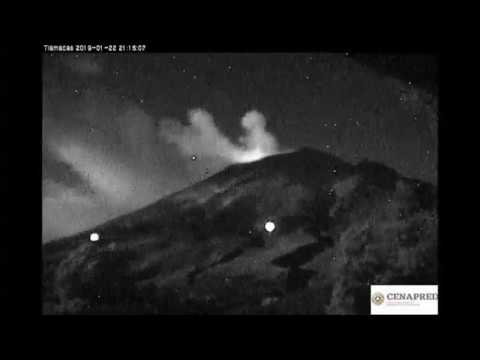
Featured image: Popocatepetl eruption at 03:06 UTC, January 23, 2019. Credit: CENAPRED/WebCamsDeMexico
A strong explosion took place at Mexico's Popocatepetl volcano at 03:06 UTC on January 23, 2019 (21:06 CST, January 22).
The eruption threw incandescent fragments to a distance of 2 km (1.2 miles) over the slopes of the volcano. Ash was dispersed in a northeasterly direction, suggesting ashfall in the localities of that sector, CENAPRED said.
At 03:30 UTC, the volcanic cloud was reaching a height of near 7.6 km (25 000 feet) above sea level, the Washington VAAC reported 04:08 UTC. Ash is expected to dissipate over the next 12 hours.
Secuencia de la fuerte explosión del #Popocatépetl.
En las comunidades cercanas fue escuchada la explosión y también se reportó retumbos (ventanas y puertas vibrando) hasta Puebla.Semáforo de alerta continúa en amarillo fase 2. pic.twitter.com/Y1EmV8drCY
— SkyAlert (@SkyAlertMx) January 23, 2019
Video de la fuerte explosión del #Popocatépetl a las 21:06 h desde la @webcamsdemexico del lado de Puebla.
Sigue la actividad del volcán en vivo desde tu #SkyAlertApp. pic.twitter.com/etKPRaOOl8
— SkyAlert (@SkyAlertMx) January 23, 2019
In the last 24 hours, Popocatepetl volcano monitoring system registered 94 exhalations. Additionally, 68 minutes of low amplitude harmonic tremor were observed and two volcano-tectonic earthquakes – M2.3 and M1.9.
Geological summary
Volcán Popocatépetl, whose name is the Aztec word for smoking mountain, towers to 5 426 m (17 801 feet) 70 km (43.5 miles) SE of Mexico City to form North America's 2nd-highest volcano.
The glacier-clad stratovolcano contains a steep-walled, 400 x 600 m (1 312 x 1 968 feet) wide crater. The generally symmetrical volcano is modified by the sharp-peaked Ventorrillo on the NW, a remnant of an earlier volcano. At least three previous major cones were destroyed by gravitational failure during the Pleistocene, producing massive debris-avalanche deposits covering broad areas to the south.
The modern volcano was constructed south of the late-Pleistocene to Holocene El Fraile cone.
Three major plinian eruptions, the most recent of which took place about 800 CE, have occurred from Popocatépetl since the mid-Holocene, accompanied by pyroclastic flows and voluminous lahars that swept basins below the volcano.
Frequent historical eruptions, first recorded in Aztec codices, have occurred since precolumbian time. (GVP)

Teo Blašković founded The Watchers in 2011 and edited it until 2026, covering seismic and volcanic activity, extreme weather, space weather and near-Earth objects. Articles on this page are his archive.
Published in the last 24 hours
- High Risk of excessive rainfall covers Florida’s Space Coast as St. Johns River near Cocoa reaches 5.67 m
- Four small asteroids will pass close to Earth from November 21 to 23
- Cyclone Akvan weakens after landfall near Gopalpur; more than 300 000 evacuated in Odisha, India
- A broad low over southeastern Florida and the northwestern Bahamas has a 30 percent chance of subtropical or tropical development within 48 hours and a 50 percent chance within 7 days, the National Hurricane Center says
