
Queensland hit by very rare M5.1 earthquake, Australia
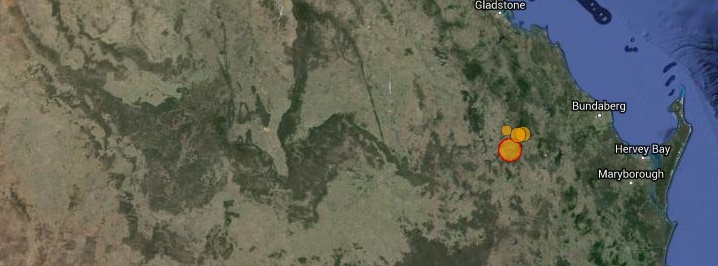
Image credit: Geoscience Australia (Imagery ©Google 2015)
A shallow M5.1 earthquake was registered 25 kilometers (15.5 miles) from the city of Eidsvold, Queensland, Australia at 02:57 AEDT on February 16, 2015 (15:57 UTC on February 15). Geoscience Australia (GA) is reporting depth of 15 km (9.32 miles).
Numerous aftershock were recorded in the region shortly after. The most noticeable were M3.2 which struck at 16:40 UTC at a depth of 1 km, M3.4 registered at 17:37 UTC at a depth of 5 km and M2.5 at a depth of 0 km registered at 18:06 UTC.
According to "I felt it" reports the quake lasted about 10 seconds and was felt as far away as Brisbane in the south, Rockhampton in the north and Toowoomba in the south west (up to 220 km). No significant damage had been recorded due to the remoteness of the epicenter.
Protection equipment at four power substations activated during the quake to cut supply as a safety precaution. About 6 000 people were affected by the power outages.
GA seismologist Andrea Thom said for the Brisbane Times this was the third earthquake stronger than magnitude 5 recorded in Queensland since records began.
The last was in 1935, about 45 kilometers south of the epicenter of Monday morning's quake, with a magnitude of 5.5.
Prior to that, the most recent earthquake stronger than magnitude 5 was in 1883.
GA seismologist Hugh Glanville said the quake could have been devastating had it hit a more populated area. "It was lucky the Eidsvold earthquake occurred in a more remote part of Queensland," he said, adding that the area was riddled with fault lines.
"Australia is on one tectonic plate; that extends from New Zealand to Fiji, across to Vanuatu and the Solomon Islands and up to Papua New Guinea and Indonesia. As it collides with the plate near Sumatra, stress builds up on our continent and that has left the Eidsvold region vulnerable to earthquakes, because there are fault lines everywhere."

Teo Blašković founded The Watchers in 2011 and edited it until 2026, covering seismic and volcanic activity, extreme weather, space weather and near-Earth objects. Articles on this page are his archive.
Published in the last 24 hours
- High Risk of excessive rainfall covers Florida’s Space Coast as St. Johns River near Cocoa reaches 5.67 m
- Four small asteroids will pass close to Earth from November 21 to 23
- Cyclone Akvan weakens after landfall near Gopalpur; more than 300 000 evacuated in Odisha, India
- A broad low over southeastern Florida and the northwestern Bahamas has a 30 percent chance of subtropical or tropical development within 48 hours and a 50 percent chance within 7 days, the National Hurricane Center says
