
Sudden, powerful explosion at Ubinas volcano, Peru

Featured image: Ubinas volcano eruption on August 21, 2014. Credit: INGEMMET
A powerful and sudden explosion occurred at Ubinas volcano, Peru, on August 21, 2014. This latest strong eruption started at 20:36 UTC (15:36 local time). The explosion ejected blocks up to 2 km away from the volcano.
The eruption was likely a vulcanian-type event, i.e. caused by the sudden release of pressure as viscous (sticky) and gas-rich magma had accumulated beneath a solid plug in the vent. It shows that the eruptive phase at the volcano continues and is capable of producing extremely dangerous explosions, VolcanoDiscovery reported.
(3) En este enlace podrán ver el video de la explosión registrada en el volcán #Ubinas. https://t.co/mlrDINbcjk pic.twitter.com/iRVW3oyLmO
— IGP (@igp_peru) August 21, 2014
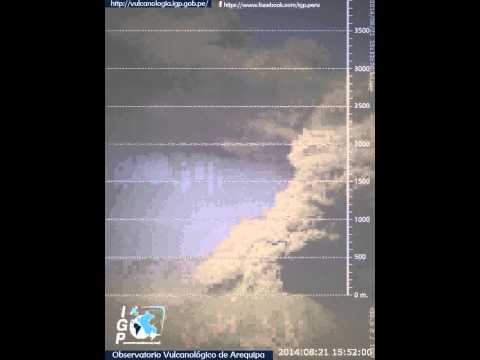
Video courtesy IGP
INGEMMET reported that during August 13 – 17 seismicity at the volcano decreased but the low level eruptions continued. Mild steam-and-gas emissions rose 200-400 m above the summit and drifted SE and NE.
Below is the latest image of Ubinas volcano captured by OVI – INGEMMET camera located some 25 km NE from the volcano.

Current webcam image of Ubinas volcano. Credit INGEMMET – IGP
Geologic summary
A small, 1.4-km-wide caldera cuts the top of Ubinas, Peru's most active volcano, giving it a truncated appearance. Ubinas is the northernmost of three young volcanoes located along a regional structural lineament about 50 km behind the main volcanic front of Perú. The growth and destruction of Ubinas I volcano was followed by construction of Ubinas II volcano beginning in the mid-Pleistocene. The upper slopes of the andesitic-to-rhyolitic Ubinas II stratovolcano are composed primarily of andesitic and trachyandesitic lava flows and steepen to nearly 45 degrees.
The steep-walled, 150-m-deep summit caldera contains an ash cone with a 500-m-wide funnel-shaped vent that is 200 m deep. Debris-avalanche deposits from the collapse of the SE flank of Ubinas about 3700 years ago extend 10 km from the volcano. Widespread plinian pumice-fall deposits from Ubinas include one of Holocene age about 1000 years ago. Holocene lava flows are visible on the volcano's flanks, but historical activity, documented since the 16th century, has consisted of intermittent minor-to-moderate explosive eruptions. (GVP)

Teo Blašković founded The Watchers in 2011 and edited it until 2026, covering seismic and volcanic activity, extreme weather, space weather and near-Earth objects. Articles on this page are his archive.
Published in the last 24 hours
- High Risk of excessive rainfall covers Florida’s Space Coast as St. Johns River near Cocoa reaches 5.67 m
- Asteroid 2026 WJ to pass Earth at 1.7 lunar distances at 04:20 UTC on November 22, with 2026 WD following at 4.4 lunar distances on November 23
- Cyclone Akvan crossed the north Andhra Pradesh and south Odisha coasts close to Gopalpur on November 20 with 70-80 km/h winds gusting to 90, and has weakened into a deep depression
- A broad low over southeastern Florida and the northwestern Bahamas has a 30 percent chance of subtropical or tropical development within 48 hours and a 50 percent chance within 7 days, the National Hurricane Center says
