
Mount St. Helens still active, no signs of impending eruption
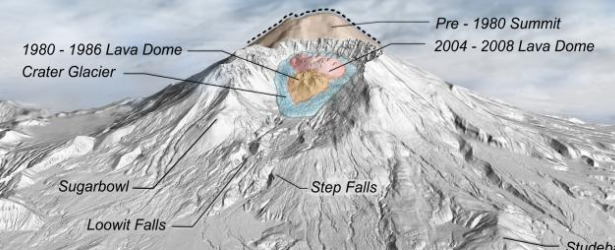
Image credit: USGS
In latest information statement from Cascades Volcano Observatory, issued 16:05 UTC today, they report that the analysis of current behavior at Mount St. Helens indicates that the volcano remains active and is showing signs of long-term uplift and earthquake activity, but there are no signs of impending eruption.
"Since the end of the 2004-2008 dome-building eruption at Mount St. Helens, scientists at the USGS Cascades Volcano Observatory (CVO) and the Pacific Northwest Seismic Network (PNSN) have been monitoring subtle inflation of the ground surface and minor earthquake activity reminiscent of that seen in the years following the 1980-1986 eruptions.
Careful analysis of these two lines of evidence now gives us confidence to say that the magma reservoir beneath Mount St. Helens has been slowly re-pressurizing since 2008. It is likely that re-pressurization is caused by arrival of a small amount of additional magma 4-8 km (2.5-5 miles) beneath the surface. This is to be expected while Mount St. Helens is in an active period, as it has been since 1980, and it does not indicate that the volcano is likely to erupt anytime soon. Re-pressurization of a volcano’s magma reservoir is commonly observed at other volcanoes that have erupted recently, and it can continue for many years without an eruption.
USGS and PNSN are continuing to monitor ground deformation and seismicity at Mount St. Helens. In an effort to learn more about activity beneath the volcano, they will conduct two additional types of measurements this summer. Surveys will measure the types and amounts of volcanic gases being released, and the strength of the gravity field at the volcano. Both types of measurements are sensitive to changes in the amount or depth of subsurface magma.

Digital elevation map of Mount St. Helens with annotation of pre-1980 topografy and deposits from 1980 – 2008. Image credit: USGS
The information collected at Mount St. Helens continues to help scientists interpret behaviors at other volcanoes and to improve eruption forecasting capabilities. Additional research results will be posted in USGS Updates, Information Statements, and on the USGS-CVO website.
In a previously planned but related development, an experiment called “Imaging Magma Under St. Helens” (iMUSH) will start this summer and run for the next few years. The experiment, jointly funded by the National Science Foundation and USGS, is designed to produce a better picture of the magma plumbing system under the volcano. It may also provide new insights into the ongoing re-pressurization process.
The USGS Cascades Volcano Observatory and Pacific Northwest Seismic Network continue to monitor Mount St. Helens and other volcanoes of the Cascade Range for signs of increased unrest. The likelihood of detecting short-term precursory phenomena before the next eruption at Mount St. Helens is enhanced by the existence of an effective monitoring network established in response to recent eruptions. Efforts are underway to bring networks at other dangerous volcanoes in the Cascade Range up to a similar standard.
The USGS and the Pacific Northwest Seismic Network at University of Washington continue to watch conditions at Mount St. Helens closely."
Current Volcano Alert Level: NORMAL
Current Aviation Color Code: GREEN
Source: USGS – CVO

Teo Blašković founded The Watchers in 2011 and edited it until 2026, covering seismic and volcanic activity, extreme weather, space weather and near-Earth objects. Articles on this page are his archive.
Published in the last 24 hours
- High Risk of excessive rainfall covers Florida’s Space Coast as St. Johns River near Cocoa reaches 5.67 m
- Asteroid 2026 WJ to pass Earth at 1.7 lunar distances at 04:20 UTC on November 22, with 2026 WD following at 4.4 lunar distances on November 23
- Cyclone Akvan crossed the north Andhra Pradesh and south Odisha coasts close to Gopalpur on November 20 with 70-80 km/h winds gusting to 90, and has weakened into a deep depression
- A broad low over southeastern Florida and the northwestern Bahamas has a 30 percent chance of subtropical or tropical development within 48 hours and a 50 percent chance within 7 days, the National Hurricane Center says
