
Wireless device converts 'lost' energy into electric power
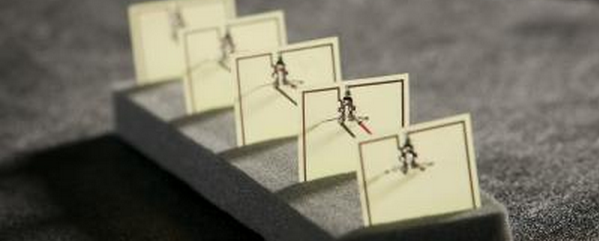
Image credit: Duke University
Using inexpensive materials configured and tuned to capture microwave signals, researchers at Duke University's Pratt School of Engineering have designed a power-harvesting device with efficiency similar to that of modern solar panels.
The device wirelessly converts the microwave signal to direct current voltage capable of recharging a cell phone battery or other small electronic device, according to a report appearing in the journal Applied Physics Letters in December 2013. (It is now available online.)
It operates on a similar principle to solar panels, which convert light energy into electrical current. But this versatile energy harvester could be tuned to harvest the signal from other energy sources, including satellite signals, sound signals or Wi-Fi signals, the researchers say.
The key to the power harvester lies in its application of metamaterials, engineered structures that can capture various forms of wave energy and tune them for useful applications.
Undergraduate engineering student Allen Hawkes, working with graduate student Alexander Katko and lead investigator Steven Cummer, professor of electrical and computer engineering, designed an electrical circuit capable of harvesting microwaves.

Duke engineering students Alexander Katko (left) and Allen Hawkes show a waveguide containing a single power-harvesting metamaterial cell, which provides enough energy to power the attached green LED. Image credit: Duke University
They used a series of five fiberglass and copper energy conductors wired together on a circuit board to convert microwaves into 7.3V of electrical energy. By comparison, Universal Serial Bus (USB) chargers for small electronic devices provide about 5V of power.
"We were aiming for the highest energy efficiency we could achieve," said Hawkes. "We had been getting energy efficiency around 6 to 10 percent, but with this design we were able to dramatically improve energy conversion to 37 percent, which is comparable to what is achieved in solar cells."
"It's possible to use this design for a lot of different frequencies and types of energy, including vibration and sound energy harvesting," Katko said. "Until now, a lot of work with metamaterials has been theoretical. We are showing that with a little work, these materials can be useful for consumer applications."
For instance, a metamaterial coating could be applied to the ceiling of a room to redirect and recover a Wi-Fi signal that would otherwise be lost, Katko said. Another application could be to improve the energy efficiency of appliances by wirelessly recovering power that is now lost during use.
"The properties of metamaterials allow for design flexibility not possible with ordinary devices like antennas," said Katko. "When traditional antennas are close to each other in space they talk to each other and interfere with each other's operation. The design process used to create our metamaterial array takes these effects into account, allowing the cells to work together."
With additional modifications, the researchers said the power-harvesting metamaterial could potentially be built into a cell phone, allowing the phone to recharge wirelessly while not in use. This feature could, in principle, allow people living in locations without ready access to a conventional power outlet to harvest energy from a nearby cell phone tower instead.
"Our work demonstrates a simple and inexpensive approach to electromagnetic power harvesting," said Cummer. "The beauty of the design is that the basic building blocks are self-contained and additive. One can simply assemble more blocks to increase the scavenged power."
For example, a series of power-harvesting blocks could be assembled to capture the signal from a known set of satellites passing overhead, the researchers explained. The small amount of energy generated from these signals might power a sensor network in a remote location such as a mountaintop or desert, allowing data collection for a long-term study that takes infrequent measurements.
- An open access copy of the original report is freely available from Duke University for those who do not have access to Applied Physics Review.
Source and

Teo Blašković founded The Watchers in 2011 and edited it until 2026, covering seismic and volcanic activity, extreme weather, space weather and near-Earth objects. Articles on this page are his archive.
Earlier reporting
Nothing on Watchers was published in the last 24 hours. These are older articles.
- On October 22, 2017, a single flash of lightning stretched 515 miles from eastern Texas to near Kansas City, a distance that takes eight hours to drive, and nobody realized how far it had gone until scientists went back through the satellite data years later Epicenter
- CPC posts a slight risk of heavy rain from the Gulf Coast to the Northeast urban corridor November 25-29, and a moderate risk of West Coast wind and Sierra snow on November 25
- Florida's east coast faces a moderate flash flood risk Wednesday through Friday, with 4 to 8 inches of rain forecast and the St. Johns River near Cocoa already in major flood at 17.13 feet
- Cyclone Akvan to make landfall between Nellore and Visakhapatnam around noon on November 20, IMD forecasts 120-130 km/h winds gusting to 145

This technology is only new to western countries. It has been existent for over 60 years if not more. Well, for us we get an oscillator and we oscillate 12 volts at about 60Hz and then we connect a single wire onto the positive wire of two wires from the oscillating terminals. We connect a germanium in series with the load we want to run into the ground/earth. By doing that, we never deplete the battery since there is zero counter back emf, actually the system becomes asymmetrical Insteady of symmetrically regauged as of lorentz's. That way we can receive our 12 volts this time from the quantum field the battery being a dipole and not the power source as of conventional science. By this one can receive 12 volts as long as the battery lives. Anyways am not giving more extra information on this since am watched by the elites but whoever tries it and it works, we shall one day meet each other! I love humans though they hate me!
Is this similar to how Tesla reportedly tuned his apparatus to harvest the residual electricity from the 40 per second lightning strikes worldwide?
this is fantastic,with as much as is around cell towers…ecletric poles above groung,we should be harvesting it…also I believe an engine using apposing magnets is the answer to perpetual motion…your University should explore this idea!