
Sun hurled two bright CMEs into space, both non-Earthbound
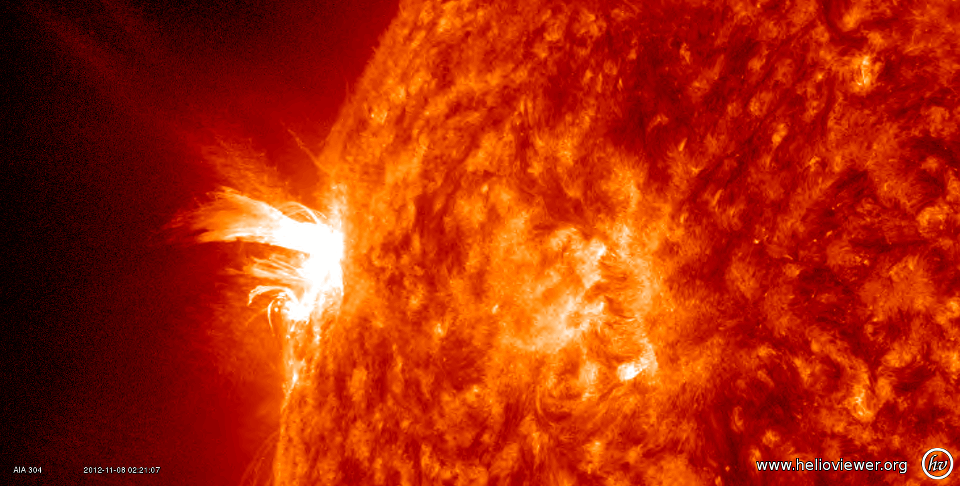
Image credit: TW
New region 1611 rotated into view on the east limb and produced a moderate M1.7 flare at 02:23 UTC and a type II radio sweep shortly after, on November 8, 2012. Flare generated bright coronal mass ejection (CME) in eastward direction which means that it would not be geoeffective.

Bellow is the video by NASA’s Solar Dynamics Observatory showing the extreme UV flash caused by flare-generated CME.


Note:
Data was not updating on SDO website, but now it is online. Just in case, when SDO is offline, for up-to-date data, please go here.

Published in the last 24 hours
- High Risk of excessive rainfall covers Florida’s Space Coast as St. Johns River near Cocoa reaches 5.67 m
- Four small asteroids will pass close to Earth from November 21 to 23
- Cyclone Akvan weakens after landfall near Gopalpur; more than 300 000 evacuated in Odisha, India
- A broad low over southeastern Florida and the northwestern Bahamas has a 30 percent chance of subtropical or tropical development within 48 hours and a 50 percent chance within 7 days, the National Hurricane Center says
