
Cyclone Bingiza hits Madgascar
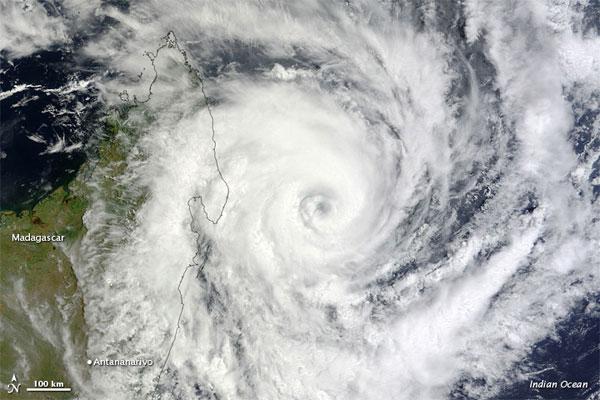
Image credit: NASA Terra / MODIS (Earth Observatory)
The U.S. Navy's Joint Typhoon Warning Center (JTWC) reported that, as of about noon Madagascar time on Feb. 14, Bingiza had maximum sustained winds of 98 mph (155 kilometers per hour) and gusts up to 120 mph (195 kph).
Image credit: NASA Terra/MODIS (EO)
NASA's Terra satellite captured this image of Bingiza at 10:00 a.m. local time on Feb. 13, 2011. In the image, Bingiza's eye approaches northern Madagascar, and a spiral arm grazes Antananarivo.
Although Bingiza would weaken somewhat over land, the storm was expected to re-strengthen after passing over northern Madagascar, thanks to high sea surface temperatures, according to a NASA statement. The JTWC forecast that, on the western side of Madagascar, the storm would travel southward, roughly tracing the island’s west coast.

Published in the last 24 hours
- Cyclone Akvan crossed the north Andhra Pradesh and south Odisha coasts close to Gopalpur on November 20 with 70-80 km/h winds gusting to 90, and has weakened into a deep depression
- High Risk of excessive rainfall covers Florida’s Space Coast as St. Johns River near Cocoa reaches 5.67 m
- Asteroid 2026 WJ to pass Earth at 1.7 lunar distances at 04:20 UTC on November 22, with 2026 WD following at 4.4 lunar distances on November 23
- A broad low over southeastern Florida and the northwestern Bahamas has a 30 percent chance of subtropical or tropical development within 48 hours and a 50 percent chance within 7 days, the National Hurricane Center says
