• New hybrid plasma wave mode observed over Jupiter’s north pole

    NASA’s Juno spacecraft has detected a new plasma wave mode in Jupiter’s auroral magnetosphere, where electron plasma frequency is lower than the ion gyrofrequency, an unprecedented condition in space plasma physics. The discovery was made during recent polar passes by Juno and is described in a study published last month by a team led by R. L. Lysak. Researchers propose this wave type, now called the Alfvén0-Langmuir mode emerges in extremely low-density, highly magnetized plasma.

  • Auroras on Jupiter flash in seconds, defying old models

    The largest planet in the solar system is putting on a show no telescope has fully caught before. New data from the James Webb Space Telescope shows the gas giant’s auroras flickering in bursts measured in seconds, not minutes. Scientists now face fresh questions about where that power comes from.

  • Unexpected size changes observed in Jupiter’s Great Red Spot

    Astronomers have discovered that Jupiter’s Great Red Spot (GRS), the largest storm in the solar system, is undergoing a surprising oscillation in shape. Using data from the Hubble Space Telescope collected over 90 days, researchers observed fluctuations in the storm’s size, shape, and speed.

  • Juice mission on track, world’s first lunar-Earth flyby successfully redirects spacecraft to Venus

    The European Space Agency’s JUICE mission successfully completed the world’s first lunar-Earth flyby on August 20, 2024, a vital maneuver that used the gravitational forces of the Moon and Earth to send the spacecraft toward Venus. This accomplishment is critical for saving fuel and modifying the spacecraft’s trajectory as it travels to Jupiter.

  • 30 years since the historic collision of comet Shoemaker-Levy 9 with Jupiter

    Thirty years ago, Comet Shoemaker-Levy 9 collided with Jupiter, marking a historic moment in astronomy. This collision gave scientists a first-of-its-kind direct observation of an extraterrestrial collision within our Solar System, providing important information regarding Jupiter’s atmosphere and its role in protecting the inner planets from cosmic debris.

  • Aurorae discovered on all four major moons of Jupiter

    A team of astronomers using the W. M. Keck Observatory in Hawaii has discovered that aurorae at visible lengths appear on all four of Jupiter’s major moons, namely Io, Europa, Ganymede, and Callisto. The discovery was made using the High-Resolution Echelle Spectrometer (HIRES) at the Keck Observatory, as well as other high-resolution spectrographs at the Large Binocular Telescope and Apache Point Observatory.

  • Astronomers record small asteroid impacting Jupiter

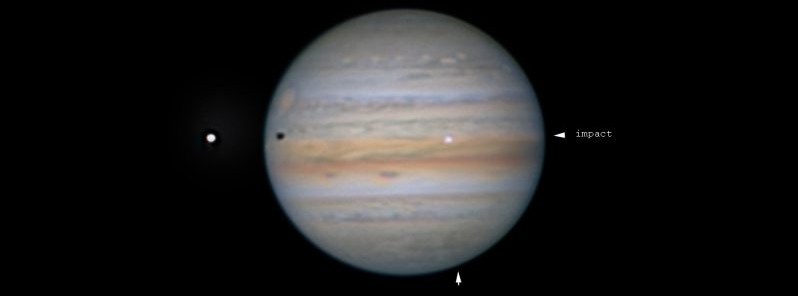
    A bright fireball — most likely a small asteroid or a comet — struck Jupiter at 22:39 UTC on September 13, 2021. The impact was seen and captured by astronomers across the world who were observing the ongoing transit of the shadow of Jupiter's moon Io. "A…

  • First close-up images of Ganymede in more than 20 years

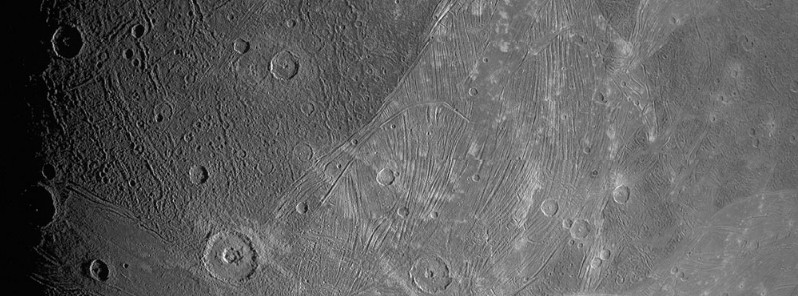
    The first two images from Juno spacecraft's June 7, 2021, flyby of Jupiter’s giant moon Ganymede have been received on Earth. This was the closest any spacecraft has come to this moon in a generation. The photos – one from the Jupiter orbiter’s…

  • Study reveals key discovery about aurora activity on Jupiter

    A team of international researchers has made a major discovery about aurora activity on Jupiter. Their study supports the previously controversial idea that Jupiter's polar cap is threaded in part with closed magnetic field lines and proves the lights hold clues…