• ESA confirms controlled reentry plan for Cluster satellite Rumba on October 22

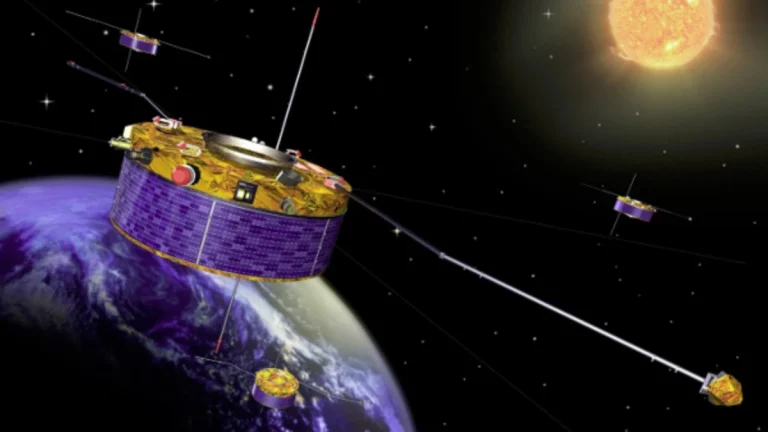
    ESA is preparing the second targeted atmospheric reentry of its long-running Cluster mission, with the spacecraft Rumba expected to descend into Earth’s atmosphere over a remote region of the South Pacific Ocean on October 22, 2025. The maneuver will follow the first controlled reentry of Salsa in September 2024 and continues ESA’s program to end the 24-year mission through precise, safe disposal of each satellite.

  • Atomic clocks enter orbit to test relativity and redefine time standards

    The newly launched Atomic Clock Ensemble in Space (ACES) mission will advance our understanding of how gravity affects the passage of time. By comparing highly accurate clocks aboard the International Space Station with those on Earth, ACES aims to test key concepts in Einstein’s theory of relativity and explore fundamental physics.

  • Asteroid 2024 YR4 triggers planetary defense procedures

    A newly discovered asteroid designated 2024 YR4 has activated global planetary defense protocols after initial observations indicated a small but notable chance of impact in seven years. International monitoring networks have begun refining its trajectory, while space agencies evaluate potential response strategies, including possible deflection measures.

  • ESA’s Salsa (Cluster 2) satellite making controlled reentry over Pacific Ocean on September 8

    After 24 years of studying Earth’s magnetosphere, the ESA’s Salsa satellite from the Cluster mission is on course to reenter the atmosphere in a controlled descent. The reentry, scheduled for 18:48 UTC, on September 8, 2024, is part of a broader effort by the ESA to mitigate space debris risks by ensuring the satellite disintegrates safely over the South Pacific.

  • Juice mission on track, world’s first lunar-Earth flyby successfully redirects spacecraft to Venus

    The European Space Agency’s JUICE mission successfully completed the world’s first lunar-Earth flyby on August 20, 2024, a vital maneuver that used the gravitational forces of the Moon and Earth to send the spacecraft toward Venus. This accomplishment is critical for saving fuel and modifying the spacecraft’s trajectory as it travels to Jupiter.