
Comet Interceptor: ESA announces new space mission to intercept ‘pristine’ comets
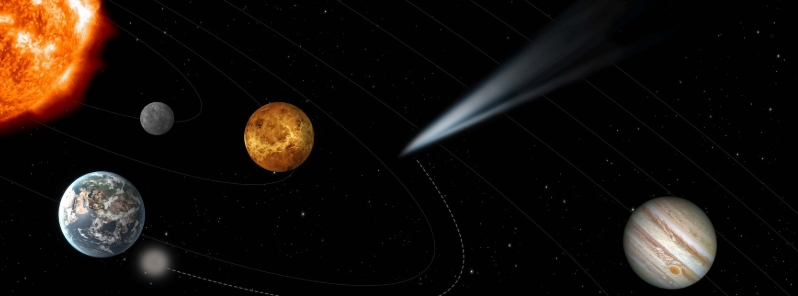
Image credit: ESA
The European Space Agency (ESA) announced its new mission — Comet Interceptor — is expected to launch in 2028. The mission aims to investigate a "pristine" comet or other interstellar object that is only just starting its journey into the inner Solar System.
Comprising three spacecraft, the mission will be the first to visit a truly pristine comet. Because these objects are difficult to spot until they are close to the Sun, the idea is that the mission would launch to a parking orbit around the Lagrange point L2, until an interesting ‘pristine’ comet visits the inner Solar System. It will then intersect the comet's orbit to study its nucleus, gases, dust, and plasma environment.
The spacecraft will perform simultaneous observations from multiple points around the comet, generating a 3D profile of the object.
"Pristine or dynamically new comets are entirely uncharted and make compelling targets for close-range spacecraft exploration to better understand the diversity and evolution of comets," said Gunther Hasinger, ESA's director of science.
"The huge scientific achievements of Giotto and Rosetta– our legacy missions to comets– are unrivaled, but now it is time to build upon their successes and visit a pristine comet, or be ready for the next ‘Oumuamua-like' interstellar object."

Recently, Comet C/2020 F3 (NEOWISE) made its nearest approach to the Earth between July 22 to 23. Charlotte Gotz, a research fellow at ESA, explained that even though the object is nearby, a spacecraft would still be unable to visit it.
"Comet NEOWISE is on an almost parabolic orbit, ad it was only detected in March 2020. And because it is very fast and relatively far away, we cannot build a spacecraft to encounter it in time."
However, Gotz said ESA's Comet Interceptor mission plans to do something like that in the future.
"The way we do it is by parking a spacecraft in orbit at the Lagrange point 2 and we just wait for a comet to be discovered."
"Now the only part of the journey that we still have to do is the one to the point where the comet intersects Earth's orbit and voila– we get a flyby of a 'great' dynamic comet."

Comet Interceptor concept. Image credit: ESA
Comet Interceptor will investigate the nucleus surface and the gases, dust, and plasma that surrounds the object.
"We can compare this to results from missions like Rosetta and Giotto, which observed periodic comets." These comets are those that have come close to the Sun many times before.
"Comets are the storytellers from the formation of our Solar System, so if we can explore the unchanged surface of a comet, we can look back in time and find out how the Solar System and Earth formed."

Published in the last 24 hours
- Right about now, Voyager 1 is crossing a line no human-made object has ever reached, a full light-day from Earth, which means a message NASA sends tonight won't arrive until tomorrow night, and the spacecraft's answer won't make it home until the night after that
- G1 geomagnetic storm watch remains in effect as NOAA forecasts Kp 4.67 late on November 17 and early on November 18
- Atmospheric river brings moderate risk of heavy rain, mountain snow and high winds to northern California and southwest Oregon on November 24-25
- M6.6 earthquake hits the Banda Sea 148 km west-southwest of Tual, Indonesia, at 68 km depth, USGS issues Green alert
