
Solar Cycle 26 enters the harder-to-predict side of the solar cycle
Researchers at the University of Oulu in Finland found stronger long-term geomagnetic precursor relationships within even-to-odd solar-cycle pairs than across odd-to-even transitions. The result is potentially relevant to Solar Cycle 26 because it will follow odd-numbered Cycle 25, the type of transition for which the researchers found weaker precursor relationships, although the study does not issue a specific forecast for Cycle 26. The study used a 180-year composite aa-based geomagnetic record, hindcast Solar Cycles 10–24 using leave-one-out cross-validation, and generated a prediction for Solar Cycle 25.
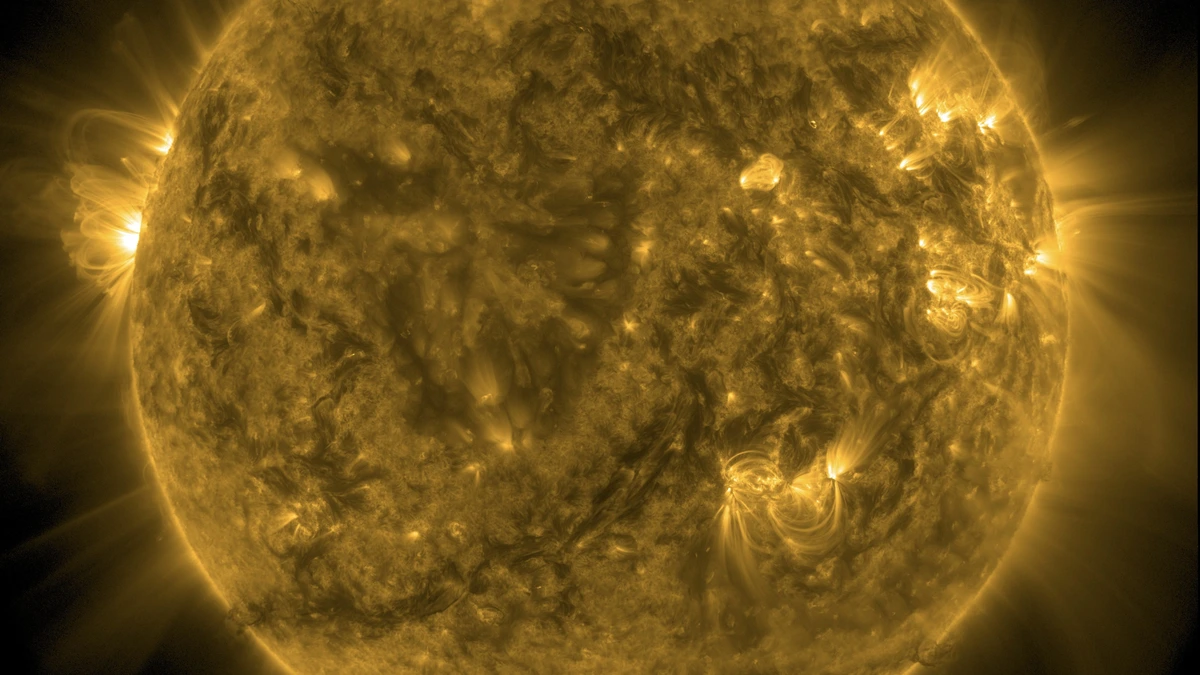
The Sun observed by NASA’s Solar Dynamics Observatory on September 10, 2025. Researchers studying long-term geomagnetic activity found substantial differences in predictability between even-to-odd and odd-to-even solar-cycle transitions. Credit: NASA/GSFC/Solar Dynamics Observatory
Researchers Timo Qvick, Timo Asikainen and Kalevi Mursula of the University of Oulu’s Space Climate Group found a pronounced even-odd asymmetry in long-range prediction of geomagnetic activity. Almost all parameters they tested for odd-numbered cycles could be predicted using aa-index or sunspot measurements from the preceding even cycle, while predicting even-cycle parameters from the preceding odd cycle was considerably more uncertain.
Solar Cycle 26 will follow odd-numbered Solar Cycle 25, placing the next cycle in the type of odd-to-even transition for which the study found the weaker precursor relationships.
The paper does not provide a specific forecast for Solar Cycle 26. Its model predicts the evolution of geomagnetic activity, not the amplitude of the approximately 11-year sunspot cycle itself. Qvick et al. make predictions for a new geomagnetic cycle around the aa minimum at the start of that cycle, which typically occurs a few months after the corresponding sunspot minimum. Some parameters of even-numbered cycles were more effectively predicted from aa measurements available near that starting minimum than from measurements carried forward from the preceding odd cycle.
The aa index is a global measure of geomagnetic activity derived from K indices recorded at two approximately antipodal magnetic observatories and expressed in nanotesla (nT). The conventional aa series begins in 1868. To extend the analysis further back, the Oulu team used calibrated magnetic-declination-based Ak(D) observations from Helsinki for the period before the standard aa record, producing the composite series used in the study from observations extending back to July 1844.

The researchers combined the Helsinki extension with the homogenized aa series and more recent calibrated aa observations, then smoothed the composite with a 13-month Gleissberg filter. The resulting record allowed them to study the large-scale evolution of geomagnetic activity over approximately 180 years rather than treating individual storms or short periods of space weather in isolation.
Even and odd solar cycles have a physical context in the Sun’s approximately 22-year magnetic, or Hale, cycle. During one Hale cycle, the global solar magnetic field changes orientation twice across two successive roughly 11-year sunspot cycles. Sunspot cycles also show an empirical tendency known as the Gnevyshev-Ohl rule, under which an even-numbered cycle is generally followed by a stronger odd-numbered cycle. The relationship is not universal; Solar Cycles 22 and 23 form the most recent violation discussed by the researchers.
Qvick and colleagues represented each geomagnetic cycle with two peaks separated by a local minimum, using linear interpolation between the identified extrema. Coronal mass ejections are the predominant geomagnetic driver during the ascending-to-maximum phase of a solar cycle, while high-speed solar-wind streams associated with coronal holes become more important during the declining-to-minimum phase. The model was designed to reproduce both components rather than forcing the geomagnetic cycle into a single smooth peak.
Using the observed extrema, the two-peak representation produced a correlation of almost 0.95 with the smoothed aa series over the full record. The average correlation within individual cycles was 0.92, ranging from 0.85 for Solar Cycle 20 to 0.98 for Solar Cycle 12.
The predictive relationships differed sharply by cycle parity. For even-numbered cycles, aa minima at the beginning and end of the same cycle had a correlation of 0.89. The equivalent relationship for odd cycles was not statistically significant. Solar Cycle 22 was the only even cycle in the analyzed record in which the ending aa minimum was lower than the minimum at the beginning of the cycle.
A separate precursor was more useful for estimating declining-phase activity in even-numbered cycles. The researchers averaged aa values over a seven-month interval running from six months before the cycle minimum through the minimum month. That measurement correlated at 0.92 with the amplitude of the declining-phase peak in even cycles and increased to 0.96 when Solar Cycle 16 was excluded as an outlier. The corresponding relationship for odd cycles was 0.68 and was not statistically significant.
The findings show why weak odd-to-even precursor relationships do not amount to a complete loss of predictive information. Data collected close to the start of an even cycle can supply useful information that was not available from the preceding odd cycle, while the paper also identifies timing relationships extending across cycles of the same parity. The study therefore supports a statistical asymmetry between even-to-odd and odd-to-even forecasting rather than a literal loss of solar “memory.”
The team tested the forecasting method by hindcasting Solar Cycles 10–24 with leave-one-out cross-validation and then generating a prediction for Solar Cycle 25. When reconstructing a particular cycle, its own observations and fitted parameters were excluded from the regression used to generate the prediction, reducing the risk of evaluating the model on the same cycle used to train that regression. Prediction uncertainty was estimated from residuals associated with the remaining cycles.
For Solar Cycle 25, the model placed the declining-phase geomagnetic peak in October 2025 and assessed the cycle as slightly larger in geomagnetic activity than Solar Cycle 24. The authors reported that observed smoothed aa activity through the available portion of Cycle 25 had already reached a level showing that the eventual declining-phase maximum would be at least somewhat higher than the value originally predicted by the model. They did not present that observation as proof that the entire Solar Cycle 25 declining-phase evolution had already been completed.
Solar Cycle 25 has separately passed its sunspot maximum. SILSO at the Royal Observatory of Belgium determined that the smoothed monthly sunspot number reached 161 in October 2024 and has since moved into an overall declining trend. A declining solar cycle can continue to produce strong solar and geomagnetic activity, and the Oulu study does not determine the date of the next solar minimum.
The distinction between sunspot-cycle forecasting and geomagnetic-cycle forecasting is central to the study. Most long-range solar predictions have concentrated on the approximately 11-year sunspot cycle, while geomagnetic forecasts have commonly focused on operational periods of hours to weeks. The Oulu model instead attempts to describe how geomagnetic activity evolves across an entire solar cycle, including the different phases dominated by CME-related activity and high-speed solar-wind streams.
References:
1 Qvick, T., Asikainen, T., & Mursula, K. (2026). Predicting geomagnetic activity in the ascending and declining phases of the solar cycle. Space Weather, 24(8), e2026SW004992. DOI: 10.1029/2026SW004992. https://doi.org/10.1029/2026SW004992

I’m a science journalist and researcher at The Watchers, contributing to the Epicenter edition, where I cover peer-reviewed scientific research and emerging discoveries across Earth and space sciences. With a background in astronomy and a passion for environmental science, I’ve worked in shark and coral conservation in Fiji, conducting reef and shark-behavior research, contributing to mangrove restoration, and earning PADI Open Water and Coral Reef Certifications. I bring a blend of scientific rigor and storytelling to illuminate the discoveries shaping our planet and beyond.

Commenting rules and guidelines
We value the thoughts and opinions of our readers and welcome healthy discussions on our website. In order to maintain a respectful and positive community, we ask that all commenters follow these rules.