
Ryugu samples reveal nitrogen compounds concentrated in salts from ancient asteroid brines
Samples returned from asteroid Ryugu contain ammonium-bearing clay, C≡N-bearing species and sodium nitrate clustered with sodium-carbonate-rich material. The authors conclude that these nitrogen reservoirs probably became concentrated as the last brines in Ryugu’s parent body disappeared, linking nitrogen storage to the final stages of aqueous alteration and identifying a chemical setting that could have supported prebiotic organic reactions. The study was published in Nature Astronomy on August 27, 2026.
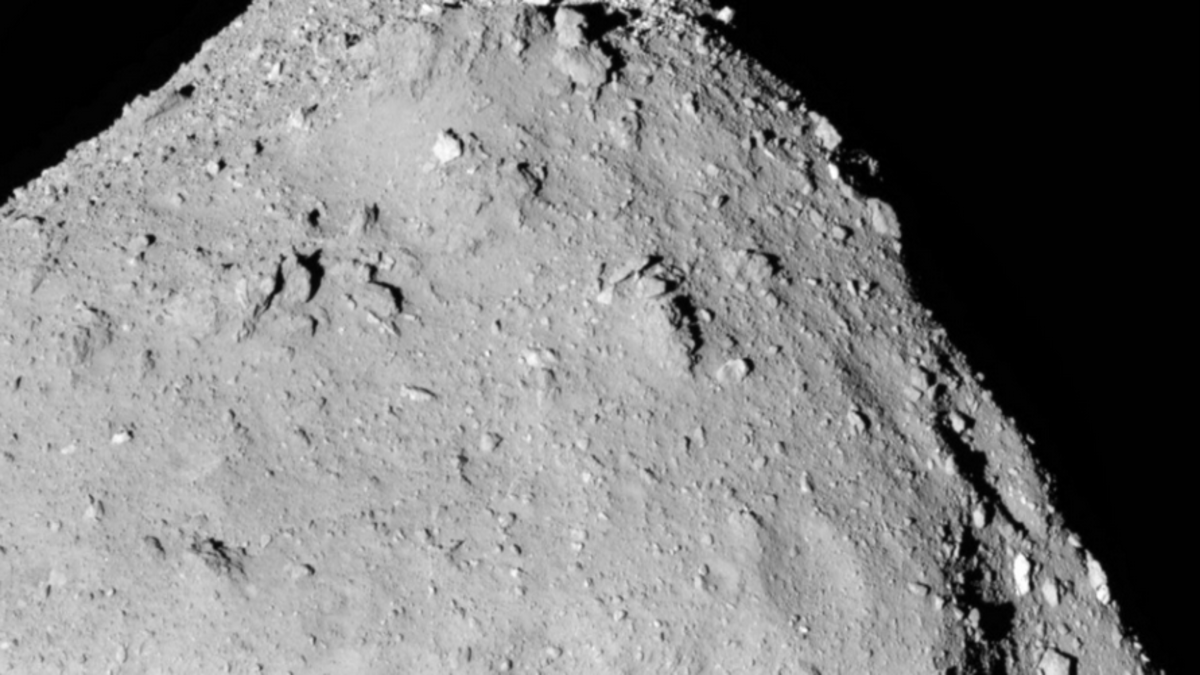
Ryugu close-up. Ryugu is named after a magical underwater palace in a Japanese folktale, appropriately enough it seems to be a palace for water in the real world too. Credit: UTokyo
Brine is salty liquid water left behind as water is removed from a system. In the chemical history reconstructed for Ryugu’s parent body, freezing and evaporation reduced the amount of liquid water while increasing the concentration of dissolved material until salts, including sodium carbonate, precipitated. The new work addresses where nitrogen-bearing compounds were stored during that late aqueous stage and shows that several chemically different forms of nitrogen occur with those salt-rich materials.
A research group led by Toru Matsumoto of Kyoto University identified three nitrogen reservoirs in samples collected by Japan’s Hayabusa2 mission. Nitrogen K-edge measurements found a broad absorption feature at about 405.6 eV in parts of the phyllosilicate matrix, consistent with ammonium incorporated into clay minerals. Another Ryugu grain contained a feature at 399.8 eV assigned to C≡N-bearing species, in which carbon and nitrogen are joined by a triple bond.
Sodium-carbonate-rich material contained a sharp nitrogen feature at 405.2 eV and a broader feature near 412 eV, consistent with sodium nitrate. Electron diffraction provided an independent mineralogical check by identifying a particle of nitratine, the mineral form of NaNO₃. The different signatures show that nitrogen was retained in several chemical reservoirs rather than in a single mineral phase.
The team combined infrared spectroscopy, X-ray spectroscopy and electron microscopy to determine which molecular bonds were present, the chemical state of nitrogen and where the nitrogen-bearing material occurred relative to the salts. Using several techniques on the same returned material allowed the researchers to connect chemical composition with mineral-scale location instead of relying on a single spectral signature.
The authors infer that the nitrogen history began before the final salts formed. They propose that reactive ammonia and C≡N-bearing species were incorporated when Ryugu’s parent body formed and survived through its period of aqueous alteration. The enrichment of nitrogen species and incorporation of ammonium into phyllosilicates probably occurred later, as the remaining brines disappeared and sodium carbonate precipitated.
That sequence matters for prebiotic chemistry because concentration changes how often dissolved compounds can interact. Matsumoto et al. propose that persistent ammonia and C≡N-bearing material could have supplied nitrogen for organic synthesis, while increasingly concentrated residual brines could have increased intermolecular reactions and possibly promoted dehydration-driven polymerization.
The samples do not directly record those reactions taking place and do not establish that complex biomolecules or life formed on Ryugu’s parent body. The prebiotic connection is an interpretation of the reconstructed chemical environment, while the measured evidence consists of the nitrogen-bearing phases, their chemical states and their spatial relationship with sodium-carbonate-rich material.
Returned samples are especially important for studying this stage of asteroid chemistry because many salt minerals are highly soluble and can be altered after exposure to moisture on Earth. Material collected directly from Ryugu preserves mineral relationships that can be difficult to recover from meteorites after they have passed through Earth’s atmosphere and remained at the surface.
The results also provide a comparison point for other primitive Solar System bodies. Ammoniated minerals have been detected remotely on Ceres and carbonaceous asteroids, and the authors propose by analogy that salt- and ammonium-rich icy bodies containing concentrated subsurface brines could host related nitrogen chemistry. The Ryugu measurements do not demonstrate that the same late-brine process occurred on Ceres.
A further test will come from comparisons with material returned from asteroid Bennu. Matsumoto said examining similarities and differences between Ryugu and Bennu can help determine how and to what extent materials relevant to life were produced in primitive Solar System bodies. Whether related material was later transported to Earth remains a separate question that asteroid sample-return studies can continue to constrain.
References:
1 Matsumoto, T., Yuzawa, H., Koike, M., Kebukawa, Y., Noguchi, T., Yada, T., Suga, H., Ina, T., Sakuma, H., Shirose, Y., Kitamura, Y., Igami, Y., & Miyake, A. (2026). Ammonium-bearing clays and multiple nitrogen species linked to the late-stage brines of Ryugu’s parent body. Nature Astronomy. Advance online publication. https://doi.org/10.1038/s41550-026-02962-y
2 リュウグウの砂に生命の材料につながる濃厚な塩水の痕跡―太古の塩結晶とともに残された多様な窒素化合物 – Kyoto University – September 3, 2026

I’m a science journalist and researcher at The Watchers, contributing to the Epicenter edition, where I cover peer-reviewed scientific research and emerging discoveries across Earth and space sciences. With a background in astronomy and a passion for environmental science, I’ve worked in shark and coral conservation in Fiji, conducting reef and shark-behavior research, contributing to mangrove restoration, and earning PADI Open Water and Coral Reef Certifications. I bring a blend of scientific rigor and storytelling to illuminate the discoveries shaping our planet and beyond.

Commenting rules and guidelines
We value the thoughts and opinions of our readers and welcome healthy discussions on our website. In order to maintain a respectful and positive community, we ask that all commenters follow these rules.