
Oklahoma’s Ames impact just moved nearly 100 million years on the geological clock
New uranium-lead measurements from zircon recovered inside Oklahoma’s buried Ames impact structure place its youngest dated material at 369.7 ± 5.9 million years, nearly 100 million years later than the Ordovician age long assigned to the crater. The result does not provide an exact collision date, but it sets a much younger upper age limit for impact-related zircon recrystallization and shifts Ames toward a different period of Earth history.
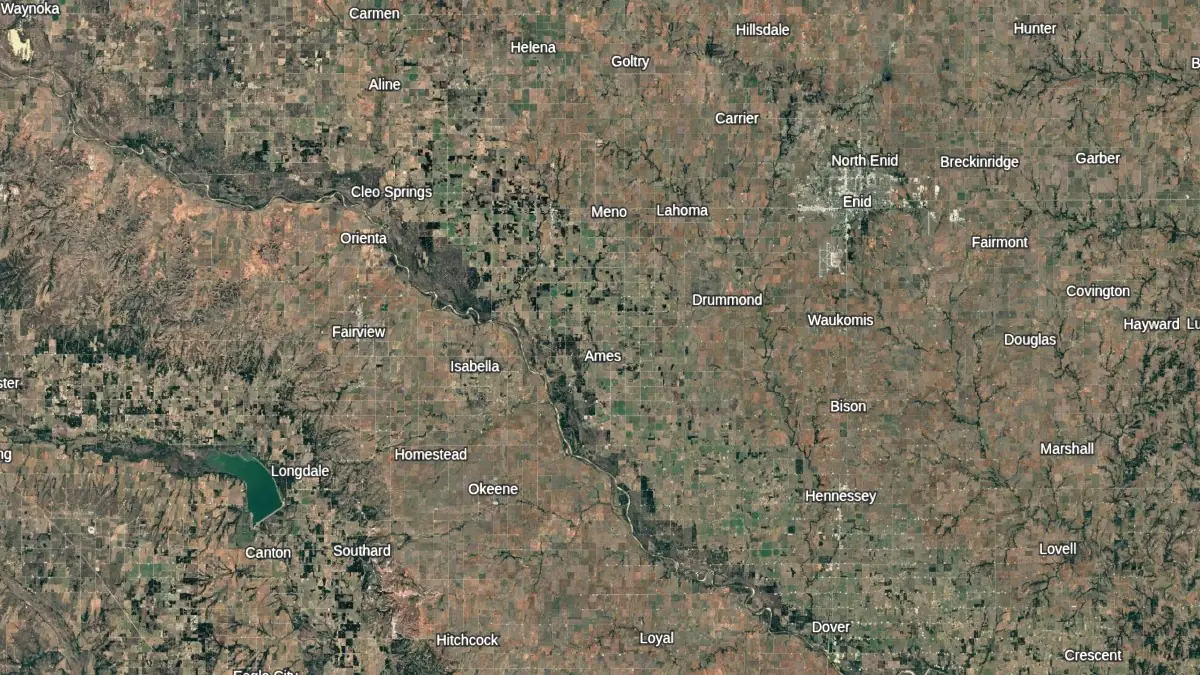
Satellite image centered over Ames, Oklahoma, United States. Credit: Google, Landsat, Copernicus
Researchers arrived at the younger chronology by dating zircon recovered from impact-affected granite inside the Ames structure. The result challenges an age previously inferred largely from fossils in crater-associated sediments and changes where the structure fits in the geological record.
Ames had long been placed within the Ordovician Meteor Event, an interval when an unusually large amount of asteroid debris reached Earth. Under the new chronology, the crater no longer fits comfortably within that Ordovician grouping and instead falls close in time to the Late Devonian Frasnian–Famennian extinction interval. The study does not establish that the Ames impact caused or contributed to that extinction.
The Ames structure is a buried complex impact crater beneath Ames, Oklahoma, with an outer rim about 14–16 km (9–10 miles) across. Its previous age was inferred mainly from biostratigraphy, including conodont fossils recovered from sediments associated with the crater. Those fossils placed Ames in the Late Ordovician.
Biostratigraphy and radioisotopic dating do not measure the same part of a geological history. Fossils constrain the age of sedimentary layers, while minerals such as zircon can preserve isotopic evidence of when a rock formed or when parts of a crystal were later modified. The new study tested whether zircon inside the impact structure recorded a younger event than the fossil-based chronology had implied.
Researchers led by Elizabeth J. Catlos analyzed zircon extracted from impact-affected granitic material. Zircon is especially useful for geochronology because uranium atoms become incorporated into the crystal as it forms and then decay into lead at known rates. Measuring those uranium and lead isotopes allows researchers to determine when parts of a crystal formed or were later recrystallized.
The youngest group of zircon analyses yielded a weighted mean age of 369.7 ± 5.9 million years (Ma) from 10 measurements after one statistical outlier was excluded. The researchers describe that population as the best maximum-age constraint on impact-related zircon recrystallization.
In physical terms, the measurement places an upper limit on how old that impact-related modification can be. It does not mean the meteorite struck precisely 369.7 million years ago. The dated zircon records a geological response associated with the impact history, and the exact timing of the collision remains less tightly constrained.
Two independent uranium-lead techniques were used: secondary ion mass spectrometry and laser ablation inductively coupled plasma mass spectrometry. Their results agree within the reported uncertainties, supporting the interpretation that the younger Devonian dates are a genuine part of the zircon record rather than an artifact of one analytical method.
The zircon crystals also preserve evidence from much older parts of the site’s history. Many retain internal growth zoning formed when they originally crystallized in Precambrian rock, and older analyses cluster near 1.4 billion years. Some grains contain microstructures associated with later impact modification, including low-angle grain boundaries within microcracks and granular zircon cutting across earlier growth zoning.
Zircon does not behave like a geological stopwatch that resets completely during every major event. Parts of the same crystal can retain an ancient formation age while other regions are recrystallized or isotopically disturbed much later. The Ames grains therefore preserve both the age of the original basement rock and evidence of younger geological modification.
A second mineral system records an even later episode. Plagioclase dated with the 40Ar/39Ar method produced approximate total-fusion ages of about 310.5 Ma and 250.5 Ma. Catlos and colleagues interpret those younger ages as records of post-impact heating associated with burial and regional thermal history, not as dates for the meteorite collision.
The competing age records help explain why Ames has been difficult to date. Fossils, zircon, plagioclase and crater-fill sediments can preserve different parts of the same geological history. Each responds differently to impact, burial, heating and later alteration, so determining when the crater formed requires identifying which archive is actually tied most closely to the collision.
Under the previous chronology, Ames was grouped with North American impact structures associated with the Ordovician Meteor Event, which began roughly 466–468 million years ago following the breakup of an asteroid parent body. Ames was important in that discussion because it is one of the larger impact structures previously assigned to that interval.
The 369.7 ± 5.9 Ma zircon population instead overlaps, within uncertainty, the geological interval surrounding the Frasnian–Famennian boundary. The paper cites published ages around 371.8–372.4 Ma for that boundary, depending on the timescale calibration used. Other North American impact structures also have Middle to Late Devonian ages, giving Ames a different regional context if the younger interpretation is correct.
Chronological proximity is not evidence of causation. The study does not show that Ames triggered the Frasnian–Famennian extinction, nor does it identify a physical mechanism linking the crater to the biological crisis. The revised chronology changes which hypotheses Ames can reasonably be tested against, but it does not establish an extinction connection.
A major uncertainty remains. Most of the youngest zircon grains do not show diagnostic shock deformation, and the authors call for additional dating and microstructural work to strengthen the connection between the Devonian zircon population and the impact itself. The new measurements narrow the possible age substantially, but they do not yet turn 369.7 ± 5.9 Ma into a direct collision date.
Ancient impact structures are often reconstructed from several geological clocks that preserve different parts of the same history. At Ames, the new radioisotopic evidence challenges a chronology built largely from stratigraphy and leaves researchers with a younger, more tightly constrained window for determining when the impact actually occurred.
References:
1 Catlos, E. J., Parisi, A. F., Brookfield, M. E., Erickson, T., Gulick, S. P. S., Schmitt, A. K., Stockli, D. F., Miggins, D. P., Ruchte, B., & Cloos, M. (2026). The Ames impact structure, Oklahoma: New radioisotopic constraints and implications for North American impact chronology. Meteoritics & Planetary Science, 61(8), 2103–2139. https://doi.org/10.1111/maps.70191
2 Meteor hit Oklahoma 100 million years later than previously thought – The University of Texas at Austin – September 28, 2026

I’m a science journalist and researcher at The Watchers, contributing to the Epicenter edition, where I cover peer-reviewed scientific research and emerging discoveries across Earth and space sciences. With a background in astronomy and a passion for environmental science, I’ve worked in shark and coral conservation in Fiji, conducting reef and shark-behavior research, contributing to mangrove restoration, and earning PADI Open Water and Coral Reef Certifications. I bring a blend of scientific rigor and storytelling to illuminate the discoveries shaping our planet and beyond.

Commenting rules and guidelines
We value the thoughts and opinions of our readers and welcome healthy discussions on our website. In order to maintain a respectful and positive community, we ask that all commenters follow these rules.