
North Atlantic temperature patterns change with AMOC strength, models show
A Nature Communications study published on August 5, 2026, identifies three state-dependent relationships between Atlantic Meridional Overturning Circulation (AMOC) strength and North Atlantic sea surface temperature (SST): a typical dipole fingerprint under strong AMOC, amplified subpolar SST anomalies at intermediate strength, and muted North Atlantic signals in a weak-AMOC regime. The year of peak AMOC–SST sensitivity emerged as a predictor of the modeled transition into the weak-AMOC regime and the associated decay of the North Atlantic warming hole.
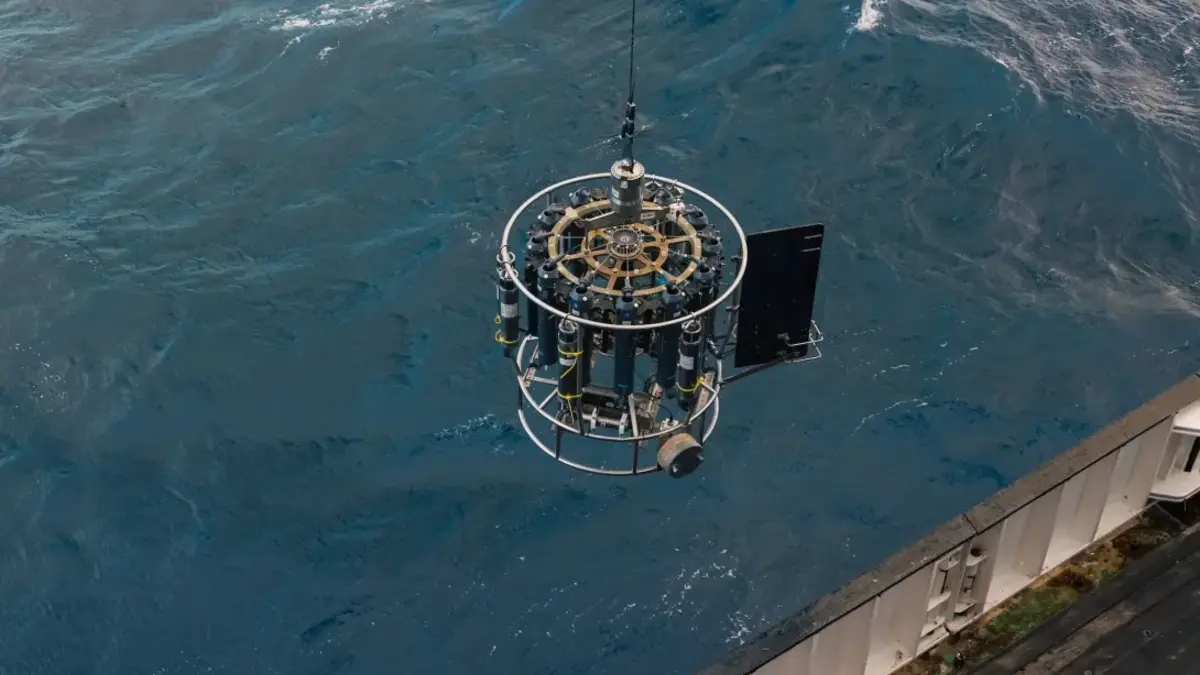
CTD being lowered into the ocean. Credit: NOC
Fan et al. (2026) analyzed the relationship between the Atlantic Meridional Overturning Circulation (AMOC) and sea surface temperature (SST) with Community Earth System Model simulations spanning several climate states and a multi-model ensemble. The experiments produced three regimes: strong AMOC with the typical North Atlantic dipole fingerprint, intermediate AMOC with amplified subpolar SST anomalies, and weak AMOC with a muted North Atlantic SST signal.
AMOC transports warm upper-ocean water northward through the Atlantic and returns cooler water southward at depth. Sea surface temperature patterns across the subpolar North Atlantic have been widely used to infer changes in AMOC strength. An SST fingerprint describes the spatial temperature pattern associated with changes in the circulation; a dipole consists of two regions with opposite-signed temperature anomalies.
The modeled SST response changes across the three AMOC states. The familiar dipole fingerprint occurs under strong AMOC, subpolar SST anomalies reach greater amplitudes at intermediate strength, and North Atlantic SST signals become smaller in the weak-AMOC regime. AMOC–SST sensitivity reaches its maximum before the weak regime.
The researchers report that the year of peak AMOC–SST sensitivity predicts the transition into the weak-AMOC regime and the associated decay of the North Atlantic warming hole. The warming hole is a subpolar North Atlantic region where SST has cooled relative to the broader warming of the ocean. They describe peak-sensitivity timing as a physically based constraint on model uncertainty in climate projections and attribute the three regimes mainly to changes in atmospheric radiative processes. Ocean processes contribute indirectly through air–sea interactions.
Mackay et al. (2024) reported cooling of about 0.4 K per century in the region over the long observational record examined in their study. The team examined the SST fingerprint with the MPI-ESM1.2-HR climate model under historical forcing, abrupt quadrupling of atmospheric CO2, and the SSP2-4.5 future pathway. Their SST-based AMOC fingerprints were calculated from regressions between an AMOC index and SST, representing the potential SST response associated with a 1 Sv change in AMOC.
The fingerprint differed across the forcing experiments, and SST introduced greater uncertainty into AMOC reconstruction during stabilized conditions because of multiple forcing mechanisms and decadal variability. One sverdrup (Sv) equals 1 million m³/s (35.3 million ft³/s) of water transport.
The results do not indicate that SST is unsuitable for inferring AMOC variability. Instead, they show that the relationship between AMOC strength and its North Atlantic SST fingerprint is state-dependent, meaning SST-based AMOC indicators cannot be assumed to remain stationary across different climate states. The findings also do not establish that the present-day observed AMOC has entered any of the three modeled regimes.
Direct AMOC measurements provide an observational record at 26°N in the Atlantic. The RAPID program has monitored the circulation there since 2004, and the UK National Oceanography Centre (NOC) reported in September 2025 that the 20-year record carried a trend of −0.9 ± 0.7 Sv per decade. NOC said observations should continue through at least 2034 to establish the trend and determine whether it reflects long-term natural variability or anthropogenic influence.
AMOC is closely monitored because changes in its strength alter the redistribution of heat, salt and carbon through the Atlantic Ocean. Sustained weakening can affect North Atlantic temperatures, regional sea level, precipitation patterns and marine ecosystems, with climatic effects extending beyond the Atlantic basin.
The current scientific assessment is that AMOC is very likely to weaken during the 21st century, although the magnitude and rate of that weakening remain uncertain. The Intergovernmental Panel on Climate Change (IPCC) assesses with medium confidence that the projected decline will not involve an abrupt collapse before 2100.
References:
1 Fan, Y., Chan, D., Danabasoglu, G., Kim, W. M., Zhang, P., & Li, L. (2026). Regime shifts of AMOC-sea surface temperature relationship. Nature Communications. DOI: 10.1038/s41467-026-76149-4. https://doi.org/10.1038/s41467-026-76149-4
2 Mackay, Q., Fan, Y., Karnauskas, K. B., & Li, L. (2024). Nonstationarity of the Atlantic Meridional Overturning Circulation’s fingerprint on sea surface temperature. Geophysical Research Letters, 51(19), e2024GL109789. DOI: 10.1029/2024GL109789. Geophysical Research Letters

I’m a science journalist and researcher at The Watchers, contributing to the Epicenter edition, where I cover peer-reviewed scientific research and emerging discoveries across Earth and space sciences. With a background in astronomy and a passion for environmental science, I’ve worked in shark and coral conservation in Fiji, conducting reef and shark-behavior research, contributing to mangrove restoration, and earning PADI Open Water and Coral Reef Certifications. I bring a blend of scientific rigor and storytelling to illuminate the discoveries shaping our planet and beyond.

Commenting rules and guidelines
We value the thoughts and opinions of our readers and welcome healthy discussions on our website. In order to maintain a respectful and positive community, we ask that all commenters follow these rules.