
Main driver of Sargassum blooms in the Atlantic Ocean revealed
A new study from the Max Planck Institute for Chemistry identifies equatorial upwelling of phosphorus-rich deep water as the primary driver behind the record Sargassum blooms affecting the Caribbean, Gulf of Mexico, and northern South America. Researchers show that this nutrient supply strengthens nitrogen fixing cyanobacteria living on Sargassum, giving the algae a competitive advantage that has intensified since 2011 and contributed to a new negative record of biomass this year.
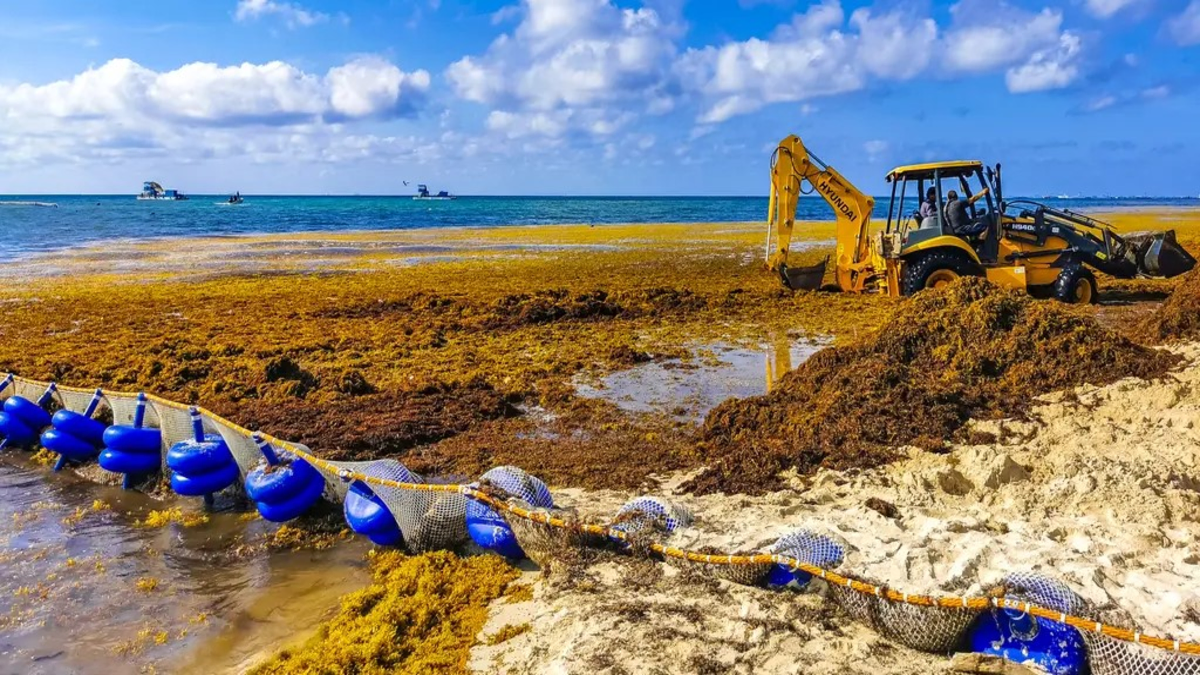
Playa del Carmen, a popular vacation destination on Mexico's Yucatán Peninsula, faces significant Sargassum strandings during summer months, as do other Caribbean coastlines. To maintain beach access for swimmers, the brown algae must be regularly cleared using machinery. Researchers at the Max Planck Institute for Chemistry have now been able to use coral drill cores to uncover the mechanism driving these algal blooms. Credit: Arkadij Schell
By early June 2025, an estimated 38 million tons of Sargassum drifted into the Caribbean, the Gulf of Mexico, and northern South America, marking a new negative record. The volume overwhelmed beaches in locations such as Playa del Carmen, where machinery is required to clear the algae during the summer months.
The strandings have become a seasonal phenomenon that affects local economies and significantly stresses coastal ecosystems.
The algae emit hydrogen sulfide as they decay, creating a strong odor that repels tourists and can irritate local communities. At the same time, the biomass can pile several meters high, block access points, and bury shoreline habitats. The repeated arrival of such large mats raises public concerns about long-term impacts and the possibility of even larger events in the future.
Sargassum was historically concentrated in the Sargasso Sea east of Florida, where it formed a stable floating biome. That changed in 2010, when strong winds displaced Sargassum into the tropical Atlantic for the first time. This relocation brought the algae closer to regions influenced by equatorial upwelling, effectively altering its nutrient environment.
Since 2011, scientists have identified a recurring Great Atlantic Sargassum Belt that stretches from West Africa toward the Caribbean. This belt responds strongly to trade wind patterns and marks the zone where deep ocean nutrients reach the surface
Understanding why the belt formed and why it continues to expand has become a main focus for marine researchers.
The missing trigger
The new study shows that strong winds along the equator displace warm surface water and allow cool deep water to rise. This upwelled water is rich in phosphorus and carries a chemical signature known as excess P, referring to phosphorus present in stoichiometric excess relative to nitrogen. When this deep water reaches the surface, it introduces nutrients that are otherwise scarce in the tropical Atlantic.
Cyanobacteria living on Sargassum respond immediately to the increase in phosphorus. These microbes fix atmospheric nitrogen gas into ammonium through a biochemical process that supplies the algae with usable nitrogen. In the nutrient-poor tropical Atlantic, this partnership provides Sargassum with a competitive advantage that other algae cannot access.
Because nitrogen fixation is energetically expensive, cyanobacteria require an ample phosphorus supply to maintain high activity. Upwelling delivers precisely this combination of cool temperatures and nutrient-enriched water, allowing the symbiosis between Sargassum and its epiphytes to flourish. This is why the algae grow so aggressively in areas affected by equatorial upwelling.
This mechanism did not operate in the Sargasso Sea where the water is warmer and less influenced by deep ocean phosphorus. Once Sargassum was relocated in 2010 to a region with stronger upwelling, its growth potential changed dramatically. The expansion of the Great Atlantic Sargassum Belt after 2011 is consistent with this shift.
What coral skeletons reveal about a century of nutrient change
To trace long-term changes in nitrogen fixation, scientists collected coral drill cores from Belize, Cuba, Mexico, Martinique, and Costa Rica. Corals build their calcareous skeletons by incorporating nitrogen from surrounding water, leaving behind annual growth layers akin to tree rings. These layers preserve the ratio of nitrogen isotopes, which indicates whether nitrogen fixation was active at the time.
When cyanobacteria fix nitrogen, they lower the ratio of nitrogen-15 to nitrogen-14 in seawater. Coral layers that display low values of this ratio therefore mark periods of high nitrogen fixation. By analyzing more than 120 years of coral records, the research team reconstructed historical trends in open ocean nitrogen supply.
To confirm that these coral layers accurately reflect nitrogen fixation, seawater samples were collected aboard the research vessel Eugen Seibold. These samples provided modern calibration data and demonstrated that corals reliably record nitrogen fixation signals. This verification allowed researchers to link historical coral values to modern observations of Sargassum biomass.
The reconstructed record shows significant increases in nitrogen fixation in 2015 and 2018, which coincide with years of extreme Sargassum blooms.
Lead author Jonathan Jung noted that in the first set of measurements, they noticed two significant increases in nitrogen fixation in 2015 and 2018, two years of record Sargassum blooms. “So we compared our coral reconstruction with annual Sargassum biomass data, and the two records aligned perfectly. At that time, however, it was not at all clear whether there was a causal link.”
After further analysis, the team found that nitrogen fixation and Sargassum growth have been tightly coupled since 2011. This alignment corresponds to the period when Sargassum first entered the equatorial Atlantic, where upwelling delivers excess phosphorus.
Eliminating other nutrient sources
Earlier hypotheses suggested that Saharan dust might fertilize the ocean by delivering iron and phosphorus. However, the new study compared dust deposition with biomass observations and found that dust input did not correlate with biomass. This result contradicts previous suggestions that dust episodes could be major drivers of Sargassum growth.
Nutrient discharge from the Amazon and Orinoco rivers was also considered. These rivers release large seasonal plumes of freshwater and dissolved nutrients, but their influence is typically confined to coastal zones. Satellite and field data show no interannual correlation between river discharge and Sargassum biomass in open waters where the Great Atlantic Sargassum Belt forms.
Atmospheric nitrogen deposition is another potential nutrient source, but it is several orders of magnitude weaker than nitrogen fixation in the tropical Atlantic. Measurements indicate that atmospheric inputs cannot supply enough nitrogen to sustain large-scale Sargassum blooms. This supports the conclusion that the dominant nitrogen source must come from microbial fixation rather than external deposition.
Sea surface temperatures and salinity in the equatorial Atlantic also fall within normal ranges during bloom years. Although Sargassum grows well between 23 and 28 degrees Celsius and at salinities above 34 practical salinity units, these conditions are consistent across many years and do not explain why biomass varies so strongly from year to year. Nutrient supply remains the most compelling explanation.
Climate patterns that control when blooms form
The study identifies specific climate conditions that enhance upwelling. When the tropical North Atlantic cools and the southern Atlantic warms, air pressure differences intensify. These gradients strengthen easterly winds, which push surface water aside and allow phosphorus-rich deep water to rise.
This process interacts with the Atlantic Multidecadal Oscillation and the Atlantic Meridional Mode, both of which modulate trade wind strength and surface circulation. During negative phases of these climate modes the Intertropical Convergence Zone shifts southward, reinforcing the winds that drive upwelling. These same periods frequently align with the largest Sargassum blooms recorded in satellite imagery.
The Atlantic Meridional Mode affects conditions on shorter timescales of months to years. Its negative phase corresponds to cooler waters near 10 degrees north latitude and stronger winds near 5 degrees north latitude. These patterns match periods when Sargassum biomass expands most rapidly in the equatorial Atlantic.
The study notes that these climate patterns have been aligned in ways that favor upwelling since 2011, the year when Sargassum first established the Great Atlantic Sargassum Belt. This alignment partly explains why the scale of blooms has increased over the past decade. As long as these climate modes continue to favor phosphorus-rich upwelling, Sargassum growth is likely to remain high.
What this means for future predictions
The researchers conclude that phosphorus from upwelling deep water and nitrogen supplied by cyanobacteria jointly drive the modern Sargassum bloom cycle. Their mechanistic model explains more variability in Sargassum biomass than any previous hypothesis. It also clarifies why blooms surged only after 2011 when the algae were first transported into the equatorial Atlantic.
Because this process depends on winds, sea surface temperature contrasts and the strength of upwelling, these parameters can be monitored to forecast upcoming bloom seasons. Early detection of strong upwelling signals could give coastal communities several months of advance notice. This predictive capability will become increasingly important for regions that rely on tourism or have sensitive coastal habitats.
The study also highlights uncertainty in how global warming will influence the processes that deliver excess phosphorus to the surface. Changing wind patterns or shifts in climate modes could strengthen or weaken future upwelling. Senior author Alfredo Martinez Garcia explains that the longevity of Sargassum in the tropical Atlantic will depend on how climate change affects the mechanisms that supply phosphorus.
To refine future projections, the research team plans to measure new coral records from a wider range of Caribbean locations. These records will help determine how nutrient cycles respond across different regions and will support ongoing efforts to mitigate the impacts of Sargassum on reefs and coastal communities.
References:
1 The driver of Sargassum blooms in the Atlantic Ocean – Max Planck Institute – November 5, 2025
2 Equatorial upwelling of phosphorus drives Atlantic N2 fixation and Sargassum blooms – Jonathan Jung et al. – Nature Geoscience – November 5, 2025 – https://doi.org/10.1038/s41561-025-01812-2 – OPEN ACCESS

I’m a science journalist and researcher at The Watchers, contributing to the Epicenter edition, where I cover peer-reviewed scientific research and emerging discoveries across Earth and space sciences. With a background in astronomy and a passion for environmental science, I’ve worked in shark and coral conservation in Fiji, conducting reef and shark-behavior research, contributing to mangrove restoration, and earning PADI Open Water and Coral Reef Certifications. I bring a blend of scientific rigor and storytelling to illuminate the discoveries shaping our planet and beyond.

Any fellow Watcher also notice something here?
What is our fundamental source of phosphorous as a dissolved nutrient?
Volcanoes. Underwater volcanoes in this context.
Good science on display, until we defer to the AMO, AMM ‘magic’ and the derivational ICZ phases. These descriptors are never causes, simply an invocation of ‘force majeur’.
What drives surface ocean current speed to e.g. perhaps facilitate the sargassum displacement?
Heat content.
Only one energy source in contact-proximity to the Earth’s oceans able to deliver sufficient kinetic energy to speed up ocean currents within the two decades indicated and it is neither the sun, nor the Earth’s atmosphere.
Watchers might recall the spring 2023 SST North Atlantic and global heat plume event? I wonder how the sagassum season went that summer? Noting atmospheric heat content and CO2 acceleration followed this oceanic heating, rather than preceding it.
Earth’s albedo effects?
Fellow Watchers, we are potentially speaking to mantle-derived activity here. ‘Biblical’ forces indeed.
Our profound gratitude with deep appreciation once again to Reet for the treasures you immaculately scribe and craft for us, thank you.