
Kīlauea’s swelling summit exposes a repeatable pattern before lava fountains
Kīlauea’s summit repeatedly swelled as magma accumulated between lava-fountaining episodes, creating a measurable deformation pattern that scientists used to narrow the timing of subsequent fountains. A study published in Science on October 8, 2026, documents the relationship across an eruption sequence that produced 54 episodes after beginning in December 2024.
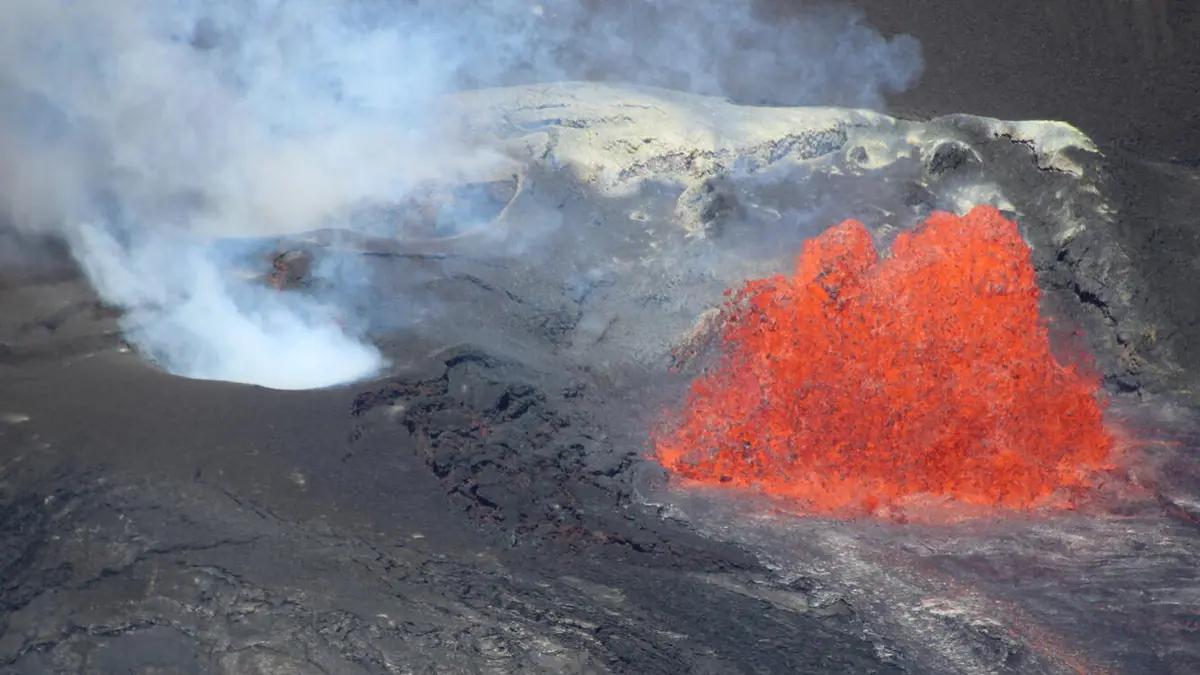
Episode 54 of lava fountaining at Kīlauea summit began on August 25, 2026. Credit: USGS
The physical meaning is straightforward: as magma accumulated beneath Halemaʻumaʻu, pressure increased and the ground above the summit magma system tilted outward and upward; when lava fountains released magma, the summit rapidly deflated.
Hawaiian Volcano Observatory scientists were able to use that repeating inflation-deflation cycle to issue forecast windows beginning with episode 5 in January 2025. The result matters for volcano monitoring because deformation supplied an operational signal before fountaining while the system continued to follow the same pattern.
Episodic lava fountaining remains poorly understood because the behavior is rare. Flinders et al. (2026) report only three previous occurrences at Kīlauea since 1823, leaving relatively few sustained sequences in which scientists can examine how pressure, magma movement and gas release interact before individual fountain episodes. The current eruption supplied dozens of repetitions of the same broad process instead of a single short-lived event.
A tiltmeter measures extremely small changes in the slope of the ground. At Kīlauea’s summit, upward movement in the UWD tiltmeter record is consistent with inflation of the summit magma system, while downward movement corresponds to deflation. A four-month HVO record shows strong deflation associated with fountain episodes 48 through 54, with the inflation-deflation cycles particularly clear around episodes 51 through 54.

HVO did not treat those measurements as exact eruption times. Forecast windows changed as the rate of summit inflation accelerated, slowed or temporarily reversed, allowing scientists to adjust the expected timing rather than assign a single predicted moment. The observations constrained when another fountain became more probable under a repeating deformation regime; they did not establish a general method for predicting volcanic eruptions.
The Science study combines geochemical, geophysical and geologic monitoring into a multiparameter record of the eruption. The authors report systematic correlations between summit inflation and lava fountaining and describe the observations as enabling quantitative forecasts. Fundamental questions remain about how magma-reservoir pressure, conduit permeability and volatile exsolution control the start of individual episodes.
The long sequence also gave scientists repeated observations across fountains of very different intensity. Episode 43 on March 10, 2026, produced a south-vent fountain reaching 540 m (1 770 feet), the highest verified fountain of the current eruption according to HVO. The approximately nine-hour episode deposited tephra across parts of Hawaiʻi Volcanoes National Park and temporarily affected access along parts of the park and Highway 11.
Episode 54 began at 10:30 LT on August 25, 2026, and ended at 19:33 LT after nine hours of continuous fountaining from the north vent. The fountain reached approximately 150 m (500 feet), while the eruption plume rose to about 5 200 m (17 000 feet) above sea level. HVO recorded about 12.7 microradians of deflationary tilt during the episode, providing another direct measurement of the summit’s response as magma was released.
The regular forecasting relationship did not continue unchanged after episode 54. By October, summit deformation had become irregular, even though pressure within the system remained high. HVO reported on October 9 that those irregular inflation and deflation patterns prevented scientists from modeling a new forecast window.
Kīlauea remained at Volcano Alert Level WATCH and Aviation Color Code ORANGE at 08:53 LT on October 9, 2026. HVO recorded seven shallow earthquakes across the summit during the preceding 24 hours and no appreciable tilt change at the Uēkahuna instrument, while sulfur dioxide emissions during pauses between episodes typically ranged from 1 000–5 000 tonnes per day.
The changing summit conditions have also affected access within Hawaiʻi Volcanoes National Park. Halemaʻumaʻu Trail and part of Byron Ledge Trail were closed on October 7, covering a combined 2.1 km (1.3 miles), after increased summit seismicity, continuing inflation and rockfall concerns. The National Park Service reported more than 200 shallow earthquakes beneath the summit during the previous week.
The present deformation pattern leaves an important scientific question open. The earlier sequence showed that a repeatable inflation-deflation cycle can provide useful timing information when Kīlauea’s summit magma system behaves consistently, but HVO cannot currently apply the same forecasting relationship. Another fountain episode, renewed intrusive activity beneath Kaluapele, or magma moving through existing weak crack systems within the summit region remain possible under the October 9 assessment.
References:
1 Flinders, A. F., Deligne, N. I., Hon, K., Downs, D. T., Lynn, K. J., Nadeau, P. A., Mulliken, K., Chang, J. C., Dotray, P. J., Bagnardi, M., Johanson, I. A., Zoeller, M. H., Anderson, K. R., Patrick, M. R., Kern, C., Sealing, C. R., Poland, M. P., Phillips, D., Cappos, M., DeSmither, L., Ellis, A. P., Fuke, S., Fukunaga, P., Hawk, M., Hoomanawanui, T.-J., Jamora, J., Kamakeʻeaina, A., Kamibayashi, K., Lowman, S., Tollett, W., Rubio, K., Swaney, S., Warren, S. M., Winslow, H., Bennington, N. L., Jolly, A., Adams, R. G., Decker, M., Forster, L., Gallant, E., Gansecki, C., Hazlett, R., Houghton, B. F., Kohagura, N., Lundblad, S., Pasqualon, N. G., Poepoe, K., Neuman, H., Cauley, C., & Wilde, K. (2026). Insights from more than a year of ongoing episodic lava fountaining at Kīlauea. Science, 394(6820), aef2931. https://www.science.org/doi/10.1126/science.aef2931

I’m a science journalist and researcher at The Watchers, contributing to the Epicenter edition, where I cover peer-reviewed scientific research and emerging discoveries across Earth and space sciences. With a background in astronomy and a passion for environmental science, I’ve worked in shark and coral conservation in Fiji, conducting reef and shark-behavior research, contributing to mangrove restoration, and earning PADI Open Water and Coral Reef Certifications. I bring a blend of scientific rigor and storytelling to illuminate the discoveries shaping our planet and beyond.

Commenting rules and guidelines
We value the thoughts and opinions of our readers and welcome healthy discussions on our website. In order to maintain a respectful and positive community, we ask that all commenters follow these rules.