
Hubble reveals evolving decagon around Saturn’s south pole
NASA/ESA Hubble Space Telescope observations have revealed an evolving 10-sided atmospheric wave encircling Saturn’s south pole, with the telescope’s archive tracing the feature back to 2023. The research places the wave near 63°S within a powerful atmospheric jet and shows that it extends through multiple levels of Saturn’s atmosphere. Its formation mechanism and long-term stability remain unresolved.
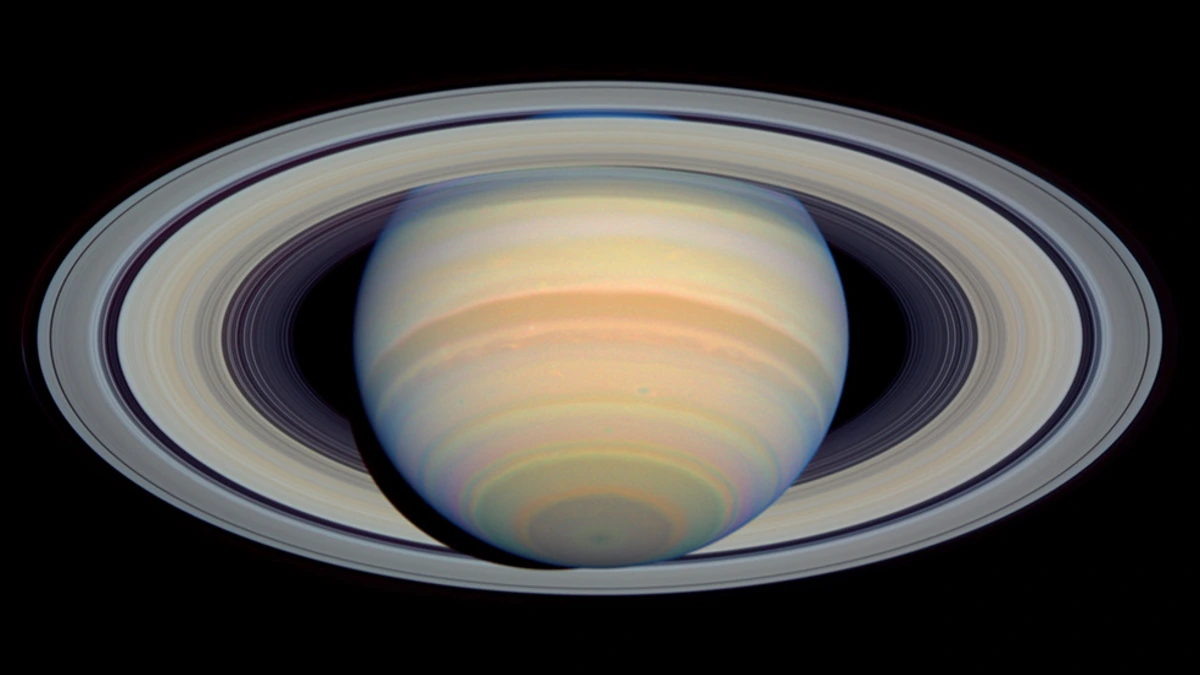
Saturn in visible light. Credit: NASA
The discovery grew from a combination of ground-based observations and Hubble data. Agustín Sánchez-Lavega of the University of the Basque Country and amateur astronomers Trevor Barry and Jean-Paul Oger noticed a subtle undulating band near Saturn’s south pole in images collected in 2024 through the university’s Planetary Virtual Observatory Laboratory, which accepts planetary images contributed by observers around the world. Ground-based observations obtained in 2025 strengthened the case for a polygonal structure, after which researchers examined earlier Hubble observations and confirmed that the feature was already present in 2023.
A particularly clear Hubble view was obtained with Wide Field Camera 3 on August 29, 2025. NASA/ESA observations place the wave around 63°S, embedded within one of Saturn’s powerful jet streams. Images obtained at different wavelengths show the apparent position of the decagon shifting slightly because each wavelength probes a different altitude in Saturn’s atmosphere. The observations establish that the pattern extends vertically through multiple atmospheric levels rather than being restricted to a single visible cloud layer.
The decagon is not stationary relative to Saturn. The study found that the pattern moves eastward at approximately 2.5 m/s (5.6 mph), substantially slower than the surrounding zonal jet, which reaches approximately 116 m/s (260 mph) near 60.5°S. The longitudes of the decagon’s vertices also oscillate with a period of about 32 days and amplitudes ranging from 4.6° to 8.4°, indicating more complex behavior than Saturn’s comparatively stable northern hexagon.
NASA and ESA describe the decagon as the first large, regular-sided jet pattern observed in Saturn’s southern hemisphere. Saturn’s north pole contains the better-known hexagonal atmospheric wave, which has been observed whenever conditions permitted for more than 40 years. Researchers have not established that the southern decagon shares the northern hexagon’s longevity or stability, and further observations are required to determine how the two structures compare.

NASA, ESA, STScI, A. Sánchez-Lavega (University of the Basque Country), A. Simon (NASA-GSFC), M. Wong (UC Berkeley); Image Processing: A. Pagan (STScI)
Researchers had searched for a southern counterpart for decades. Sánchez-Lavega said the team had examined Hubble images for such a feature since 1990 because Saturn has a broadly symmetrical north-south jet-stream system. NASA’s Cassini spacecraft, which orbited Saturn from 2004 to 2017, showed no sign of a comparable long-lived southern formation. Hubble now confirms that the decagon was present by 2023, but the observations do not establish an exact date when the structure formed.
Saturn’s changing seasons gradually brought the planet’s south-polar region back into better view from Earth, helping ground-based observers identify the structure. Hubble then provided sharper observations across complete rotations of Saturn without the atmospheric smearing that affects observations from Earth. The observations belong to Hubble’s Outer Planet Atmospheres Legacy program, or OPAL, which has photographed the outer planets annually for more than a decade and allows slowly evolving atmospheric features to be followed over several years.
Amy Simon, a study co-author and OPAL principal investigator at NASA’s Goddard Space Flight Center, said the feature has become stronger in successive observations, giving researchers an opportunity to observe a giant atmospheric pattern while it develops. The evidence supports an evolving structure, but it does not establish that scientists observed the decagon at the moment of its formation.

The process responsible for the decagon has not yet been established. NASA says additional observations with Hubble and the James Webb Space Telescope, together with analysis of computer models, are needed to determine how the wave formed, how long it may persist, and how it compares with Saturn’s northern hexagon. Researchers also plan to monitor whether the southern pattern settles into a stable, long-lived configuration or continues to change.
References:
1 Sánchez-Lavega, A., Simon, A. A., Wong, M. H., et al. (2026). A decagon wave around Saturn’s south pole. Science Advances, 12(36), eaee4251. https://www.science.org/doi/10.1126/sciadv.aee4251
2 NASA’s Hubble Tracks New Decagon Encircling Saturn’s South Pole – NASA Hubble Mission Team – September 2, 2026

I’m a science journalist and researcher at The Watchers, contributing to the Epicenter edition, where I cover peer-reviewed scientific research and emerging discoveries across Earth and space sciences. With a background in astronomy and a passion for environmental science, I’ve worked in shark and coral conservation in Fiji, conducting reef and shark-behavior research, contributing to mangrove restoration, and earning PADI Open Water and Coral Reef Certifications. I bring a blend of scientific rigor and storytelling to illuminate the discoveries shaping our planet and beyond.

Commenting rules and guidelines
We value the thoughts and opinions of our readers and welcome healthy discussions on our website. In order to maintain a respectful and positive community, we ask that all commenters follow these rules.