
Great Atlantic Sargassum Belt records second-largest year in 2026
The Great Atlantic Sargassum Belt reached its 2026 annual peak in June, making 2026 the second-highest Sargassum year in the continuous satellite record, behind 2025. The Caribbean Sea and Gulf of America (Gulf of Mexico) set June records. Mexico’s Instituto Oceanográfico del Golfo y Mar Caribe maintained a high Sargassum classification on August 26, with 29 920 metric tons (32 981 short tons) estimated in the Mexican Caribbean and substantial concentrations remaining farther east across the Caribbean and western central Atlantic.
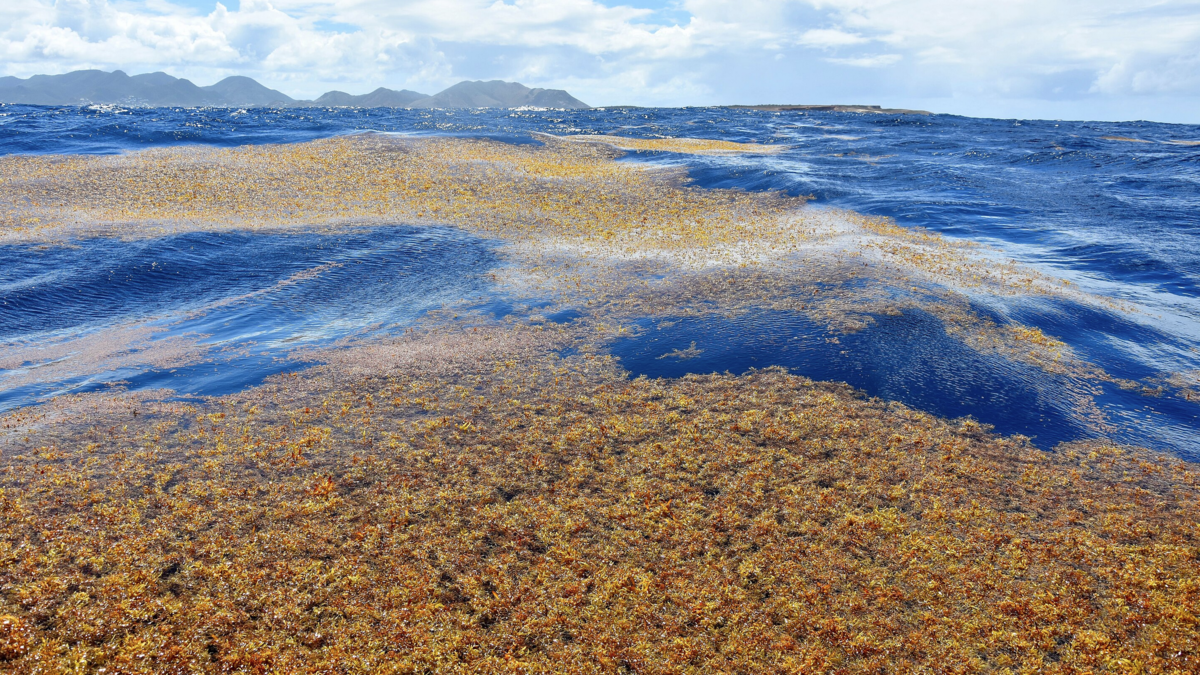
Large patches of Sargassum adrift near the island of Saint Martin. Credit: VELY Michel
NASA Earth Observatory reported that the western Caribbean contained 3.6 million metric tons (4 million short tons) of Sargassum in June, while the eastern Caribbean contained 9 million metric tons (9.9 million short tons). The Gulf contained 5 million metric tons (5.5 million short tons), nearly twice its previous June record, set in 2025.
Satellite observations showed Sargassum abundance declining through July after the June peak. The decrease followed a rapid buildup during the first four months of 2026 and the largest June concentrations observed in the Caribbean Sea and Gulf during the satellite era.
The Oceanographic Institute of the Gulf and Caribbean Sea (IOGMC), part of Mexico’s Secretariat of the Navy, estimated 29 920 metric tons (32 981 short tons) of Sargassum in the Mexican Caribbean from satellite observations dated August 25. Its August 26 bulletin maintained a high Sargassum classification and tracked the nine groups nearest the Quintana Roo coast.

Seven of the nine groups were projected to have a probability or possibility of coastal arrival within 24 hours, including areas south of Punta Nizuc and Cancún, Puerto Morelos, Xcacel, Cozumel, Tulum, Puerto Aventuras and Mahahual. Two groups had 24-hour displacement trajectories without a probability of coastal arrival.
The same assessment estimated 28 708 metric tons (31 645 short tons) in the central Caribbean, 92 501 metric tons (101 965 short tons) in the eastern Caribbean west of the Lesser Antilles and 75 879 metric tons (83 642 short tons) in the western central Atlantic. The measurements show substantial Sargassum remaining across the region despite the basin-scale decline after the June peak.
IOGMC’s annual comparison graph placed the 2026 Mexican Caribbean maximum at 90 538 metric tons (99 801 short tons), above the 86 074 metric tons (94 880 short tons) maximum shown for 2025. The comparison also includes 63 253 metric tons (69 724 short tons) in 2022 and 54 198 metric tons (59 743 short tons) in 2018.

NASA’s June 2026 map was produced from measurements by the Ocean Color Instrument (OCI) aboard the PACE satellite. Sargassum reflects more near-infrared sunlight than seawater because of its plant structure and chlorophyll pigments. Scientists use that spectral signal to estimate the fraction of the ocean surface covered by Sargassum within individual satellite pixels and convert those density estimates into wet biomass.
The historical ranking comes from the continuous MODIS satellite record, which extends back to March 2000. The series shows a sustained increase beginning around 2011 as the Great Atlantic Sargassum Belt developed across the tropical Atlantic. The existing satellite-record maximum occurred in July 2025.
A peer-reviewed study published in Nature Communications on April 18, 2026, examined how the processes sustaining the Great Atlantic Sargassum Belt have changed since its emergence. Xing Zhou, Lyuba Novi and colleagues developed a nonlinear regression model using observations from 2011–2022 and tested its predictions against Sargassum observations from 2023 and 2024.
The model linked the belt’s early development to a prolonged negative phase of the North Atlantic Oscillation, stronger winds, and deeper winter mixed layers that increased nutrient supply to surface waters. The modeled contribution from mixed-layer deepening declined after 2018, while nutrient recycling associated with organisms living within and around Sargassum mats increased and became the dominant nutrient source in the model during more recent years.
The researchers also examined nitrogen-isotope measurements to assess nutrient recycling within the biological community associated with Sargassum. The measurements supported the Sargassumsphere hypothesis, in which organisms associated with the mats recycle nitrogen within the mixed layer, making nutrients available to Sargassum.
The study reports that the Great Atlantic Sargassum Belt exceeded 20 million metric tons (22 million short tons) at its monthly peak every year from 2018 through 2025 and stretched more than 8 000 km (4 971 miles) across the tropical Atlantic during peak conditions. Sargassum abundance exceeded 30 million metric tons (33.1 million short tons) in 2025.
Moderate amounts of floating Sargassum in the open ocean provide habitat for turtles, fish, birds and invertebrates and add oxygen to the water through photosynthesis. Excessive accumulations near shore can tangle and suffocate marine life, while mats that sink can smother corals and seagrasses. Sargassum decomposing on beaches releases hydrogen sulfide and can affect coastal ecosystems and tourism.
Ocean currents and winds shape the location and movement of Sargassum across the tropical Atlantic. Satellite observations show that the basin-scale abundance has declined since June, while the August 21 regional measurements show large concentrations remaining across parts of the Caribbean and western central Atlantic.
References:
1 Sizing Up the Sargassum Belt – NASA Earth Observatory – July 29, 2026
2 Boletín I.O.G.M.C. Núm. 1532/22 de agosto del 2026 – Instituto Oceanográfico del Golfo y Mar Caribe, Secretaría de Marina – August 22, 2026
3 Zhou, X., Novi, L., Hay, M. E., Montoya, J. P., Aliu, A., Realff, M. J., & Bracco, A. (2026). Changing drivers of the Great Atlantic Sargassum Belt from physical forcing to ecological control. Nature Communications, 17, 4600. https://doi.org/10.1038/s41467-026-72183-4

I’m a science journalist and researcher at The Watchers, contributing to the Epicenter edition, where I cover peer-reviewed scientific research and emerging discoveries across Earth and space sciences. With a background in astronomy and a passion for environmental science, I’ve worked in shark and coral conservation in Fiji, conducting reef and shark-behavior research, contributing to mangrove restoration, and earning PADI Open Water and Coral Reef Certifications. I bring a blend of scientific rigor and storytelling to illuminate the discoveries shaping our planet and beyond.

Commenting rules and guidelines
We value the thoughts and opinions of our readers and welcome healthy discussions on our website. In order to maintain a respectful and positive community, we ask that all commenters follow these rules.