
Global fault survey reveals how much the Moon contracted during its late evolution
A global analysis of young thrust faults estimates that the Moon’s radius decreased by about 42–46 m (138–151 feet) during its late-stage contraction as the lunar interior cooled. The mapped deformation preserves substantially less contraction than some thermal-evolution models produce, leaving an unresolved gap between the Moon’s visible tectonic record and its modeled cooling history.
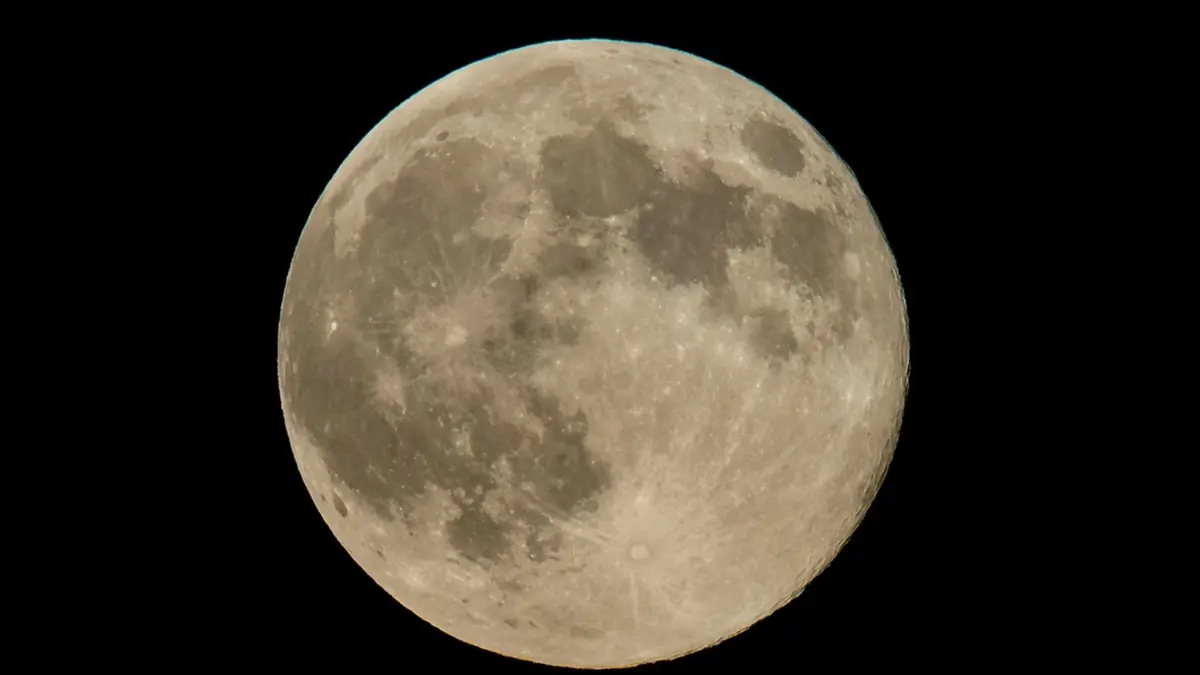
A perigee full moon or supermoon is seen, Sunday, August 10, 2014, in Washington. A supermoon occurs when the moon’s orbit is closest (perigee) to Earth at the same time it is full. Credit: NASA/Bill Ingalls
Thomas R. Watters of the Smithsonian Institution and coauthors Maria E. Banks, Cole A. Nypaver and Mark S. Robinson reconstructed the contraction from faults mapped in images obtained by the Lunar Reconnaissance Orbiter Camera (LROC). The paper describes more than 8 900 lobate thrust-fault scarps and combines the deformation recorded in the lunar highlands with small thrust faults expressed as mare ridges; a Smithsonian release accompanying the study describes the combined population as more than 10 000 young faults.
A thrust fault forms when compression pushes one block of crust up and over another. On the Moon, that shortening produces low cliff-like landforms known as lobate scarps. The researchers used the accumulated shortening recorded by these structures to estimate how much the lunar surface area, and therefore the Moon’s radius, decreased during this late stage of its geological evolution.
The combined highland and mare fault populations yield estimated global areal contractional strain of approximately 0.0048%–0.0053%. Depending on the assumed angle of the faults beneath the surface, that strain corresponds to a decrease in lunar radius of about 42–46 m (138–151 feet). For a 30° fault dip, the calculation gives approximately 44 m (144 feet).

Most of the calculated contraction is recorded in the lunar highlands. The researchers estimated highland areal contractional strain of approximately 0.0050%–0.0055%, while the mare faults add a much smaller contribution. Their inclusion matters because those small contractional structures were not incorporated into earlier global radius-change estimates.
The expanded fault inventory also changes the observational basis for earlier estimates. Work based on Apollo Panoramic Camera coverage of roughly 10% of the lunar surface produced an extrapolated radius decrease of about 70 m (230 feet). A later estimate based on an early Lunar Reconnaissance Orbiter inventory produced a value near 25 m (82 feet). The new analysis draws on a much larger global population rather than extrapolating from comparatively limited coverage.
The rate of contraction is less directly constrained than the total deformation. If the mapped faulting accumulated uniformly during the past 400 million years, Watters and colleagues calculate a maximum average radius decrease of about 11 cm per million years. If the relevant interval extends to approximately 800 million years, the average is closer to 6 cm per million years. These are inferred long-term averages based on assumed timescales, not measurements of the Moon shrinking by a directly observed amount each year.

Cooling provides the physical basis for the contraction. As heat escapes from the lunar interior, its volume decreases and compressional stress accumulates in the outer rigid shell. When that stress exceeds the strength of the crust, movement can occur on thrust faults and produce the scarps mapped from orbit.
The deformation represented by the young faults corresponds to an estimated isotropic compressional stress of about 4 MPa under the mechanical assumptions used in the paper. The researchers compare that value with stress drops of generally a few megapascals estimated for shallow moonquakes recorded by the Apollo Passive Seismic Network. The comparison connects the amount of contraction preserved at the surface with the scale of stresses associated with lunar seismic activity, although it does not demonstrate that every mapped fault is presently active.
The larger scientific issue is how little contraction the young fault record appears to contain compared with some models of lunar thermal evolution. Those models can produce much greater cumulative decreases in lunar radius. If such contraction had been widely accommodated by thrust faulting, the lunar highlands should preserve a larger population of old, heavily degraded contractional scarps. That expected ancient record has not been identified at the required scale.

Watters and colleagues discuss more than one explanation. One involves a nonmonotonic thermal history in which a thick, porous layer of impact-fragmented material, or megaregolith, altered how efficiently heat escaped from the Moon. In physical terms, such an insulating layer can change the timing and magnitude of cooling, expansion and contraction predicted by thermal models. The mapped faults constrain those histories, but they do not directly reconstruct temperatures deep inside the ancient Moon.
A second possibility is mechanical rather than primarily thermal. A sufficiently strong elastic lithosphere could have stored compressional stress without widespread faulting for a long interval. Fault formation would then have accelerated only after accumulated stresses became large enough to overcome the strength of the lithosphere. The paper presents these alternatives as interpretations that could reconcile the surface record with thermal evolution, not as uniquely demonstrated explanations.
The fault system also has a secondary connection to future lunar exploration. NASA reported in 2024 that young thrust faults occur near parts of the lunar south polar region being studied for exploration and that modeled shallow moonquakes can produce strong ground shaking and destabilize regolith on some steep slopes. That earlier work does not mean the 2026 contraction estimate establishes an immediate hazard at a particular landing site; it shows why the tectonic system matters when assessing long-lived infrastructure and future surface operations.
A major uncertainty remains the present-day behavior of individual faults. Orbital images can establish where young scarps occur and how much deformation they preserve, but imagery alone cannot determine how frequently particular faults rupture now. NASA researchers have called for new seismic measurements beyond the sparse Apollo-era network, including globally distributed observations, to determine where moonquakes originate and how active the lunar fault system remains.
References:
1 Watters, T. R., Banks, M. E., Nypaver, C. A., & Robinson, M. S. (2026). Thrust faulting and the late-stage contraction of the Moon. The Planetary Science Journal, 7, 239. doi:10.3847/PSJ/ae9eae. https://doi.org/10.3847/PSJ/ae9eae
2 New Study Reveals How Much the Moon Is Shrinking – Smithsonian Institution – October 14, 2026

I’m a science journalist and researcher at The Watchers, contributing to the Epicenter edition, where I cover peer-reviewed scientific research and emerging discoveries across Earth and space sciences. With a background in astronomy and a passion for environmental science, I’ve worked in shark and coral conservation in Fiji, conducting reef and shark-behavior research, contributing to mangrove restoration, and earning PADI Open Water and Coral Reef Certifications. I bring a blend of scientific rigor and storytelling to illuminate the discoveries shaping our planet and beyond.

Commenting rules and guidelines
We value the thoughts and opinions of our readers and welcome healthy discussions on our website. In order to maintain a respectful and positive community, we ask that all commenters follow these rules.