
First confirmed landslides discovered on Pluto, revealing a missing chapter in the dwarf planet’s geological history
Scientists have identified the first confirmed landslides on Pluto, according to a study published in Icarus on June 18, 2026, providing the first direct evidence that gravity-driven slope failures have helped shape the surface of one of the Solar System’s most distant and geologically complex worlds. Based on a reanalysis of data from NASA’s New Horizons mission, the researchers identified six large landslides near Sputnik Planitia, filling a long-standing gap in scientists’ understanding of surface processes on icy bodies in the Kuiper Belt.
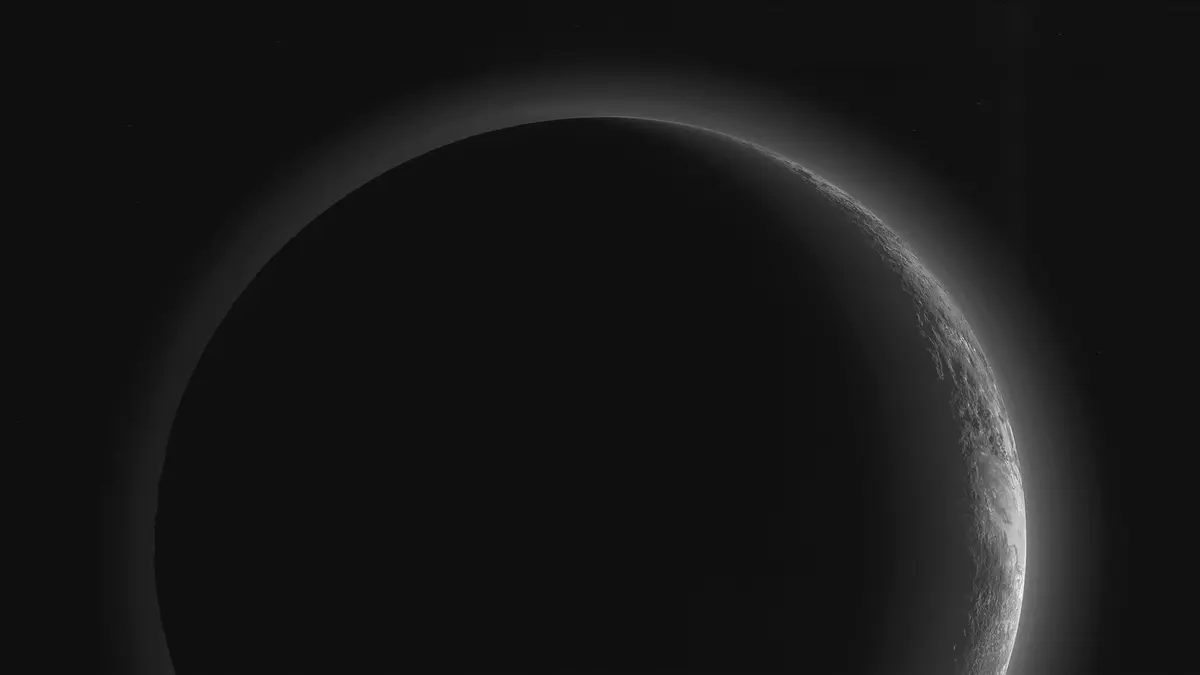
In September, NASA's New Horizons team released a stunning but incomplete image of Pluto's crescent. Credit: NASA
Landslides are among the most common geomorphological features across the Solar System, having been documented on rocky planets, moons, asteroids, comets and icy worlds. Yet despite years of study following NASA’s New Horizons flyby in 2015, Pluto remained one of the few explored planetary bodies where landslides had never been unambiguously confirmed.
Previous studies had identified lobate debris aprons along the western margin of Sputnik Planitia and investigated large chains of mountain blocks thought to have been mobilized by condensed nitrogen ice. While both features point to active surface processes, neither met the geomorphological criteria required to classify them as true landslides.
The new study, led by Marco Emanuele Discenza, changes that picture.
Re-examining high-resolution images acquired by the Long-Range Reconnaissance Imager (LORRI) aboard New Horizons, together with digital elevation models produced from LORRI and Multispectral Visible Imaging Camera (MVIC) observations, the researchers identified six landslides along the inner rims of three impact craters bordering Sputnik Planitia, Pluto’s vast, geologically young nitrogen-ice basin.
One landslide was identified within Coughlin crater, two within Giclas crater and three within a nearby unnamed crater. The researchers deliberately limited their inventory to landforms that could be unequivocally interpreted as landslides using the currently available imagery. They note that additional mass-movement features are present nearby but cannot yet be classified confidently because of image-resolution limitations.
The identified features display the classic characteristics of large landslides. They include well-defined head scarps, distinct source areas, lobate and elongated deposits, hummocky distal margins, secondary scarps, surface striations and graben-like structures. Together, these geomorphological signatures distinguish the landforms from surrounding undisturbed slopes and provide the first clear evidence of gravitational slope failure on Pluto.
The mapped landslides are large features, with vertical drops ranging from 1.5 ± 0.2 km (0.93 ± 0.12 miles) to 2.2 ± 0.2 km (1.37 ± 0.12 miles), runout distances between 10.1 ± 0.6 km (6.3 ± 0.4 miles) and 14.5 ± 0.6 km (9.0 ± 0.4 miles), and mapped surface areas reaching approximately 129.3 ± 13.2 km² (49.9 ± 5.1 mi²).
To characterize how efficiently the landslides traveled downslope, the team calculated Heim’s ratio, a commonly used measure of apparent friction. The results indicate that Pluto’s landslides are highly mobile, comparable to the most mobile landslides documented on Mars, Ceres and Pluto’s largest moon, Charon. The findings suggest that once slope failure begins, material on Pluto can travel remarkably long distances despite the dwarf planet’s extremely cold environment.
What triggered the landslides remains uncertain. The researchers identify several possible mechanisms, including tectonic activity, meteoroid impacts, cryovolcanism, erosion, slope unloading, seasonal temperature changes and geothermal heating. Of the six landslides, only one, designated LD1, shows possible evidence of a direct trigger. A younger impact crater partly deforms the western rim of Coughlin crater and may have destabilized the pre-existing slope, initiating the collapse.
Unlike most airless bodies, Pluto contains abundant volatile ices, including nitrogen (N₂), carbon monoxide (CO) and methane (CH₄), which continuously sublimate and condense as the dwarf planet progresses through seasonal climate cycles. The researchers suggest these volatile materials may modify the mechanical properties of surface layers and influence landslide behavior. They note that geothermal heating capable of sublimating subsurface volatile ices could weaken material at depth and promote slope failure, although the available data do not allow the triggering mechanism to be determined.
The study highlights an important limitation. New Horizons was a flyby mission, and the available images have a spatial resolution of approximately 300 m (984 feet) per pixel, with digital elevation models accurate to about 100 m (328 ft) vertically. While sufficient to identify the six confirmed landslides, these data do not allow smaller or less distinct mass-movement features elsewhere on Pluto to be mapped confidently.
Rather than representing a complete inventory, the six mapped landslides should therefore be viewed as the first confirmed examples currently visible in the available dataset. Additional landslides may await discovery in higher-resolution observations from future missions.
The findings add Pluto to the growing list of Solar System bodies where landslides have been conclusively identified and provide the first direct evidence that gravitational slope processes contribute to shaping the surface of this distant Kuiper Belt world. They expand scientists’ understanding of how landscapes evolve on icy planetary bodies, reinforcing the view that Pluto remains one of the Solar System’s most geologically diverse and unexpectedly active worlds.
Reference:
1 Discenza, M. E., Brunetti, M. T., Minnillo, M., Grundy, W., & Komatsu, G. (2026). First geomorphological evidence of landslides on Pluto. Icarus. Advance online publication. https://doi.org/10.1016/j.icarus.2026.117210

I’m a science journalist and researcher at The Watchers, contributing to the Epicenter edition, where I cover peer-reviewed scientific research and emerging discoveries across Earth and space sciences. With a background in astronomy and a passion for environmental science, I’ve worked in shark and coral conservation in Fiji, conducting reef and shark-behavior research, contributing to mangrove restoration, and earning PADI Open Water and Coral Reef Certifications. I bring a blend of scientific rigor and storytelling to illuminate the discoveries shaping our planet and beyond.

Commenting rules and guidelines
We value the thoughts and opinions of our readers and welcome healthy discussions on our website. In order to maintain a respectful and positive community, we ask that all commenters follow these rules.