
Fani Maoré lavas reveal isotope signature dating to Earth’s first 100 million years
High-precision neodymium isotope measurements from recently erupted lavas at the submarine Fani Maoré volcano near Mayotte in the Comoros archipelago revealed a positive 142Nd anomaly indicating that their mantle source contains material formed within the first 100 million years of Earth’s history, according to a study published in Nature on July 1, 2026. Israel et al. (2026) interpret the anomaly as evidence for preserved Hadean material and favor bridgmanite crystallized from an early deep magma ocean as its main component.
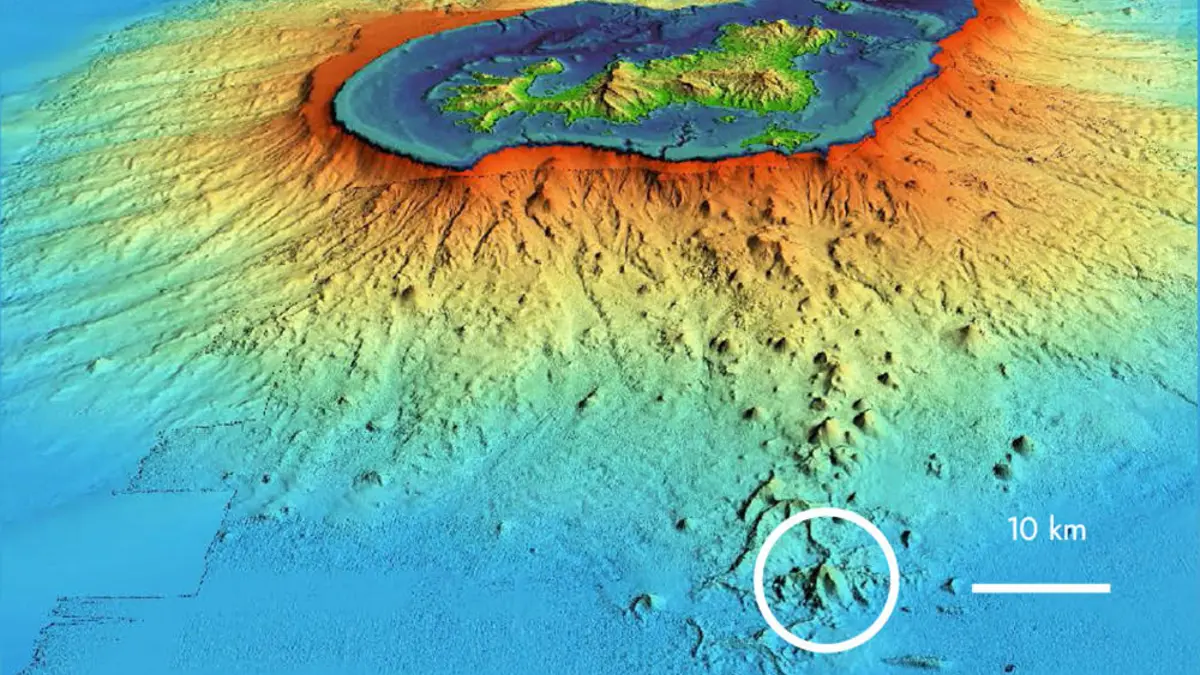
In May 2019, data from the MAYOBS scientific campaign showed that the submarine volcano, located about 50 km (31 miles) from Mayotte, had built an edifice just over 800 m (2 625 feet) high and was showing intense activity at a depth of about 3 500 m (11 483 feet). The volcano is circled in the image. Credit: IPGP
No 4-billion-year-old bridgmanite crystals were recovered directly from Fani Maoré. The observation is a neodymium isotope anomaly in modern volcanic rocks. Its mineralogical source was reconstructed from isotope evolution, high-pressure partitioning experiments and mass-balance calculations.
The significance of that anomaly lies in its age. Earth’s mantle has undergone more than 4 billion years of convection, melting and chemical mixing, so a detectable chemical signature inherited from the Hadean indicates that some material formed during the planet’s earliest differentiation survived without being completely homogenized.
Fani Maoré formed during submarine volcanism between June 2018 and January 2021 about 55 km (34 miles) east of Mayotte. Israel and colleagues analyzed 13 basanites from the new volcano and eight rocks from the eastern flank of Petite-Terre, Mayotte, collected during MAYOBS oceanographic campaigns between 2018 and 2021. All 21 samples were processed at the Institut de Physique du Globe de Paris (IPGP).
The expected differences in 142Nd are extremely small — only a few parts per million — so testing for such an ancient signal required measurements precise enough to distinguish those differences from analytical variation.
Using thermal ionization mass spectrometry and a five-line multi-dynamic neodymium isotope method, the team achieved two-year long-term reproducibility of 3.1 ppm at two standard deviations for 142Nd/144Nd in the reference material. The eight Mayotte samples averaged μ142Nd = +1.3 ± 1.3 ppm at two standard errors. The 13 Fani Maoré basanites averaged +3.2 ± 0.9 ppm.
Fani Maoré samples were statistically distinct from the JNdi-1 reference, measured at 0 ± 0.7 ppm in the comparison used by the authors. A t-test returned P = 8.9 × 10⁻⁶. Mayotte samples did not show the same separation from JNdi-1, with P = 0.14. Israel et al. interpret the positive Fani Maoré value as evidence for material with an elevated Sm/Nd ratio that formed during the Hadean and remained isolated in the mantle for at least 4.3 billion years.
Neodymium can preserve information from this interval because 146Sm, the radioactive parent of 142Nd, was present only during the early history of the Solar System. Differences in Sm/Nd established while 146Sm was still present could therefore leave a 142Nd signature that survives long after the parent isotope disappeared.
That age constraint comes from the 146Sm–142Nd isotope system. 146Sm has a half-life of 92 million years, allowing early differences in Sm/Nd to generate differences in 142Nd while enough 146Sm remained. As 146Sm decayed, later differentiation produced progressively less additional 142Nd. In the authors’ calculations, crystallization after about 4.35 billion years ago produces little additional 142Nd.
To identify a source capable of producing the Fani Maoré composition, Israel and colleagues modeled crystallization of a deep terrestrial magma ocean. Bridgmanite was among the dominant minerals expected to crystallize from the deep mantle. Samarium and neodymium enter bridgmanite and melt in different proportions, allowing early solids to develop Sm/Nd ratios that later produce positive 142Nd values.
Bridgmanite is the dominant mineral of Earth’s lower mantle. In the authors’ model, its crystallization from an early magma ocean provides a mechanism for separating samarium from neodymium strongly enough to generate the ancient isotope signature detected in the modern lavas.
The team tested that partitioning experimentally with laser-heated diamond-anvil cells. Pressures ranged from 53 GPa at 3 200 K to 97 GPa at 3 700 K. The experiments yielded partition coefficients of D(Nd) = 0.24 ± 0.12 and D(Sm) = 0.45 ± 0.10.
The 53–97 GPa range describes laboratory conditions used to reproduce mineral-melt behavior during deep magma-ocean solidification. It is not a measurement of the present depth or pressure of the Fani Maoré magma source. The measurements constrain how Sm and Nd would have separated during primordial mantle crystallization.
The calculations track bridgmanite-rich solids formed as a deep magma ocean crystallized at 4.46 ± 0.05 billion years ago. Depending on the crystallization stage, those solids develop strongly positive present-day μ142Nd and ε143Nd values. A comparatively small ancient contribution can therefore shift the isotope composition of a younger mantle source.
The next question was how much of this ancient material would be required in the source of Fani Maoré. The answer depends on which neodymium isotope system is used, because 142Nd records very early differentiation while 143Nd continued evolving over much longer geological timescales.
Mixing ordinary mantle with 8–10 ± 3% Hadean bridgmanite-rich material reproduces the mean Fani Maoré μ142Nd value of +3.2. The same two-component mixture fails to reproduce the measured ε143Nd composition. Matching ε143Nd alone requires only 2–3 ± 1% of the Hadean component.
Under the study’s non-chondritic bulk-silicate-Earth calculation, about 0.4% recycled sedimentary material reconciles the 142Nd and 143Nd constraints. The resulting Hadean bridgmanite-rich fraction is about 9–11%. A separate calculation using a chondritic Earth composition reduces the difference between the 142Nd- and 143Nd-based mixtures and does not require the recycled sediment component.
Bridgmanite-rich material remains a source interpretation derived from isotope measurements, experiments and mixing calculations, not an observed ancient mineral inclusion in the sampled lava. Its calculated proportion changes with assumptions about magma-ocean crystallization age and early mantle composition.
The authors therefore also examined whether a different Hadean process could produce the same signal, rather than assuming that deep magma-ocean crystallization was the only possible explanation.
Israel and colleagues also tested a shallower Hadean source produced by early extraction of continental crust. For the 142Nd anomaly alone, that calculation requires about 26% Hadean material if the reservoir formed 4.46 billion years ago and about 70% if it formed 4.3 billion years ago. Adding the enriched component required to satisfy the wider neodymium isotope system raises the Hadean depleted-mantle contribution to about 28–90%. The non-chondritic deep-magma-ocean calculation requires about 9–11%.
A shallow reservoir containing such a large fraction of Hadean material would have to survive more than 4 billion years of mantle circulation. Israel et al. regard that preservation scenario as less probable than retention of a smaller deep component. Geodynamic work cited in the study shows that a fraction of early magma-ocean solids can survive later mantle convection.
Positive μ142Nd anomalies have also been reported from ocean-island basalts at Réunion, Iceland and Pitcairn. Israel et al. note that analytical precision limited interpretation of those earlier measurements. Their Fani Maoré dataset reaches long-term reproducibility of 3.1 ppm and statistically separates the volcanic samples from the terrestrial reference material.
If similar signals are confirmed elsewhere, they could show that remnants of Earth’s earliest differentiation are not confined to a single mantle source and may persist beneath several volcanic regions.
A larger set of high-precision measurements from ocean-island basalts would test whether comparable Hadean components occur in other plume sources. The Fani Maoré 142Nd excess itself records chemical heterogeneity produced during Earth’s earliest history and preserved through billions of years of mantle evolution, regardless of whether the surviving reservoir ultimately proves to be the bridgmanite-rich deep component favored by the authors or another Hadean source.
References:
1 Israel, C., Chauvel, C., Inglis, E., Chen, H., Hébert, C., & Badro, J. (2026). Hadean bridgmanite in the source of a present-day ocean island. Nature, 655(8122), 389–393. https://doi.org/10.1038/s41586-026-10719-w
2 A remnant from Earth’s early history identified in an active volcano near Mayotte – Institut de Physique du Globe de Paris – July 10, 2026

I’m a science journalist and researcher at The Watchers, contributing to the Epicenter edition, where I cover peer-reviewed scientific research and emerging discoveries across Earth and space sciences. With a background in astronomy and a passion for environmental science, I’ve worked in shark and coral conservation in Fiji, conducting reef and shark-behavior research, contributing to mangrove restoration, and earning PADI Open Water and Coral Reef Certifications. I bring a blend of scientific rigor and storytelling to illuminate the discoveries shaping our planet and beyond.

Commenting rules and guidelines
We value the thoughts and opinions of our readers and welcome healthy discussions on our website. In order to maintain a respectful and positive community, we ask that all commenters follow these rules.