
ESA’s FLEX reaches orbit to reveal the secret glow of plants
The European Space Agency’s (ESA) FLEX satellite is now in orbit after launching with Copernicus Sentinel-3C from French Guiana at 01:21 UTC on September 15, 2026. FLEX was built to measure solar-induced chlorophyll fluorescence (SIF), the extremely faint light emitted by vegetation as chlorophyll absorbs sunlight during photosynthesis, giving scientists a new way to observe how plants are functioning from space.
FLEX and Sentinel-3C lift off. Credit: ESA
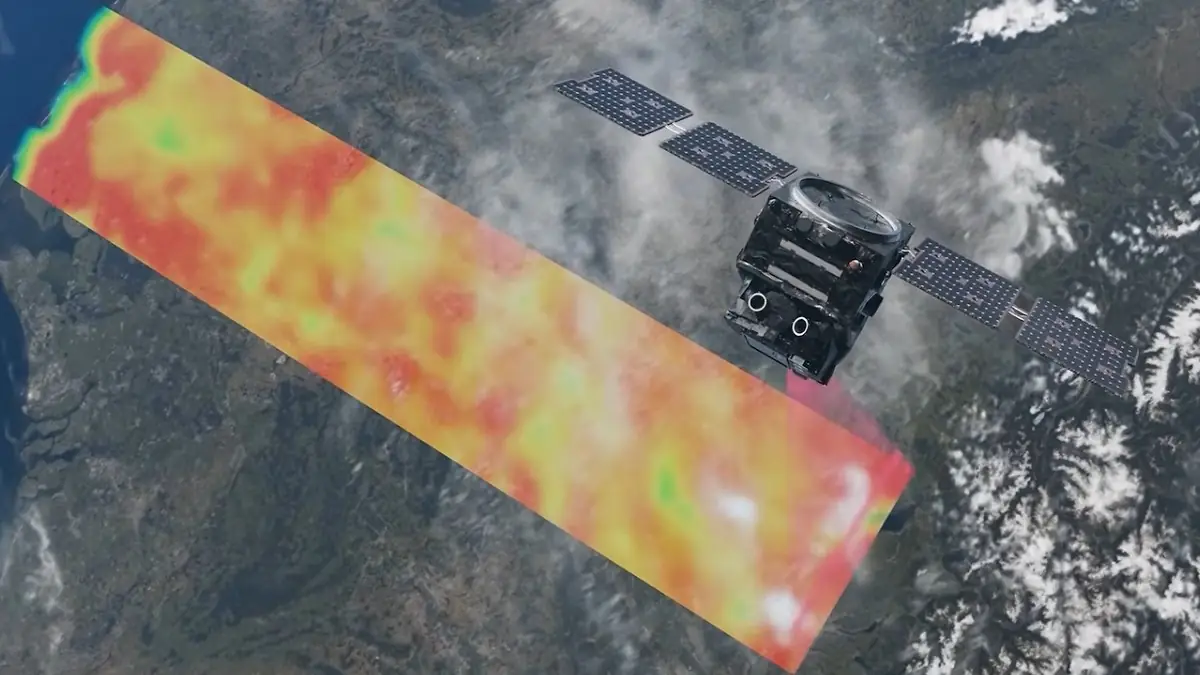
The European Space Agency’s FLEX mission is designed to detect a faint fluorescence signal emitted by vegetation, a measurement that goes beyond what conventional optical satellites can provide. While those instruments describe vegetation cover and greenness, fluorescence carries information directly connected to the functioning of photosynthesis itself.
ESA intends FLEX to use that signal to quantify photosynthetic activity and vegetation stress on a global scale, including responses to environmental pressures such as drought and heat, while improving understanding of how vegetation participates in Earth’s carbon and water cycles. Because photosynthesis itself cannot be measured directly from orbit, FLEX measures fluorescence that can be converted into indicators of photosynthetic activity.
Flight VV30 lifted off from Europe’s Spaceport in Kourou at 22:21 local time on September 14 (01:21 UTC on September 15). Sentinel-3C separated first, and FLEX followed approximately one hour later. ESA’s European Space Operations Centre subsequently received signals from both spacecraft, confirming their safe separation and contact with ground control.
The physical signal FLEX is looking for begins when chlorophyll absorbs sunlight. Most of that captured energy is used in photochemistry or dissipated as heat, while a small fraction is re-emitted at longer wavelengths as fluorescence. That glow is far too faint for human vision, but its spectral behavior changes as the photosynthetic system responds to environmental conditions.
This does not make fluorescence a simple plant-stress meter. Drought, frost and other stresses can alter how absorbed energy is divided among photochemistry, heat dissipation and fluorescence, and different physiological responses can produce different fluorescence behavior. ESA notes that fluorescence interpretation also depends on the condition of the photosynthetic machinery, making atmospheric, structural and environmental context necessary before changes in the signal can be interpreted physically.

FLEX carries a single main scientific instrument, the Fluorescence Imaging Spectrometer (FLORIS), covering wavelengths from 500–780 nm. Its spectral sampling becomes particularly fine around key absorption bands, allowing scientists to separate the weak fluorescence contribution from the much stronger sunlight reflected by Earth’s surface and atmosphere. The FLEX mission concept described by Drusch et al. (2017) was designed around this high-spectral-resolution approach to retrieve the fluorescence spectrum emitted by terrestrial vegetation.
That separation problem is one reason FLEX does not work alone. The satellite will initially fly in tandem with Sentinel-3A, with Sentinel-3C planned to replace it later. Sentinel-3 supplies measurements of clouds, aerosols, water vapor, surface temperature, land cover and other vegetation properties close in time to FLEX observations. Those measurements help researchers determine whether a change in the fluorescence signal comes from plant physiology, atmospheric conditions or characteristics of the surface being observed.
ESA plans monthly global vegetation-fluorescence maps with a spatial resolution of approximately 300 m × 300 m (984 × 984 feet). FLEX’s nominal Sun-synchronous orbit is approximately 814 km (506 miles) above Earth, with a 27-day repeat cycle and a nominal mission life of 3.5 years plus commissioning.
The spatial scale means FLEX is not designed to diagnose the condition of individual plants. Each measurement integrates the behavior of vegetation across an area roughly the size of several city blocks. The scientific objective is therefore larger: to follow how forests, grasslands, croplands and other terrestrial ecosystems change across regions and seasons, and to constrain how photosynthetic activity responds to water availability, temperature and other environmental controls.

The mission also addresses a long-standing observational gap. Scientists have been able to infer vegetation state from color, reflectance, temperature and other remotely sensed properties for decades, while measurements of solar-induced fluorescence from earlier instruments demonstrated that the signal could be detected from orbit. FLEX is the first ESA satellite specifically designed around global vegetation-fluorescence measurements rather than acquiring them as a secondary capability. ESA selected the mission in 2015 after the scientific concept had been developed through years of ground, airborne, and satellite research.
Drusch et al. (2017) described the tandem FLEX–Sentinel-3 architecture as a way to retrieve and interpret the full chlorophyll-fluorescence spectrum at spatial and spectral scales suitable for terrestrial vegetation studies. The paper established the mission concept and scientific requirements rather than reporting observations from FLEX itself; the measurements described in the new mission will have to be calibrated and validated before the scientific performance envisioned in that work can be assessed.
That distinction is important now that FLEX has reached orbit. The launch establishes the observing capability, not its scientific results. Commissioning, instrument calibration and comparison with ground, airborne and other satellite observations must come before researchers can determine how accurately FLEX retrieves fluorescence and how reliably those measurements constrain photosynthetic activity across different ecosystems.
The main scientific question is whether measurements of a signal that is only a small fraction of reflected sunlight can be retrieved consistently enough, across different atmospheres, vegetation structures and environmental conditions, to reveal changes in ecosystem function that conventional Earth-observation measurements cannot resolve on their own. FLEX’s first calibrated observations and their validation will provide the first operational test of that premise.
References:
1 Drusch, M., Moreno, J., Del Bello, U., Franco, R., Goulas, Y., Huth, A., Kraft, S., Middleton, E. M., Miglietta, F., Mohammed, G., Nedbal, L., Rascher, U., Schüttemeyer, D., & Verhoef, W. (2017). The FLuorescence EXplorer Mission Concept—ESA’s Earth Explorer 8. IEEE Transactions on Geoscience and Remote Sensing, 55(3), 1273–1284. https://doi.org/10.1109/TGRS.2016.2621820
2 FLEX and Sentinel-3C launched – ESA – September 15, 2026

I’m a science journalist and researcher at The Watchers, contributing to the Epicenter edition, where I cover peer-reviewed scientific research and emerging discoveries across Earth and space sciences. With a background in astronomy and a passion for environmental science, I’ve worked in shark and coral conservation in Fiji, conducting reef and shark-behavior research, contributing to mangrove restoration, and earning PADI Open Water and Coral Reef Certifications. I bring a blend of scientific rigor and storytelling to illuminate the discoveries shaping our planet and beyond.

Commenting rules and guidelines
We value the thoughts and opinions of our readers and welcome healthy discussions on our website. In order to maintain a respectful and positive community, we ask that all commenters follow these rules.