
AI model forecasts solar active region emergence more than 9 hours in advance
An artificial intelligence model using observations from NASA’s Solar Dynamics Observatory forecasts the onset of solar active-region emergence 9.24 hours in advance on average in its published evaluation. EarlyDetect analyzes weak acoustic and magnetic signals associated with emergence, but the model does not predict whether an emerging active region will later produce a solar flare or coronal mass ejection.
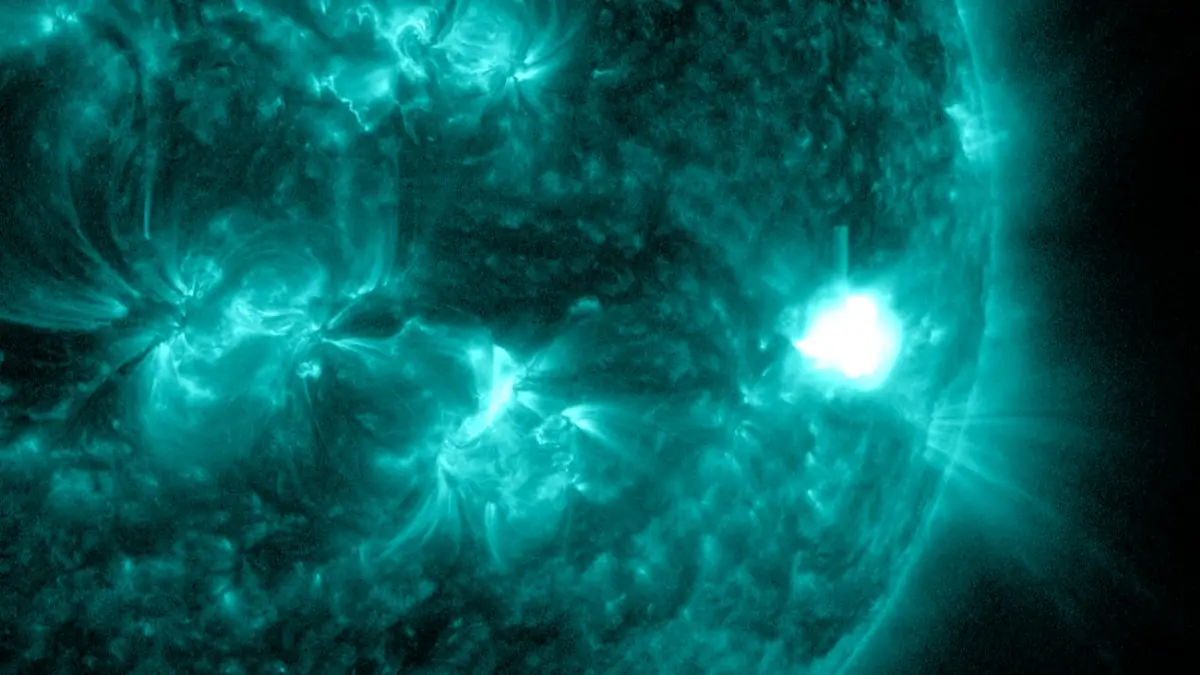
M5.8 solar flare on June 30, 2026. Credit: NASA/SDO AIA 131
Tirona et al. (2026) developed EarlyDetect to forecast changes in continuum intensity associated with solar active-region emergence. The study, published on August 14, 2026, in the Journal of Geophysical Research: Machine Learning and Computation, drew on the Solar Active Region Emergence Dataset, or SolARED. The dataset contained 50 large active regions; four were excluded from the model analysis because of data gaps or quality issues, leaving 46 regions. Researchers used 41 for training and validation and reserved five as a held-out test set.
Solar active regions form as concentrated magnetic structures rise toward and through the visible solar surface, where they can develop sunspots. Rising magnetic flux below the photosphere can also produce measurable changes in acoustic waves traveling through the Sun. Researchers used those weak acoustic changes together with magnetic-flux measurements as precursors of active-region emergence.
NASA’s Solar Dynamics Observatory (SDO) carries the Helioseismic and Magnetic Imager (HMI), which measures photospheric motion and magnetic fields. EarlyDetect uses hourly acoustic-power maps and magnetic-flux information derived from HMI observations. The underlying HMI observations used to construct the acoustic products have a 45-second cadence.
The machine-learning pipeline uses a sliding-window transformer architecture to forecast continuum-intensity evolution as far as 12 hours ahead. Acoustic-power maps and magnetic-flux measurements form the model inputs, while continuum intensity provides the emergence target. The Early Detection architecture adds attention biases and a timing-aware loss function intended to improve sensitivity to emergence onset. Researchers compared that architecture with a standard transformer and with versions using a one-dimensional convolutional, or Conv1D, front end.
Adding the Conv1D front end degraded both error performance and onset timing. The authors found that temporal smoothing reduced sensitivity to weak short-timescale fluctuations associated with the earliest precursor information. EarlyDetect retained the timing-focused architecture without the Conv1D front end.
EarlyDetect recorded a root mean square error (RMSE) of 0.1189, 10.6% lower than the long short-term memory (LSTM) baseline used in the study. Its mean onset lead time was 9.24 hours with a standard deviation of 33.19 hours, compared with 7.55 ±28.78 hours for LSTM. At the active-region level, EarlyDetect placed 4 of the 5 held-out test regions within the study’s 0–24-hour true-positive timing window, compared with 3 of 5 for LSTM. At tile level, LSTM recorded 12 of 35 true positives, compared with 9 of 35 for EarlyDetect.
The mixed performance shows why the 9.24-hour mean cannot be treated as a fixed warning interval. EarlyDetect achieved lower RMSE and a longer mean onset lead time, while LSTM produced more tile-level true positives and less timing variability. The study authors describe broader validation as necessary before judging operational reliability.
The held-out evaluation contained only five active regions, and the authors did not perform cross-validation or alternate train-test partitions. They report that the small test sample has limited representation of highly flare-productive magnetic complexity classes and state that larger, more diverse samples are required to assess stability and selection effects. NJIT also reports occasional false alarms and late forecasts. EarlyDetect remains a research model rather than a real-time operational forecasting system.
Solar flares and coronal mass ejections can originate in active regions, but many active regions never produce a major eruption. An EarlyDetect forecast identifies the emergence of an active region; it does not determine whether a flare or coronal mass ejection will follow or when one would occur.
NASA describes earlier identification of emerging active regions as information that can support continued development of space-weather forecasting methods. The published EarlyDetect evaluation does not provide 9.24 hours of advance warning of a solar storm, and neither NASA nor NJIT describes the system as ready for operational real-time forecasting.
SolARED contains acoustic-power, magnetic-flux and continuum-intensity time series for 50 large active regions observed from 2010 to 2023. The researchers also released an interactive Solar Active Region Portal for examining the data. NJIT describes SolARED as the first public dataset dedicated specifically to solar active-region emergence; that priority claim remains attributed to the institution rather than independently asserted here.
References:
1 NASA’s COFFIES Uses AI to Predict Storm-Causing Active Regions on Sun – NASA – August 14, 2026
2 Tirona, J., Patil, S., Kasapis, S., Dogan, E., Stefan, J., Kitiashvili, I. N., Kosovichev, A. G., & Xu, M. (2026). Forecasting continuum intensity for solar active region emergence prediction using transformers. Journal of Geophysical Research: Machine Learning and Computation, 3(4), e2025JH001207. https://doi.org/10.1029/2025JH001207
3 New AI Model Detects Hidden Signs of Solar Eruptions Hours Before They Emerge – New Jersey Institute of Technology – August 14, 2026

I’m a science journalist and researcher at The Watchers, contributing to the Epicenter edition, where I cover peer-reviewed scientific research and emerging discoveries across Earth and space sciences. With a background in astronomy and a passion for environmental science, I’ve worked in shark and coral conservation in Fiji, conducting reef and shark-behavior research, contributing to mangrove restoration, and earning PADI Open Water and Coral Reef Certifications. I bring a blend of scientific rigor and storytelling to illuminate the discoveries shaping our planet and beyond.

Commenting rules and guidelines
We value the thoughts and opinions of our readers and welcome healthy discussions on our website. In order to maintain a respectful and positive community, we ask that all commenters follow these rules.