
800-year-old diary reveals solar storm 14 times stronger than the largest event of the Space Age
An 800-year-old diary describing red lights in the skies over Kyoto has helped researchers identify a previously unknown solar proton event that occurred during one of the most active periods of solar activity known from the Medieval era.
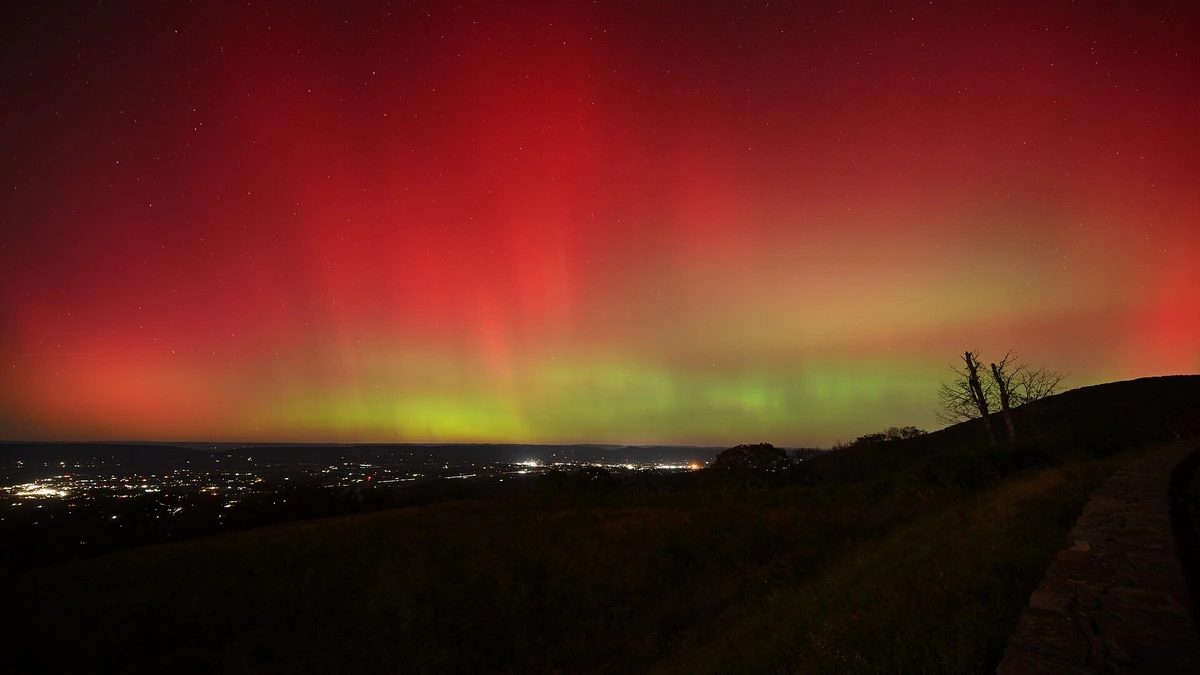
A rare low-latitude red aurora over Luray. Medieval records describe similar red lights appearing over Kyoto during a period of exceptionally high solar activity in the early 13th century. Credit: G. Edward Johnson
More than 800 years ago, the Sun unleashed a solar proton event about 14 times larger than the strongest directly observed event of the modern era.
Researchers uncovered evidence of the event in buried trees from northern Japan and historical records preserved in medieval documents, shedding new light on one of the most active periods of solar activity known from the Medieval era.
The findings were published in Proceedings of the Japan Academy, Series B by researchers from the Okinawa Institute of Science and Technology Graduate University (OIST), the National Institute of Japanese Literature, Yamagata University, Hirosaki University, Nagoya University, and collaborating institutions.
Solar proton events occur when eruptions on the Sun accelerate enormous numbers of high-energy particles toward Earth. While Earth’s atmosphere and magnetic field shield people on the ground, the threat becomes far more serious beyond that protection.
The researchers point to a stark modern example. A series of solar proton events occurred between the Apollo 16 and Apollo 17 lunar missions in 1972. Had astronauts been travelling outside Earth’s protective shield during one of those eruptions, they could have been exposed to potentially lethal radiation levels.
To investigate whether similar events occurred in the distant past, researchers analyzed annual tree rings from buried Asunaro trees recovered from the Shimokita Peninsula in Aomori Prefecture, Japan. The carbon-14 record revealed a sharp increase between 1200 CE and 1201 CE, indicating that a major solar proton event occurred sometime between the winter of 1200 CE and the spring of 1201 CE.
The event produced about 5.2 ± 1.5 kg of carbon-14 in the atmosphere. For comparison, the famous 774–775 CE Miyake Event produced about 26.2 ± 1.0 kg. The newly identified event was therefore about 20% as large as the Miyake Event and about 14 times larger than the February 1956 ground-level enhancement, the largest directly observed solar proton event of the modern era.
Historical records provided crucial context for the investigation. Researchers examined Meigetsuki, the diary of Japanese courtier and poet Fujiwara Teika (1162–1241), which describes unusual red lights in the northern sky over Kyoto. Similar observations were recorded elsewhere in Japan, while additional reports of aurorae and naked-eye sunspots were documented in China, Korea, and Europe during the same period.
The study found no carbon-14 enhancement associated with the famous three-night auroral display observed over Kyoto on February 21–23, 1204 CE. Those aurorae remain among the oldest documented examples of extreme space weather in historical records. Instead, the carbon-14 evidence points to a separate solar proton event between late 1200 CE and early 1201 CE, potentially associated with red aurorae observed in China or large sunspots recorded in East Asia during that period.
The carbon-14 data also allowed researchers to reconstruct solar activity between about 1190 CE and 1220 CE. The reconstruction suggests solar cycles averaged only 7–8 years, significantly shorter than the modern 11-year solar cycle.
According to the researchers, these unusually short cycles indicate that the Sun was operating in an exceptionally active state. The reconstruction also revealed a solar-cycle peak around 1204 CE that was not clearly recognized in earlier reconstructions.
The study identified another intriguing pattern. The 1200–1201 CE proton event appears to have occurred near a solar-cycle maximum, consistent with observations of major solar proton events in the modern era. However, some of the prolonged low-latitude auroral events documented in historical records appear to have occurred near solar-cycle minima instead.
Modern observations generally show that the strongest geomagnetic storms are more likely to occur near solar maximum. The medieval records suggest that powerful geomagnetic storms may also occur near solar minima during periods of exceptionally elevated solar activity, although the authors note that additional evidence is needed to confirm this pattern.
The findings provide a rare glimpse into the behavior of the Sun during the Medieval Solar Activity Maximum and demonstrate how historical records and annual tree-ring data can be combined to identify previously unknown space-weather events that occurred centuries before the start of modern observations.
1 藤原定家の日記と埋没樹木が明かす800年以上前の「宇宙の嵐」の痕跡 – Yamagata University – April 10, 2026
2 Extremely active Sun from 1190 to 1220 in the Medieval Period: Intercomparison of historical records and tree-ring carbon-14 – Hiroko Miyahara et al. – PROCEEDINGS OF THE JAPAN ACADEMY, SERIES B – April 10, 2026 – https://www.jstage.jst.go.jp/article/pjab/102/4/102_pjab.102.011/_pdf/-char/en – OPEN ACCESS

I’m a science journalist and researcher at The Watchers, contributing to the Epicenter edition, where I cover peer-reviewed scientific research and emerging discoveries across Earth and space sciences. With a background in astronomy and a passion for environmental science, I’ve worked in shark and coral conservation in Fiji, conducting reef and shark-behavior research, contributing to mangrove restoration, and earning PADI Open Water and Coral Reef Certifications. I bring a blend of scientific rigor and storytelling to illuminate the discoveries shaping our planet and beyond.

Commenting rules and guidelines
We value the thoughts and opinions of our readers and welcome healthy discussions on our website. In order to maintain a respectful and positive community, we ask that all commenters follow these rules.