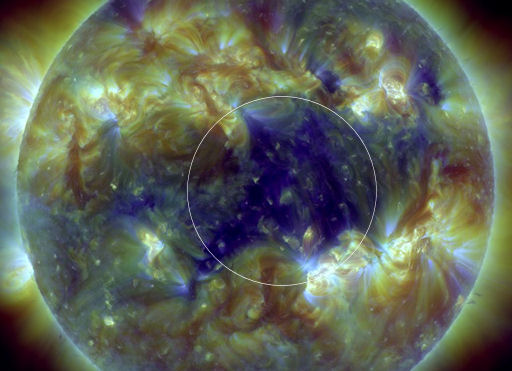
• February solar flare was sparked by five spinning sunspots

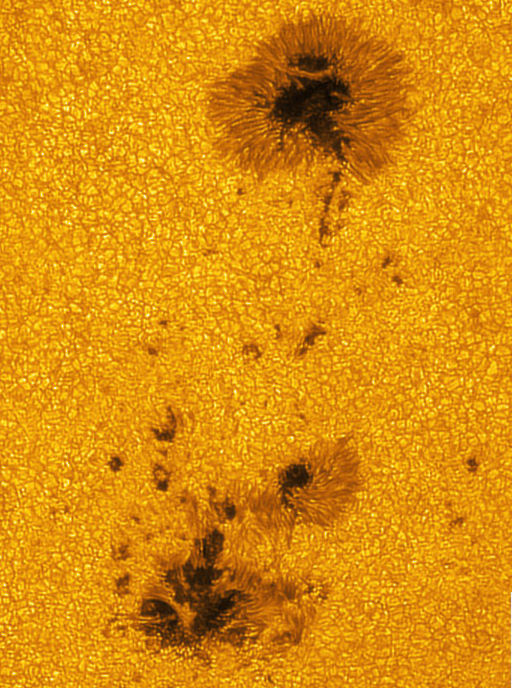
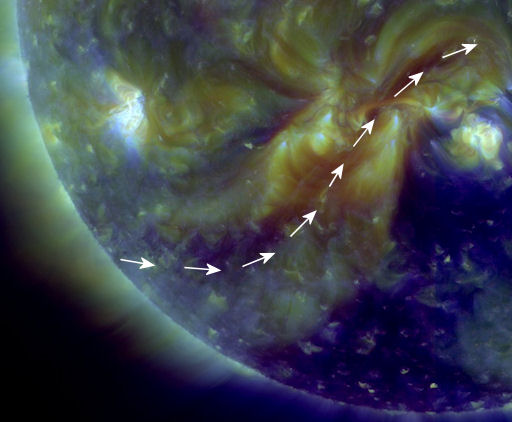
    The giant solar flare unleashed in February was caused by five rotating sunspots working in concert, the UK’s National Astronomy Meeting has heard.Images released from the Solar Dynamics Observatory (SDO) clearly show the sunspots, which are centres of magnetic

  • Heating up of solar storms season

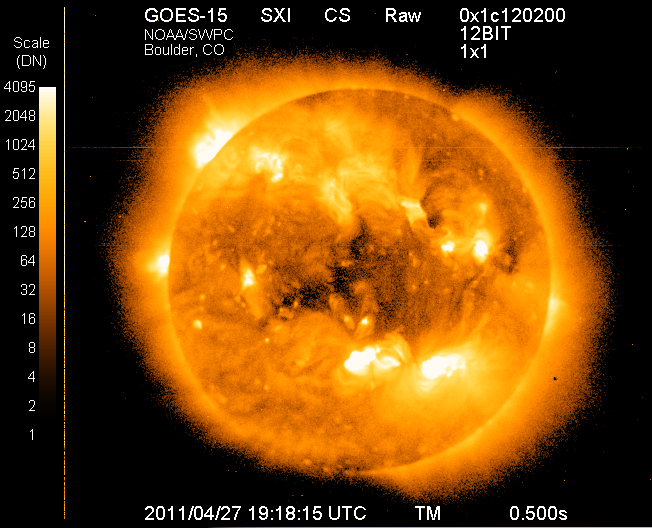
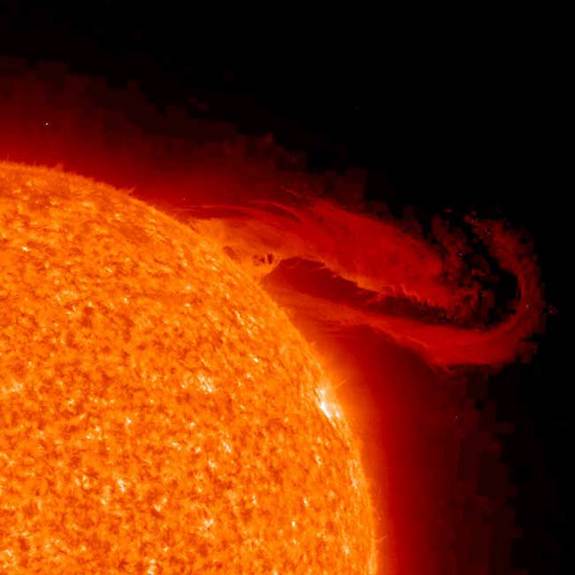
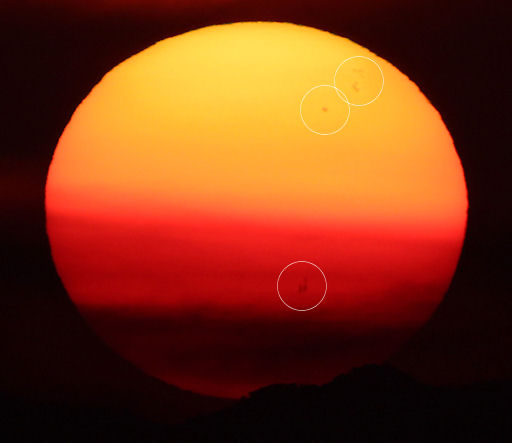
    Sun woke up after three years of sleep. Several powerful solar flares occurred in recent months, with a February 14 blast as the strongest and  the most powerful outburst in more than four years. Considering surface of Sun dotted with sunspots and recent activity,

  • Eruption of magnetic canopy of sunspot 1190

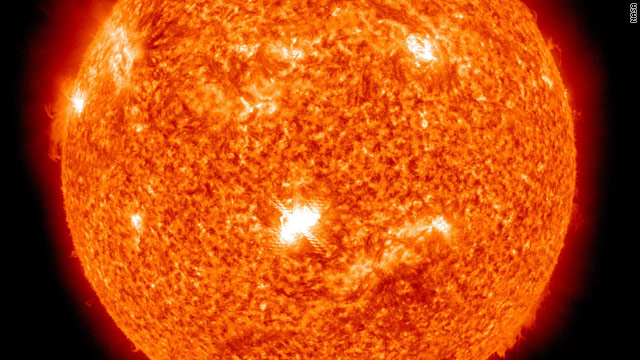
    The magnetic canopy of sunspot 1190 erupted on April 15th, producing an M-class solar flare (SDO movie). The brief blast did not, however, hurl a cloud of plasma toward Earth. NOAA forecasters estimate a 55% chance of more M-flares during the next 24 hours.

  • Filament of magnetism is curling around the sun’s southeastern quadrant

    Newly-arriving data from NASA’s STEREO probes suggest that a coronal mass ejection (CME) might be heading toward Earth. The source of the cloud appears to be sunspot complex 1185-1186, which experienced an episode of magnetic instability during the early hours of April

  • Strong activity on the far side of the sun

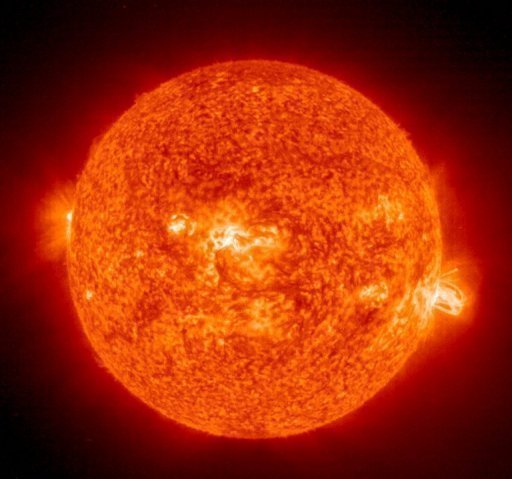
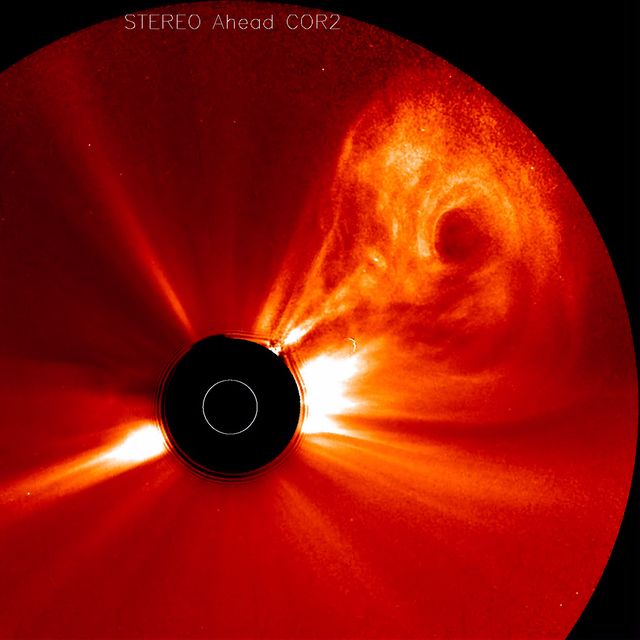
    NASA’s STEREO probes are monitoring strong activity on the far side of the sun. A spectacular CME erupted during the early hours of April 8th apparently from old sunspot AR1176. This is the second day in a row that the active region has hurled massive clouds into

  • Massive solar disturbance & CME on Far-side of Sun

    NASA twin STEREO spacecraft observed a spectacular coronal mass ejection launched from the vicinity of decaying sunspot 1176 on April 3rd around 0500 UT. The blast was not Earth directed. Nevertheless, there is a chance that the expanding cloud will deliver a glancing

  • Coming of big troubled sunspot region

    A big sunspot is emerging over the sun’s southeastern limb, and it is crackling with activity. NASA’s Solar Dynamics Observatory recorded a surge of extreme ultraviolet radiation from the sunspot’s magnetic canopy on March 21st:This appears to be the return of old

  • M-class solar flare eruption

    While we are still on impact of CME from X-flare events from March 9th, the sun got new M-class flare eruption.Effects from the 07 March CME was slowly subsiding during day one (11 March), but the arrival of a coronal hole high speed stream is expected to become

  • X1.5-flare produced Earth-directed CME

    UPDATE:A coronal mass ejection (CME) hit Earth’s magnetic field on March 10th around 0630 UT. Solar wind conditions, post-impact, are favorable for geomagnetic activity.March 9th ended with a powerful solar flare. Earth-orbiting satellites detected an X1.5-class