• M6.2 earthquake hits off the coast of Philippines

    A strong earthquake registered by the USGS as M6.2 hit off the coast of the Philippines at 10:17 UTC on April 22, 2025. The agency is reporting a depth of 118 km (73 miles). EMSC is reporting the same magnitude and depth.

  • Severe storms spawn 15 tornadoes in Texas and Oklahoma, Enhanced Risk forecast for Mississippi Valley on Sunday

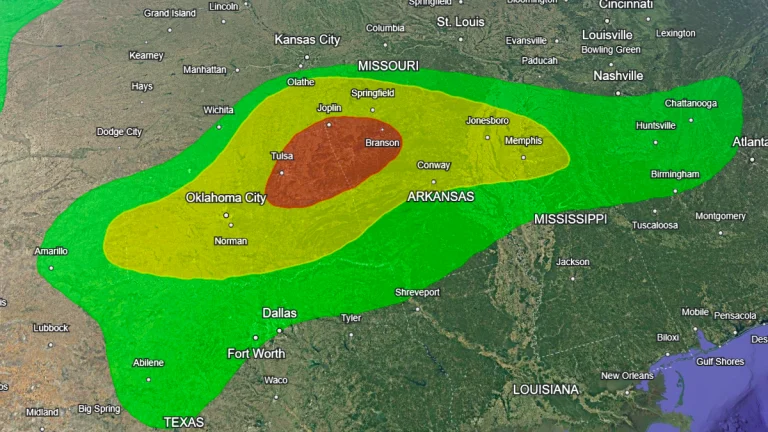
    At least 15 tornadoes ripped through Texas and parts of Oklahoma on Saturday, April 19, 2025, as thunderstorms moved through the Southern Plains, downing trees and power lines, causing power outages, and damaging multiple homes. There is an Enhanced Risk of severe thunderstorms over parts of the middle and lower Mississippi Valley on Sunday.

  • Seismologists analyze Myanmar’s devastating M7.7 earthquake

    An M7.7 earthquake struck near Mandalay, Myanmar, on March 28, 2025, killing more than 5 000 people and injuring at least 11 400. The shallow, high-magnitude event ruptured a long section of the Sagaing Fault, prompting seismologists to investigate its complex rupture dynamics and evidence of supershear propagation.

  • At least 4 dead as Storm Hans batters Italy and France

    At least 4 people died in Italy and France as Storm Hans battered the countries with heavy rains, floods, and snow since Wednesday, April 16, 2025. Many areas in lowland Italy have received over 300–500 mm (12–20 inches) of rainfall, triggering landslides and causing rivers to swell, while heavy snow in the Alps has caused avalanches in France.

  • Polar vortex collapse to influence spring weather across U.S. and Canada

    Large-scale pressure changes following a strong sudden stratospheric warming event in mid-March 2025, which caused the collapse of the polar vortex, are expected to drive spring weather patterns across Canada and the United States into May. Northerly winds are expected to bring colder air into parts of North America, while high-pressure zones may lead to warmer conditions in the central U.S. and southern Canada. The shifts in weather patterns are consistent with the typical effects observed following a polar vortex disruption, where the jet stream becomes more erratic, leading to unusual temperature distributions and weather events.