
G2 geomagnetic storm watch in effect for April 16 following solar filament eruption
A G2 – Moderate geomagnetic storm watch is in effect for April 16, 2025, due to an Earth-directed coronal mass ejection from an April 13 filament eruption. Solar activity is forecast to remain moderate through April 15, with potential X-class flares from Region 4055, before decreasing to low levels on April 16.

Image credit: NASA SDO/AIA 304, Helioviewer, The Watchers. Acquired at 08:30 UTC on April 13, 2025
Two filament eruptions were observed over the past two days. The first was approximately 20
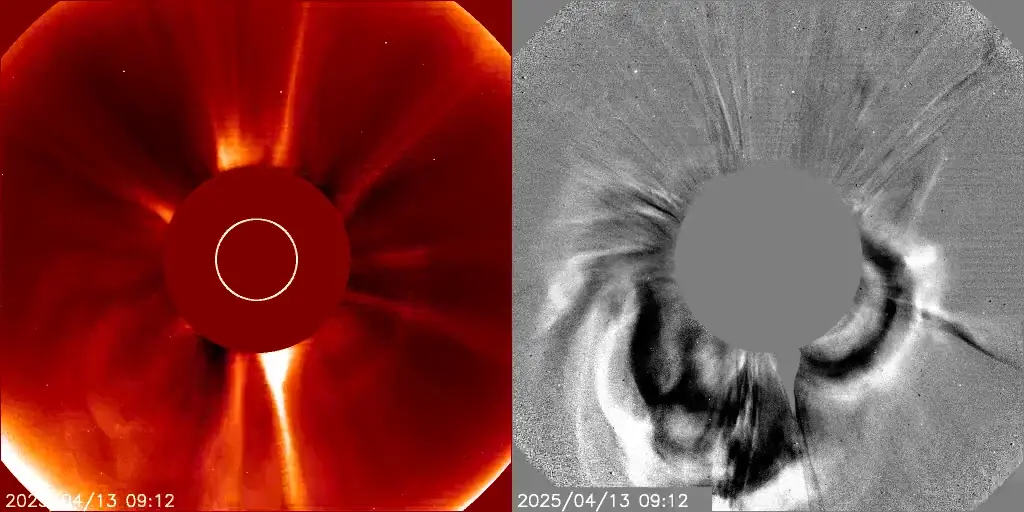
degrees long, centered near S20E20, and began erupting after 21:30 UTC on April 12, while the second was approximately 12 degrees long, centered near S22W09. This one began erupting after 05:00 UTC on April 13. CME signatures were observed in subsequent coronagraph imagery following each event.
Initial analysis and modeling of the second CME indicated a likely Earth-directed component, with anticipated arrival at Earth near midday on April 16.
As a result, a G2 – Moderate geomagnetic storm watch is in effect for April 16. Potential impacts include weak power grid fluctuations, minor impact on satellite operations, and aurora at high latitudes, i.e., the northern tier of the U.S.


Solar activity is expected to reach moderate levels, with a slight chance for isolated X-flares on April 14 and 15 due to the flare potential from Region 4055. Activity is expected to decrease to low levels on April 16, with M-class flares likely, as Region 4055 moves further beyond the west limb.
The greater than 2 MeV electron flux at geostationary orbit reached high levels in 24 hours to 00:30 UTC today, while the greater than 10 MeV proton flux was at background levels.
The 2 MeV electron flux is expected to remain at moderate to high levels through April 15, with a slight chance for S1 – Minor solar radiation storm levels on April 14 and 15 due to the flare potential of Region 4055.

Solar wind parameters remained enhanced over the past 24 hours as influence from the negative polarity coronal hole high speed stream (CH HSS) continued.
The total magnetic field strength was between 3–8 nT, the Bz component varied between -6 and +4 nT, and solar wind speeds steadily decreased from approximately 465 km/s to 435 km/s. Phi angle was predominantly oriented in the negative sector, with a few isolated rotations into a positive position.

The solar wind environment is expected to continue under continued, yet waning, negative polarity CH HSS influence through April 15.
By mid to late day on April 16, substantial enhancements are expected with the anticipated arrival of the CME that left the Sun on April 13.
The geomagnetic field was at quiet to active levels due to continuing CH HSS effects over the past 24 hours.
Quiet to unsettled conditions are expected, with isolated active periods likely, on April 14–15 as CH influence lingers. Mostly unsettled levels are expected early on April 16.
By mid to late UTC day on April 16, G1 – Minor to G2 – Moderate storm levels are likely with the anticipated arrival of the April 13 CME.
References:
1 Forecast Discussion – SWPC – Issued at 00:30 UTC on April 14, 2025

I'm a dedicated researcher, journalist, and editor at The Watchers. With over 20 years of experience in the media industry, I specialize in hard science news, focusing on extreme weather, seismic and volcanic activity, space weather, and astronomy, including near-Earth objects and planetary defense strategies. You can reach me at teo /at/ watchers.news.

Commenting rules and guidelines
We value the thoughts and opinions of our readers and welcome healthy discussions on our website. In order to maintain a respectful and positive community, we ask that all commenters follow these rules.