
Strong solar radiation in progress, severe geomagnetic storm watch in effect
A strong solar radiation storm is currently in progress as a result of a major X1.8 solar flare at 01:56 UTC on October 9, 2024.

Image credit: SWPC
A strong solar radiation storm is currently underway following a major X1.8 solar flare at 01:56 UTC on October 9, 2024.
Proton flux counts began rapidly increasing after the flare, reaching the S1 – Minor solar radiation storm threshold at around 04:40 UTC. Levels reached S2 – Moderate by 07:30 UTC and S3 – Strong by 12:30 UTC.
Potential impacts include increased radiation exposure for passengers and crew on high-altitude, high-latitude flights, as well as elevated radiation risks for astronauts conducting extra-vehicular activities.
Spacecraft may experience single-event upsets to satellite operations, noise in imaging systems, and slight reductions in solar panel efficiency.
Additionally, polar HF (high frequency) radio propagation could be degraded or experience episodic blackouts.
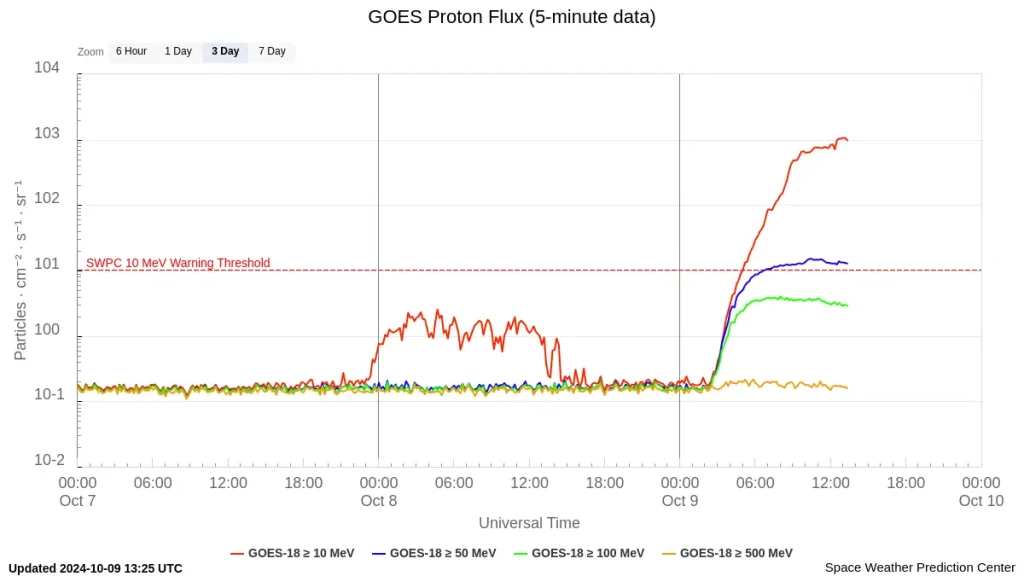
The storm was produced by a significant, long-duration solar flare classified as X1.8 that erupted from geoeffective Active Region 3848 at 01:56 UTC on October 9. The flare produced a fast-moving coronal mass ejection (CME), expected to impact Earth between late October 10 and early October 11.
As a result, a G4 – Severe or Greater Geomagnetic Storm Watch is in effect for October 10 and 11.
Potential impacts of G4 – Severe geomagnetic storms are primarily expected poleward of 45 degrees Geomagnetic Latitude.
Power grids may experience widespread voltage control issues, and protective systems could mistakenly trip key assets, while induced pipeline currents may intensify.
Spacecraft systems could face surface charging, increased drag on low Earth orbit satellites, and issues with tracking and orientation. Satellite navigation (GPS) may be degraded or inoperable for hours, and HF (high frequency) radio propagation could be sporadic or blacked out. Auroras may be visible as far south as Alabama and northern California.


Teo Blašković founded The Watchers in 2011 and edited it until 2026, covering seismic and volcanic activity, extreme weather, space weather and near-Earth objects. Articles on this page are his archive.
Earlier reporting
Nothing on Watchers was published in the last 24 hours. These are older articles.
- On October 22, 2017, a single flash of lightning stretched 515 miles from eastern Texas to near Kansas City, a distance that takes eight hours to drive, and nobody realized how far it had gone until scientists went back through the satellite data years later Epicenter
- CPC posts a slight risk of heavy rain from the Gulf Coast to the Northeast urban corridor November 25-29, and a moderate risk of West Coast wind and Sierra snow on November 25
- Florida's east coast faces a moderate flash flood risk Wednesday through Friday, with 4 to 8 inches of rain forecast and the St. Johns River near Cocoa already in major flood at 17.13 feet
- Cyclone Akvan to make landfall between Nellore and Visakhapatnam around noon on November 20, IMD forecasts 120-130 km/h winds gusting to 145
