
Very strong M6.9 earthquake hits Kermadec Islands at intermediate depth

Image credit: TW/SAM, Google
A very strong earthquake registered by the USGS as M6.9 hit Kermadec Islands, New Zealand at 06:41 UTC on March 4, 2023. The agency is reporting a depth of 205.7 km (128 miles). EMSC is reporting M6.9 at a depth of 150 km (93 miles).
The epicenter was located 927.4 km (576.3 miles) NE of Ngunguru, Northland, New Zealand.
Based on all available data, there is no tsunami threat from this earthquake, PTWC said.
The USGS issued a Green alert for shaking-related fatalities and economic losses. There is a low likelihood of casualties and damage.
Overall, the population in this region resides in structures that are highly resistant to earthquake shaking, though some vulnerable structures exist. The predominant vulnerable building types are reinforced masonry and unreinforced brick with timber floor construction.
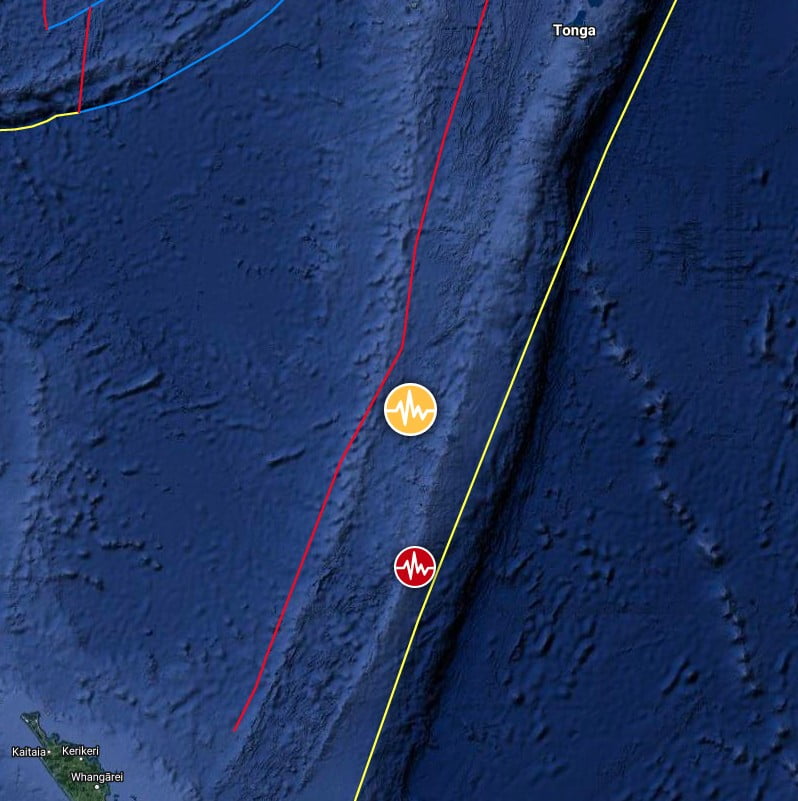
Regional seismicity


Teo Blašković founded The Watchers in 2011 and edited it until 2026, covering seismic and volcanic activity, extreme weather, space weather and near-Earth objects. Articles on this page are his archive.
Earlier reporting
Nothing on Watchers was published in the last 24 hours. These are older articles.
- In 2002 a magnitude 7.9 quake on the Denali Fault shoved the ground about 14 feet sideways under the Trans-Alaska Pipeline, but engineers had designed Teflon sliders for the pipe nearly 30 years earlier, and no oil spilled.
- In July 1958, an earthquake shook about 30 million cubic meters of rock into Alaska's Lituya Bay, and the splash stripped forest from a slope 1,720 feet high, taller than the Empire State Building; Howard Ulrich and his 7-year-old son rode the wave out in their fishing boat
- Deep M6.2 earthquake hits Vanuatu 43 km from Port-Olry at 143 km depth, no tsunami threat as USGS issues Green alert
- In 1920, a man out hunting on a farm in Namibia sat down on a strange black rock, scratched it with his knife and saw metal shine underneath. It was Hoba, a 60-ton meteorite, the largest ever found, and there is no crater around it Epicenter
