
Unique, lava-fueled thunderstorm produces 1 200 lightning strikes, Kilauea

Image credit: USGS/HVO
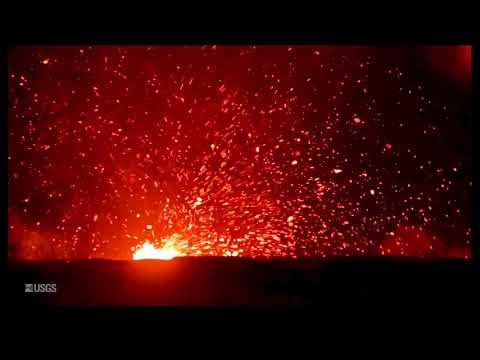
A lava-fueled thunderstorm over active lava fields in the lower East Rift Zone of Kilauea volcano in Hawaii produced about 1 200 lightning strikes within just 7 hours on July 2, 2018, NWS said.
According to West Hawaii Today, spokeswoman for Mayor Harry Kim said that the county 'got calls galore from people' concerning the intense thunderstorm, which was centered largely over fissure 8 in Leilani Estates, with lightning strikes also occurring along the 13 km long (8 miles) lava channel from the active fissure to the lava ocean entry at Kapoho.
Science and operations officer at the National Weather Service office in Honolulu, meteorologist Robert Ballard, said that the volcano was definitely a major player in Monday's weather.
"Seeing that is really unique for us, and we’re learning about how that’s going to have to change our forecast a little bit for that localized area," he said.

"While lava played a major role in the thundershowers, there were a couple of different things at play," Ballard said.
"The other major player was an upper level low (pressure system) that was about 600 km (370 miles) north of Hilo. And south of the upper level low, it was dragging a pocket of cooler-than-normal air across the Big Island."
"That’s why we had thunderstorms not only over the lava field, we also had a couple of isolated thunderstorms on Maunakea. There was also one on the slopes of Mauna Loa and even a brief one down in Ka‘u, as well," he said. "Another contributing factor was moisture rising from the laze plume at the lava’s ocean entry point in Kapoho."

Another lava-related phenomenon that has been documented in videos and photos recently are small whirlwinds that seem to emanate from the lava. "These are not too dissimilar to waterspouts that we see at the base of cumulus clouds," Ballard said.
"Anytime you have a really strong updraft within the cloud, the air below it wants to pull inward. And it pulls inward… in a spiral, because it’s forming a weak, little low pressure area there. That’s how the whirlwind gets started. And once it gets started, it just feeds off the heat energy to sort of keep itself going and sustain itself."

Teo Blašković founded The Watchers in 2011 and edited it until 2026, covering seismic and volcanic activity, extreme weather, space weather and near-Earth objects. Articles on this page are his archive.
Published in the last 24 hours
- On 13 April 2029 the 340 m asteroid Apophis will pass about 32,000 km above Earth's surface, inside the ring of geosynchronous satellites, and NASA says observers across the Eastern Hemisphere will see it without a telescope or binoculars. Epicenter
- Dust shed by Halley's Comet gives Earth the Eta Aquarids every May and the Orionids every October, and the comet itself, which passed 4.94 million km away on 10 April 837 at about magnitude -3.5, is due to reach perihelion on 28 July 2061. Epicenter
- Detonations from Krakatoa on 26 and 27 August 1883 were heard over nearly one thirteenth of the globe, as far as Rodrigues about 4,800 km away, where the chief of police logged roars like heavy guns until 3 p.m., the Royal Society reported in 1888. Epicenter
- One dead, 15 injured and 152 homes left uninhabitable across five regions of Peru after the M6.7 Junín earthquake of 20 November, COEN-INDECI reports.
