
Quadrantids: An above average meteor shower reaches peak of activity
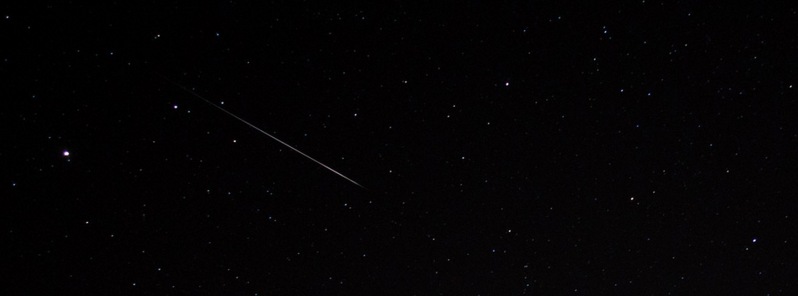
Image credit: Quadrantid meteor by Josh Beasley (CC - Flickr)
The Quadrantid meteor shower will reach its peak activity, with about 80 meteors per hour (ZHR), on the night of January 3 and the early morning hours of January 4, 2015. A waning crescent moon will not interfere much with meteors and any of its fireballs.
This shower was first observed in 1825 and is considered to be one of the best annual meteor showers. However, its peak lasts only a few hours due to its thin stream of particles and the fact that Earth crosses it at a perpendicular angle.
Quadrantids are known for their bright fireball meteors, larger explosions of light and color that can persist longer than an average meteor streak. Fireballs are also brighter, with magnitudes brighter than -3.
Unlike most meteor showers which originate from comets, the Quadrantids originate from an asteroid named 2003 EH1, discovered on March 6, 2003 by the Lowell Observatory Near-Earth Object Search (LONEOS). It is possible, however, that 2003 EH is a "dead comet" or a new kind of object being discussed by astronomers called a "rock comet." It is a small object with a diameter of only about 3 km (1.8 miles).
Quadrantids are best viewed in the northern hemisphere during the night and pre-dawn hours.
Their radiant, the point in the sky from which they appear to come from, is an obsolete constellation called Quadrans Muralis, located between the constellations of Bootes and Draco (near the end of the handle of the "Big Dipper").
An alternative name for the Quadrantids is the Bootids since the meteors appear to radiate from the modern constellation of Bootes.

Teo Blašković founded The Watchers in 2011 and edited it until 2026, covering seismic and volcanic activity, extreme weather, space weather and near-Earth objects. Articles on this page are his archive.
More reporting
- Etchless photonic crystal reaches high-Q resonances in the deep ultraviolet
- Avalanche forecasts are getting more local, but snow stability remains a scale problem
- Zero-field NMR resolves molecular fingerprints from natural-abundance carbon-13
- Very strong El Niño favors wetter 2026–27 winter in Philadelphia region, but snowfall remains uncertain
