
Quadrantid meteor shower peaks on January 3rd and 4th
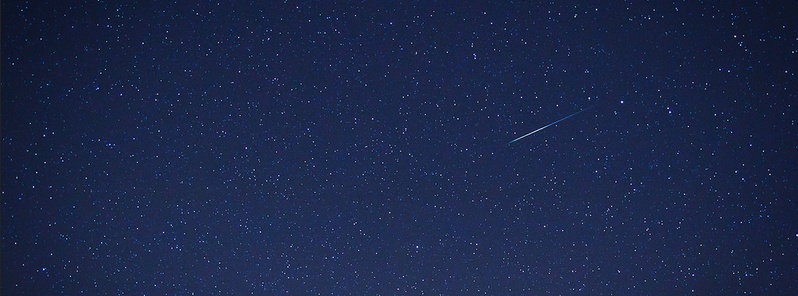
Image credit: Quadrantid meteor by Donovan Shortey (CC via Flickr)
Quadrantids are considered to be one of the best annual meteor showers, known for their bright fireball meteors – larger explosions of light and color that can persist longer than an average meteor streak.
This year, they peak on the night of January 3rd and the morning of January 4th, around 04:00 UTC. Traveling at velocity of 41 km/s (25.5 mps), Quadrantids radiate from the constellation Bootes, originally Quadrans Muralis which is now a defunct constellation. We can usually expect approximately 80 meteors per hour, however, the nearly full moon will block out most of the show this year.
Quadrantids origin is an extinct asteroid or a possible "rock comet" 2003 EH1, discovered on March 6, 2003 by the Lowell Observatory Near-Earth Object Search (LONEOS). Their peak is much shorter than an average meteor shower due to its thin stream of particles and the fact that Earth crosses the stream at a perpendicular angle.

2003 EH1 orbit diagram by JPL
They are active from December 28 – January 12 and are best viewed in the Northern Hemisphere, during the night and pre-dawn hours.
Don't miss the Quadrantids – the first shooting stars of 2015: http://t.co/hXsjKAJnaZ pic.twitter.com/3w1VwBMWBv
— Astronomy Now (@AstronomyNow) January 2, 2015
To view the Quadrantids, find an area well away from city or street lights. Be patient – the show will last until dawn, so you have plenty of time to catch a glimpse.

Teo Blašković founded The Watchers in 2011 and edited it until 2026, covering seismic and volcanic activity, extreme weather, space weather and near-Earth objects. Articles on this page are his archive.
Published in the last 24 hours
- High Risk of excessive rainfall covers Florida’s Space Coast as St. Johns River near Cocoa reaches 5.67 m
- Asteroid 2026 WJ to pass Earth at 1.7 lunar distances at 04:20 UTC on November 22, with 2026 WD following at 4.4 lunar distances on November 23
- Cyclone Akvan crossed the north Andhra Pradesh and south Odisha coasts close to Gopalpur on November 20 with 70-80 km/h winds gusting to 90, and has weakened into a deep depression
- A broad low over southeastern Florida and the northwestern Bahamas has a 30 percent chance of subtropical or tropical development within 48 hours and a 50 percent chance within 7 days, the National Hurricane Center says
