
Activity at Colima volcano intensifies, 12-km exclusion zone established, Mexico
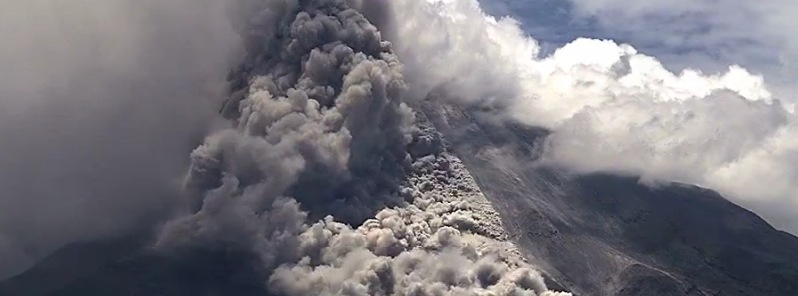
Featured image: Eruption of Colima volcano on July 10, 2015. Credit: WebCamsDeMexico.
Authorities have evacuated some 800 people living within a 12-km (7.4 miles) exclusion zone established around the Colima volcano due to increased volcanic activity and large amounts of ash being spewed from the crater since Thursday, July 9, 2015.
Civil protection officials described the recent activity at Colima as "atypical" and said that eruptions of this kind and intensity hadn't been seen since the major eruption of 1913.
Hamlet of Yerbabuena, close to the volcano's base, was coated in a layer of ash 5 cm (2 inches) thick.
Mario Anguiano, the Governor of Colima, said that the airport just outside the state capital was closed because of falling ash.
Three possible scenarios are expected:
(1) slow fading of activity over the next months,
(2) the collapse of the volcano's domes,
(3) a major explosive eruption.
The last large explosive eruption of Colima occurred on January 20, 1913 and lasted for four days.
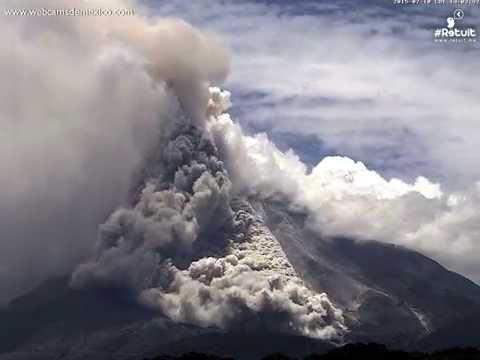
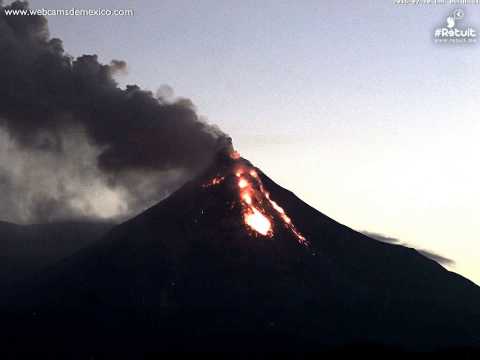
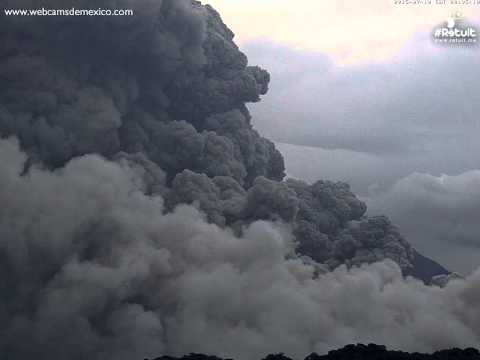
Videos courtesy of WebCamsDeMexico
Geological background
The Colima volcanic complex is the most prominent volcanic center of the western Mexican Volcanic Belt. It consists of two southward-younging volcanoes, Nevado de Colima (the 4320 m high point of the complex) on the north and the 3850-m-high historically active Volcán de Colima at the south. A group of cinder cones of late-Pleistocene age is located on the floor of the Colima graben west and east of the Colima complex. Volcán de Colima (also known as Volcán Fuego) is a youthful stratovolcano constructed within a 5-km-wide caldera, breached to the south, that has been the source of large debris avalanches.
Major slope failures have occurred repeatedly from both the Nevado and Colima cones, and have produced a thick apron of debris-avalanche deposits on three sides of the complex. Frequent historical eruptions date back to the 16th century. Occasional major explosive eruptions (most recently in 1913) have destroyed the summit and left a deep, steep-sided crater that was slowly refilled and then overtopped by lava dome growth. (GVP)

Teo Blašković founded The Watchers in 2011 and edited it until 2026, covering seismic and volcanic activity, extreme weather, space weather and near-Earth objects. Articles on this page are his archive.
More reporting
- Global simulation reveals how successive solar eruptions overtake and magnetically merge
- Ancient Martian lavas were more fluid than younger basalts, Perseverance study finds
- Howard Carter found an iron dagger on Tutankhamun's right thigh in 1925; modern XRF analysis supports a meteoritic origin of the iron
- Extreme weather exposes weak points in global oil and natural gas shipping, IEA finds
