
The weak CME impact, auroras still possible
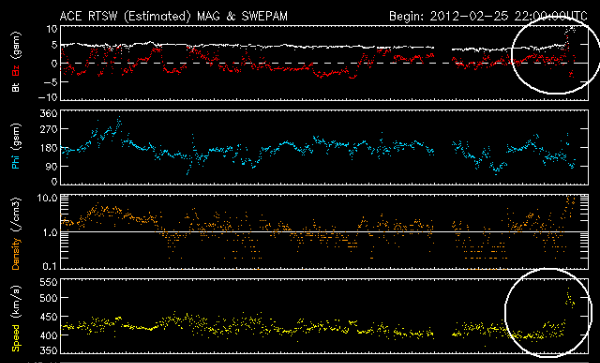
Image credit: TW
A CME hit Earth’s magnetic field on Feb. 26th at ~2100 UTC. The impact was weak and does not appear set to cause a strong geomagnetic storm according to SpaceWeather. A solar wind increase to near 550 km/s was detected by the ACE Spacecraft around 20:50 UTC. A geomagnetic sudden impulse was detected by the Boulder station at 21:41 UTC. The impact appears minor thus far, however aurora will be possible at very high latitudes.


In 3-day Solar-Geophysical Forecast issued on Feb 26 22:00 UTC NOAA/SWPC forecasts that the geomagnetic field is expected to be unsettled to active with isolated minor storm periods possible on day 1 (27 February) as the 24 February CME is expected to be geoeffective. Quiet to unsettled with isolated active conditions are expected on day 2 (28 February). Mostly quiet conditions are expected on day 3 (29 February). There is a slight chance for a >10 MeV proton event due to shock enhancement of the proton levels on days 1 – 2 (27 – 28 February).
Stay tuned for more updates!

Earlier reporting
Nothing on Watchers was published in the last 24 hours. These are older articles.
- On October 22, 2017, a single flash of lightning stretched 515 miles from eastern Texas to near Kansas City, a distance that takes eight hours to drive, and nobody realized how far it had gone until scientists went back through the satellite data years later Epicenter
- CPC posts a slight risk of heavy rain from the Gulf Coast to the Northeast urban corridor November 25-29, and a moderate risk of West Coast wind and Sierra snow on November 25
- Florida's east coast faces a moderate flash flood risk Wednesday through Friday, with 4 to 8 inches of rain forecast and the St. Johns River near Cocoa already in major flood at 17.13 feet
- Cyclone Akvan to make landfall between Nellore and Visakhapatnam around noon on November 20, IMD forecasts 120-130 km/h winds gusting to 145
