
Comet Lovejoy now visible with naked eye
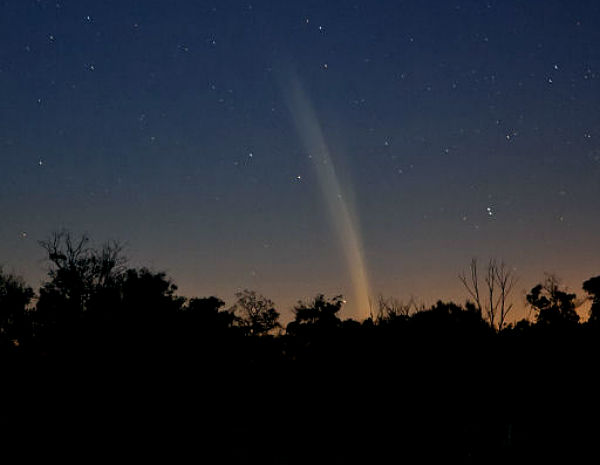
Image credit: Colin Legg
Comet Lovejoy's tail is visible after all, from around the southern hemisphere. It can be visible just before sunrise. Reports of two tails indicates that it develop dust and ion tail. The gaseous tail is blow almost directly away from the sun by solar wind and brighter and heavier dust tail follow the comet's orbit more closely. The visibility of both tails could improve in the days ahead as the comet moves away from the sun and the background sky darkens.

The comet is still close to the Sun. Over the next few days, Comet 2011 W3 will rapidly move away from the Sun and also is likely to rapidly fade. No one is really sure what the comet is doing because of the cloudy conditions in the Southern hemisphere. Hopefully clear weather will allow further observations.
After surviving its brush with the Sun, Lovejoy has re-emerged back into the HI-1 images looking even brighter and bolder than when it went in. It's visible in the HI-1 instruments on both STEREO spacecraft, but STEREO-A gives better view simply because it a little closer to the comet.

The best views from sun-watching spacecrafts is over. For now, Comet Lovejoy is still in the HI-1 fields of view on both STEREO spacecraft, but it should be leaving those sometime today. It will continue to be visible in STEREO/SECCHI HI-2 for a while, but that's a very big field of view, so it would be harder to spot it. But as it recedes from space stationed instruments it is becoming an increasingly visible object for Earth-based observers. Only those in the Southern Hemisphere would have the opportunity to observe the Comet Lovey with naked eye.

Here’s a timelapse video of Comet Lovejoy rising in the morning over western Australia captured by Colin Legg. You can see both the comet’s dust tail as well as its secondary plasma tail.
Comet Lovejoy (2011 W3) rising over Western Australia from Colin Legg on Vimeo.
Early-rising sky watchers should be alert for this rare apparition. <finder chart >

Earlier reporting
Nothing on Watchers was published in the last 24 hours. These are older articles.
- Asteroid 2026 WA passed Earth at 126,400 km, about a third of the Moon's distance, at 07:59 UTC on November 17
- Right about now, Voyager 1 is crossing a line no human-made object has ever reached, a full light-day from Earth, which means a message NASA sends tonight won't arrive until tomorrow night, and the spacecraft's answer won't make it home until the night after that
- On October 22, 2017, a single flash of lightning stretched 515 miles from eastern Texas to near Kansas City, a distance that takes eight hours to drive, and nobody realized how far it had gone until scientists went back through the satellite data years later Epicenter
- CPC posts a slight risk of heavy rain from the Gulf Coast to the Northeast urban corridor November 25-29, and a moderate risk of West Coast wind and Sierra snow on November 25

I am from Mumbai, India. Is it possible that I get to see the comet on 7th Jan..??! What time..?
Everybody talked about Comet Elenin, and people thought it was a doomsday comet, and was the Blue Kachina. So much fear and uncertainity about it, and then when it finally came close, it wasn’t visible except with strongest telescope and it just broke up. It was one of the greatest let-down in the history of astronomy. Now this comet Lovejoy, it survived a close pass of the sun and it is very visible. There is a good likehood that it will be visible in Northern Hemisphere (in February?). However, I don’t hear anyone talking much about it. It could be the Blue Kachina, but no one is saying anything…
Yes, I was also wondering if Lovejoy is the Blue Kachina of the Hopi prophesy. I guess only time will tell. Maybe we are to understand all comets or shows in space as an elelment of the Blue Kachina. It does inspire awe if nothing else. It is cool that Lovejoy just seemed to sneak in, a bit of a Trickster I guess. Kind of like a Cosmic Santa Claus! It’s so fun to be surprised.