
Seven M-class flares today
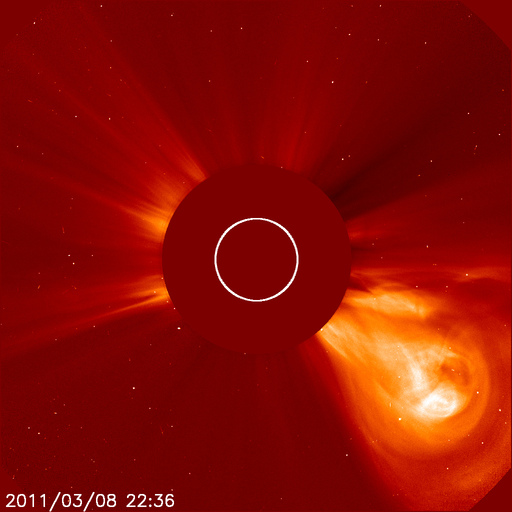
Image credit: TW

Several M-Class flares (7) took place during the day on Monday. Sunspot 1165 which is located in the southern hemisphere is in the process of rotating onto the western limb and will soon be out of direct earth view. Sunspot 1164 which is in the northern hemisphere will also rotate onto the western limb soon after 1165.
The chances for strong solar flares will decrease somewhat once these regions are out of view, however there will remain the possibility for further flares around Sunspot 1166. Just to the east of 1166, Sunspot 1169 did show some minor growth during the day on Monday.
Solar Flux reading on Monday is 153 (No pun intended). This is yet again another high for Cycle 24. The last time the solar flux was as this level, was July of 2004. Please note that this flux reading is an estimate due to the Flare activity in progress The high-sensitivity channels on the measurement device were completely overloaded by the long duration flare and produced a SFI reading of 938.6 at 20:00z. (SolarCycle24)

A coronal mass ejection (CME) exploded from the vicinity of sunspot 1164 during the late hours of March 7th. It lept away from the sun traveling some 2200 km/s, making it the fastest CME since Sept. 2005. A movie of the cloud prepared by Karl Battams of the Naval Research Lab seems to show a small but non-negligible Earth-directed component. This CME and at least one other could brush against Earth’s magnetic field on March 9th or 10th. (SpaceWeather)

Published in the last 24 hours
- High Risk of excessive rainfall covers Florida’s Space Coast as St. Johns River near Cocoa reaches 5.67 m
- Four small asteroids will pass close to Earth from November 21 to 23
- Cyclone Akvan weakens after landfall near Gopalpur; more than 300 000 evacuated in Odisha, India
- A broad low over southeastern Florida and the northwestern Bahamas has a 30 percent chance of subtropical or tropical development within 48 hours and a 50 percent chance within 7 days, the National Hurricane Center says
