
Marine iguanas in the Galápagos got shorter by as much as 6.8 cm (2.7 inches), or a fifth of their length, when El Niño left them short of the seaweed they can digest, and the biggest ones shrank the most and lived the longest
Marine iguanas in the Galápagos Islands can lose as much as 6.8 cm (2.7 inches), or one-fifth of their body length, when El Niño disrupts their food supply. Researchers tracking individual adults found that the reptiles could grow longer again when conditions improved. Among large iguanas, those that shortened most also survived longer during the food shortage, revealing an unusual response to environmental stress.
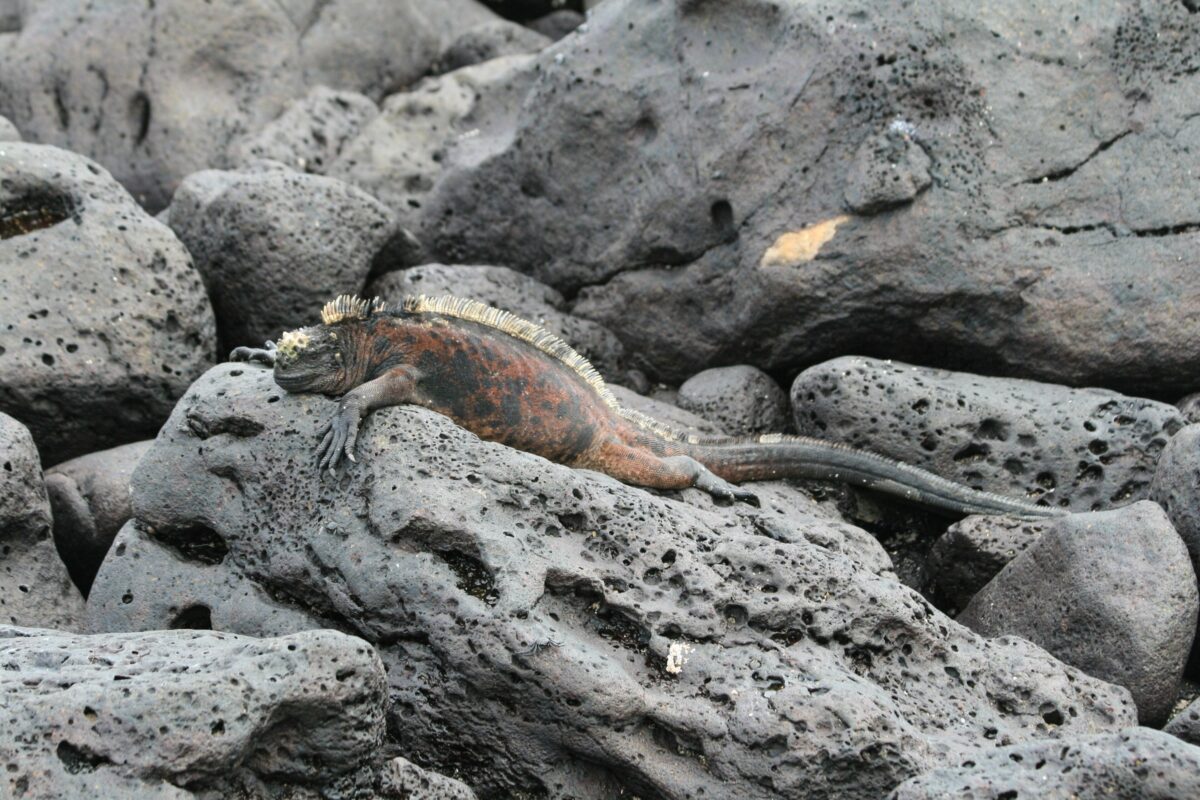
A marine iguana resting on volcanic rocks in the Galápagos Islands. Credit: RAF-YYC from Calgary, Canada (CC BY-SA 2.0), via Wikimedia Commons.
The marine iguana (Amblyrhynchus cristatus) is the only living lizard that feeds in the ocean. Along the rocky shores of Ecuador’s Galápagos Islands, it grazes on algae growing in shallow coastal water. That dependence on marine vegetation makes the animals especially vulnerable when El Niño warms the surrounding sea and disrupts the nutrient supply that supports their food.
In a study published in Nature on January 6, 2000, Martin Wikelski and Corinna Thom documented something more unusual than the weight loss expected during starvation. Adult iguanas had become measurably shorter, sometimes by as much as 20% of their body length. The change was reversible, and among large adults facing food shortages, greater shrinkage was associated with longer survival.
Measurements initially dismissed as errors revealed a repeated pattern
Wikelski and Thom examined long-term measurements from marine iguanas on Santa Fe and Genovesa, two islands in the Galápagos archipelago. Their evidence combined studies lasting 18 years and eight years, respectively, in which individually marked animals could be identified and measured again after months or years in the wild.
The researchers measured snout-to-vent length, the distance from the tip of the snout to the opening at the base of the tail. This standard measurement excludes the tail and allows changes in the length of the animal’s body to be compared without confusing them with tail damage or loss.
Some adult iguanas repeatedly produced shorter measurements than they had on earlier occasions. Such results would ordinarily suggest measuring mistakes rather than actual reductions in body length, and the unusual observations were initially set aside.
The severe 1997–98 El Niño prompted a closer examination. As Wikelski explained in a University of Illinois release, the animals had shortened too much to ignore. When researchers plotted the historical measurements, the decreases aligned with several earlier El Niño episodes.
The original paper addressed the possibility of measurement error directly. Individuals had been measured without reference to their previous lengths, and the recorded shrinkage greatly exceeded the reported measurement variation. Changes approaching one-fifth of an animal’s body length could not reasonably be dismissed as ordinary differences between measurements.
The maximum reported decrease was 6.8 cm (2.7 inches) within a two-year interval. This was an extreme observation, not the average amount lost across the populations. The researchers also documented the reverse process: surviving iguanas increased in length during subsequent La Niña conditions, when algae became more abundant.
El Niño changes the food available along the Galápagos coast
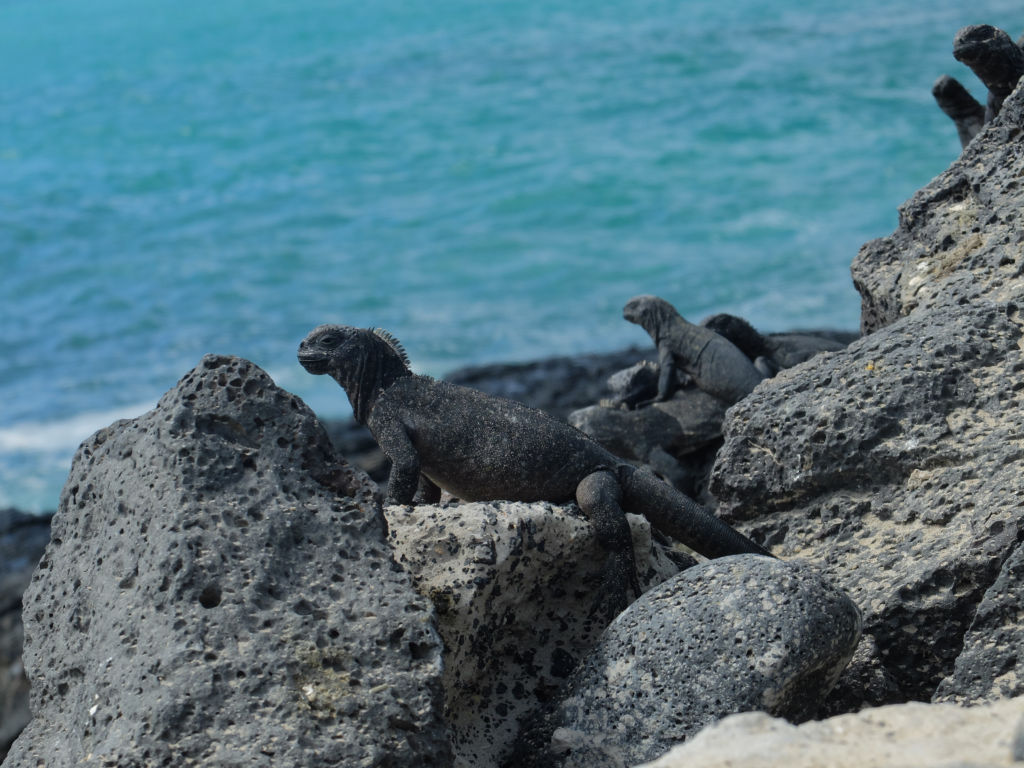
Under normal conditions, cold, nutrient-rich water reaches the Galápagos from the west and south. Upwelling, the movement of deeper water toward the surface, helps supply nutrients needed by marine algae. Green and red algae provide much of the food marine iguanas consume along the islands’ rocky intertidal and shallow subtidal zones.
El Niño alters this system. Warmer surface water and changes in ocean circulation disrupt the usual delivery of cold, nutrient-rich water. The resulting changes in algal communities can leave marine iguanas with far less of the vegetation they normally eat.
During the events investigated by Wikelski and Thom, preferred green and red algae disappeared from affected intertidal areas and were replaced by brown algae that the iguanas had difficulty digesting. Food was therefore not simply less plentiful; the vegetation remaining on the rocks was also less useful to the animals.
Marine iguanas obtain their energy by grazing on submerged vegetation, but they must also expend energy warming themselves, moving between feeding and resting sites, and maintaining their bodies. A large animal needs more total energy than a smaller one. When the supply of digestible algae collapses, that greater requirement can become a disadvantage.
The consequences can be severe. The 2000 paper reported that starvation associated with El Niño-related environmental changes could kill up to 90% of marine iguanas in affected island populations. This figure describes extreme historical population losses, not mortality during every El Niño or across the entire species.
The largest iguanas shrank most, but shrinking determined the survival advantage
One of the most significant findings concerned the relationship between body size, shrinkage, and survival. Larger iguanas generally shrank more during the 1997–98 El Niño. Females also shrank more than males of comparable initial length, a difference the researchers suggested might be related to the energetic cost of producing eggs before a food shortage.
To investigate survival, the team examined a cohort of large adults measured before and after the 1992–93 El Niño. The animals were at least 300 mm (11.8 inches) long from snout to vent. Within this cohort, individuals that lost more body length subsequently survived longer than those that shortened less.
This distinction matters. The paper also reported that the largest marine iguanas generally faced the highest mortality during algal shortages because they fed less efficiently than smaller animals. The result was not that large size itself improved survival. Rather, a substantial reduction in length appeared to help some large adults cope with conditions in which their original size had become costly.
Smaller bodies require less energy to maintain. Wikelski also proposed that shorter, slimmer iguanas, with correspondingly smaller mouths, could harvest limited algae more efficiently. The University of Illinois release described estimated survival improvements associated with increasing shrinkage, but those figures should not be interpreted as fixed benefits for every individual or every El Niño event.
The survival analysis followed known individuals through time, providing evidence that shrinkage was associated with a practical advantage. It did not establish that every iguana could shorten to the same extent, or that shrinkage would be sufficient to overcome the food shortages produced by the most severe events.
The findings also revealed a trade-off in a species where large body size can be advantageous under favorable conditions. Subsequent research by Wikelski explored how feeding performance, available energy, and environmental conditions constrain the body sizes marine iguanas can maintain on different islands.
The loss of length points toward changes in bone and connective tissue
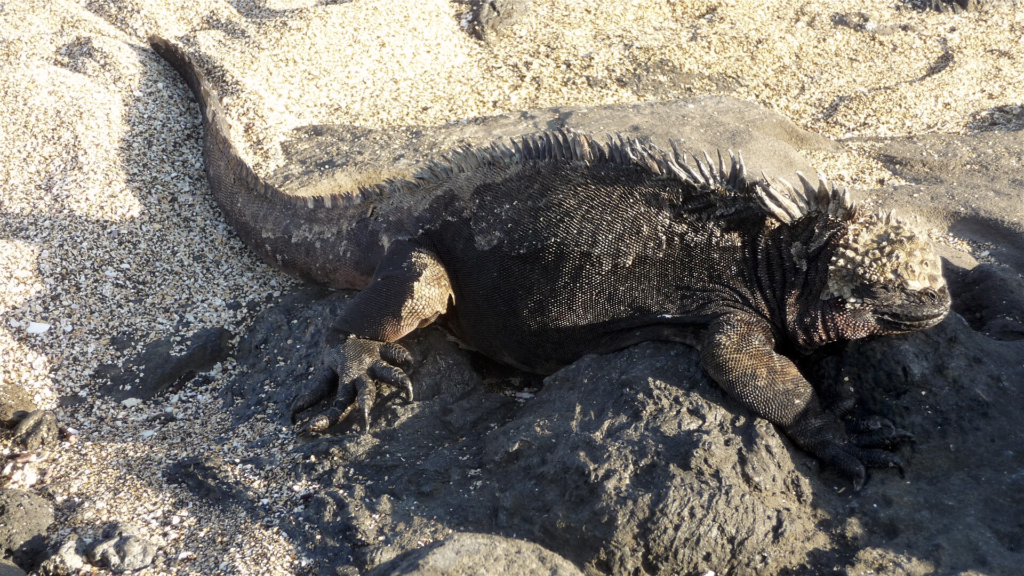
Credit: pamsai / Wikimedia Commons
Losing weight during starvation is common. Losing a substantial part of an adult vertebrate’s measured body length is a different physiological problem, particularly when that length can later be recovered.
Wikelski and Thom reasoned that contraction of cartilage and connective tissue alone could not account for the largest reductions. These tissues made up too small a proportion of the animals’ total length. They therefore proposed that bone resorption, a process in which bone tissue is broken down and its mineral components recycled, accounted for much of the shortening.
They also considered whether elevated corticosterone, a hormone associated with physiological stress in reptiles, might contribute to the process. Food scarcity, reduced activity, and hormonal changes were plausible parts of the explanation, but the 2000 study did not directly establish the complete pathway responsible for the shortening and subsequent regrowth.
The apparent reversibility was especially important. Marine iguanas could alternate between growing and shrinking as environmental conditions changed, rather than following a one-way progression toward a fixed adult length.
The authors discussed possible parallels with bone loss in humans, including osteoporosis and the effects of prolonged spaceflight. These were questions for comparative research, not evidence that marine iguana physiology could be applied to human medical treatment.
Research in 2025 found another way marine iguanas conserve energy
The original discovery raised a broader question: whether the iguanas’ response to food scarcity involved changes in energy consumption beyond those expected from having smaller bodies.
In a study published in the Journal of Zoology in 2025, Shahar Dubiner and colleagues examined heart rates and body temperatures in 665 marine iguanas monitored across 11 years, including three El Niño events. Heart rate was used as an indirect indicator of metabolic activity, while the analysis accounted for differences in body size, temperature, season, and study site.
The researchers found that adjusted heart rates were lower during El Niño conditions. Body temperatures, however, did not show the same relationship with the El Niño index. This suggested that the reptiles might reduce their metabolic activity without simply becoming cooler, although heart-rate measurements alone could not establish the size of that reduction.
A separate study by Dubiner and colleagues, published in the Journal of Experimental Biology in September 2025, measured resting metabolic rates directly. Researchers compared marine iguanas examined in February 2024, following sustained El Niño conditions, with animals measured in March 2025, after a return to neutral conditions.
In the El Niño-associated measurements, body mass relative to length was approximately 17% lower, body girth relative to length was approximately 12% lower, and resting metabolic rates were approximately 20% lower than in the subsequent neutral year. These findings provided direct evidence that reduced energy consumption accompanies the poor body condition observed during El Niño.
The 2025 comparison did not demonstrate that shortening the body by a particular amount directly causes a corresponding reduction in metabolic rate. The measurements were also made in different environmental periods, rather than through an experiment isolating shrinkage from every other physiological response.
Nevertheless, the results strengthen the interpretation that marine iguanas can respond to food shortages in more than one way. Shortening may reduce the energy demands associated with body size, while metabolic depression provides an additional means of lowering energy expenditure.
Recurring El Niño events remain a major conservation challenge
Galápagos marine iguanas are classified as Vulnerable on the International Union for Conservation of Nature Red List. Their distribution is restricted to the Galápagos Islands, and the species faces several threats, including introduced predators, marine pollution and major changes in ocean conditions. El Niño-related food shortages can produce substantial fluctuations in local populations.
The historical evidence is particularly relevant as strong warming events continue to develop in the tropical Pacific. The Watchers reported the strengthening of the 2026 El Niño in September, and a November 10 analysis compared its intensity with the major 1997–98 event. These oceanic measurements provide environmental context, but do not establish whether marine iguanas have undergone comparable shrinkage during 2026.
The ability to shorten and later regrow may help some individuals survive temporary food shortages, but it does not eliminate the risk of starvation. The original observations and the newer metabolic measurements show that these reptiles can adjust to severe environmental stress, while leaving an important conservation question unresolved: how effectively can those adjustments protect populations when marine food shortages are unusually severe or recur before the animals have fully recovered?
References
1 Wikelski, M. & Thom, C. (2000). Marine iguanas shrink to survive El Niño – Nature, 403, 37–38 – January 6, 2000. DOI: 10.1038/47396.
2 Reversible Bone Shrinkage Documented In Galapagos Iguanas – University of Illinois at Urbana-Champaign, via ScienceDaily – January 10, 2000.
3 Wikelski, M. (2005). Evolution of body size in Galapagos marine iguanas – Proceedings of the Royal Society B: Biological Sciences, 272, 1985–1993 – 2005. DOI: 10.1098/rspb.2005.3205.
4 Dubiner, S. et al. (2025). Changes in marine iguana (Amblyrhynchus cristatus) heart rates suggest reduced metabolism during El Niño events – Journal of Zoology, 325, 276–282 – 2025. DOI: 10.1111/jzo.13254.
5 Dubiner, S. et al. (2025). Marine iguanas have lower metabolic rates during El Niño – Journal of Experimental Biology, 228, jeb250907 – September 2025. DOI: 10.1242/jeb.250907.
6 Galápagos Marine Iguana – International Iguana Foundation – Undated species and conservation profile, accessed November 10, 2026.

Rishav Kothari is Editor-in-Chief of The Watchers, where he runs the newsroom and covers earthquakes, volcanoes, severe weather and space weather.
Published in the last 24 hours
- An 83-year-old lodge owner named Harry R. Truman refused to leave his home on Spirit Lake below Mount St. Helens in the spring of 1980, insisting the mountain would not get him, and the May 18 eruption buried him along with his 16 cats Epicenter
- A new model of Antarctica’s Thwaites Glacier that lets seawater seep beneath its grounded ice projects up to about 30 millimeters of sea-level rise by 2100 from that glacier alone, roughly twice the earlier average projection, in a scenario its authors call a lower bound Epicenter
- In 2017, El Niño rains turned part of Peru's Sechura Desert into a lake more than four times the size of Lake Tahoe, and families went out on wooden rafts to fish it Epicenter
- Green Lake, Hawaii's largest freshwater lake, was gone by the afternoon of June 2, 2018, after lava from Kilauea filled its basin. The water was about 20 feet deep, not the 200 feet often claimed. Epicenter
