
Google’s DeepMind redefines weather forecasting with AI-powered GenCast
An artificial intelligence (AI) model developed by Google’s DeepMind — known as GenCast — is proving to be faster and more accurate than the European Centre for Medium-Range Weather Forecasts (ECMWF) system in both speed and accuracy. DeepMind has further advanced its AI initiative by releasing GenCast’s code and parameters for non-commercial use, inviting researchers and meteorologists worldwide to explore its potential and collaboratively address its limitations.

Image credit: Google
- GenCast, the latest AI model of Google’s DeepMind, generates 15-day weather forecasts in just 8 minutes, outperforming traditional systems like ECMWF’s ENS in accuracy and efficiency.
- Trained on 40 years of historical ERA5 data, the AI-driven model uses ensemble forecasting with more than 50 simulations to predict extreme weather events.
The creation of GenCast by DeepMind, a division of Google, signals a new approach to weather forecasting using AI to outperform traditional physics-based models. This new AI-powered weather forecasting system provides medium-range predictions up to 15 days in advance within 8 minutes.
“We’ve really made dramatic progress to catch up and now overtake [physics-based models] with machine learning,” Ilan Price, a research scientist at Google DeepMind in London.
GenCast has demonstrated superior forecasting capabilities, including extreme weather events like hurricanes and heatwaves, delivering faster and more precise results than ever before.
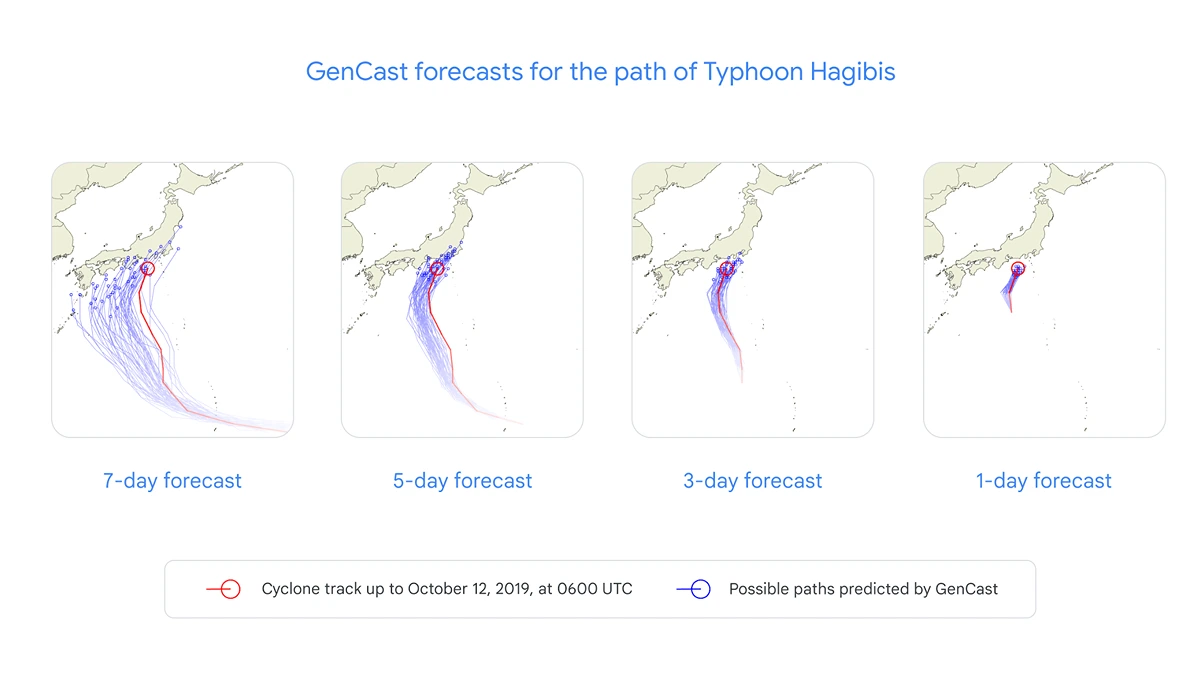
It can also deliver superior predictions of the tracks of tropical cyclones, up to 5 days in advance.
— Google DeepMind (@GoogleDeepMind) December 4, 2024
GenCast’s capabilities could not only help officials better prepare for disasters but also in other aspects of society, such as renewable energy planning. pic.twitter.com/UfCmg5Mb76
Innovative advancements
GenCast generates 15-day forecasts in under 8 minutes using Google’s Tensor Processing Unit- Version 5 (TPU v5), a processor designed for machine learning. For comparison, traditional models like ECMWF’s ENS require several hours on supercomputers.
The application operates on a 0.2o latitude/longitude grid, equivalent to approximately approximately 22 x 22 km (14 x 14 miles), providing detailed information about weather patterns.
It uses ensemble forecasting running multiple simulations with different starting conditions, unlike systems that give only one result. These ensembles allow for probability assessments, giving decision-makers better risk evaluations.
The application of GenCast outperformed ECMWF’s ENS model on 97.2% of 1 320 global forecast metrics in comparative tests and was adept at predicting extreme temperatures, cyclone paths, and wind conditions. Its hurricane track predictions maintained higher accuracy for up to 7 days, which is important for timely disaster preparedness.
“Outperforming ENS marks something of an inflection point in the advance of AI for weather prediction,” Price pointed out.
“At least in the short term, these models are going to accompany and be alongside existing, traditional approaches.”
Evolution of GenCast
GenCast received strong support from experts like Matthew Chantry of ECMWF, who called it a “game-changer” for meteorology. The tool’s probabilistic forecasts, available through Google’s Earth Engine, are expected to help researchers and operational agencies.
The model was trained using 40 years of ERA5 weather data from 1979 to 2018 and tested with weather conditions from 2019.
It was built on GraphCast and MetNet-3, an earlier AI model by DeepMind introduced in 2023. GraphCast delivered efficient 10-day forecasts with improved efficiency over traditional models. It also accurately predicted Hurricane Lee’s landfall in Nova Scotia 9 days in advance, 3 days earlier than traditional methods.
Weather affects almost everything – from our daily lives to agriculture to producing renewable energy and more.
— Google DeepMind (@GoogleDeepMind) December 4, 2024
Forecasting traditionally uses physics based models which can take hours on a huge supercomputer.
We want to do it in minutes – and better. pic.twitter.com/ntX4NRY1DA
The rise of GenCast coincides with advancements from other tech leaders between 2022 and 2024. Other tech companies like Huawei and Nvidia also developed AI forecasting tools, such as Pangu-Weather and FourCastNetm, which use deterministic methods while DeepMind focuses on refining ensemble methods with GenCast.
AI techniques behind the application
GenCast uses diffusion models, a technique common in generative AI, to forecast atmospheric conditions. It adds controlled randomness to simulate weather changes over time, combining observed data and past predictions for more accurate results.
GenCast is a diffusion model, similar to the machine learning models which also power generative AI.
— Google DeepMind (@GoogleDeepMind) December 4, 2024
We trained it on 40 years of historical data from @ecmwf, which included variables such as temperature, wind speed, and pressure at various altitudes – enabling it to learn… pic.twitter.com/ITkN13hgiu
The forecasts of GenCast use much less computing power compared to physics-based systems like ECMWF’s ENS, which depend on thousands of processors. The use of a lower energy footprint supports the push for more eco-friendly computing.
Open Science for global collaboration
DeepMind’s decision to release GenCast’s code and parameters for non-commercial use has been lauded as a step toward democratizing weather forecasting.
“This is a really great contribution to open science,” says Matthew Chantry, a machine-learning coordinator at the European Centre For Medium-Range Weather Forecasts in Reading, UK.
Researchers and meteorologists around the world are encouraged to explore the tool’s potential and address its limitations together.
Use of the application across various sectors
There is a wide range of tools for different sectors used by GenCast.
In disaster preparedness, it helps track cyclones and predict extreme weather, enabling early warnings to reduce damage and loss of life.
In the energy sector, wind forecasts help renewable energy providers optimize turbine operations, improving efficiency and grid stability.
For agriculture, long-term weather predictions help farmers make better decisions about when to plant and harvest crops.
In transportation it can assist with route planning for aviation and shipping, minimizing delays and risks.
Limitations on weather forecasting
The reliance on historical ERA5 data raises questions about the adaptability of GenCast to evolving climate patterns, even though its performance sets a new possibility.
David Schultz, Professor of Synoptic Meteorology in the School of Earth, Atmospheric and Environmental Sciences at the University of Manchester and who worked at the National Oceanic and Atmospheric Administration (NOAA) points out the reliance on traditional physics-based models for training data, comparing it to “studying every move of a chess master.”
There are still challenges in predicting hurricane intensities due to gaps in the training data. It is important to combine AI tools with current meteorological knowledge to improve forecasting.
GenCast is one of several advanced AI-driven weather models developed by Google. Other models in this suite include Google DeepMind’s deterministic medium-range forecasting tools, along with Google Research’s NeuralGCM, SEEDS, and flood prediction models. These technologies are being integrated into Google Search and Maps, enhancing predictions for rainfall, wildfires, floods, and extreme heat.
Google executives said they deeply value partnerships with weather agencies, adding they will continue working with them to develop AI-based methods that enhance their forecasting.
References:
1 GenCast predicts weather and the risks of extreme conditions with state-of-the-art accuracy – Google DeepMind – December 4, 2024
2 GraphCast: AI model for faster and more accurate global weather forecasting – Google DeepMind – November 14, 2023
3 GenCast Code – GitHub – December 4, 2024
4 GenCast Weights – Google Cloud – December 4, 2024

Rishika holds a Master’s in International Studies from Stella Maris College, Chennai, India, where she earned a gold medal, and an MCA from the University of Mysore, Karnataka, India. Previously, she served as a Research Assistant at the National Institute of Advanced Studies, Indian Institute of Science, Bengaluru, India. During her tenure, she contributed as a Junior Writer for Europe Monitor on the Global Politics website and as an Assistant Editor for The World This Week. Her work has also been published in The Hindu newspaper, showing her expertise in global affairs. Rishika is also a recipient of the Women Empowerment Award at the district level in Haryana, India, in 2022.

Informative article! Well researched and written, kudos!