
Geodetic strain data confirm Iberia’s slow clockwise rotation relative to Eurasia and Africa
A new geophysical model integrating GNSS velocity data and earthquake focal mechanisms reveals that the Iberian Peninsula is rotating slowly clockwise relative to both Eurasia and Africa. The analysis, published in Gondwana Research in January 2026, maps present-day stress and strain-rate fields across Iberia and north-western Africa, refining the geometry of the diffuse Eurasia–Africa plate boundary.
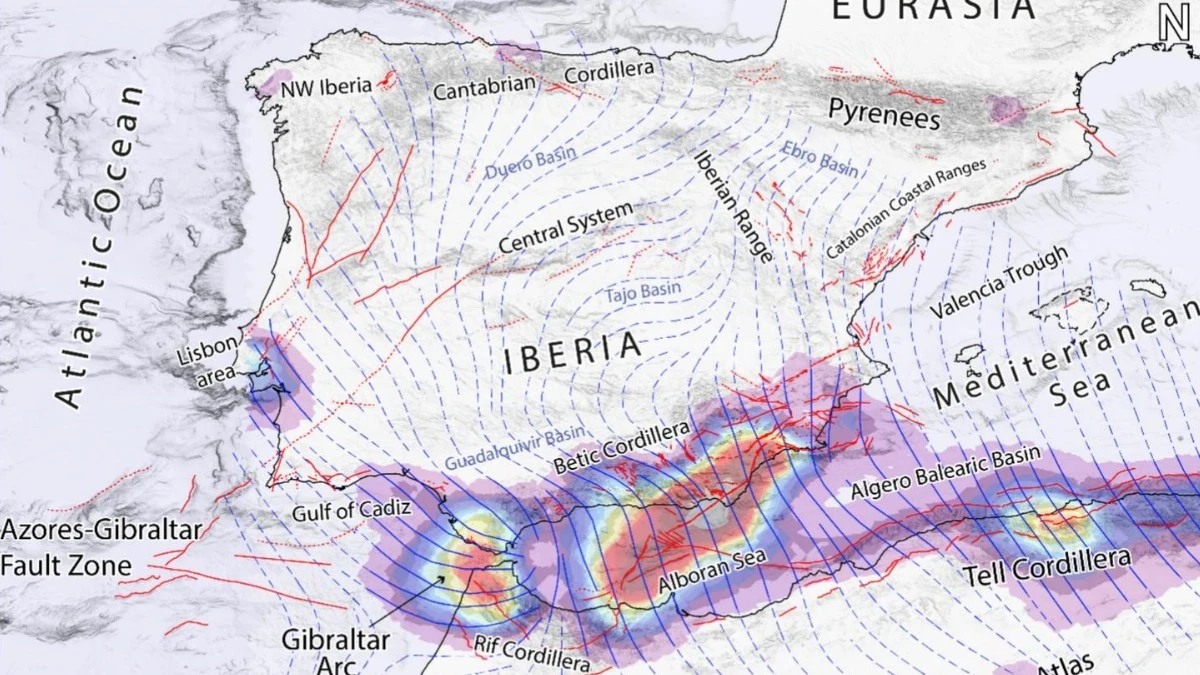
Image credit: Asier Madarieta-Txurruka et al. 2026 Gondwana Research
The study, led by Asier Madarieta-Txurruka of the University of Granada, integrates a comprehensive catalogue of earthquake focal mechanisms with updated GNSS (Global Navigation Satellite Systems) velocity data from the EUREF Permanent Network, the Spanish ERG NSS system, and partner agencies across Portugal and Morocco.
By calculating both seismic stress tensors and geodetic strain-rate fields, the team produced a unified image of how continental and oceanic crustal domains deform along the diffuse Eurasia–Africa boundary.
The results divide the region into four tectonic sectors, Atlantic, Gibraltar, Alboran, and Algero-Balearic, each displaying distinct stress orientations and strain styles.
In the Atlantic sector, stress transfer occurs directly between the converging plates, while in the Mediterranean domains, deformation is absorbed within the thinned continental crust, producing variable motion around the Gibraltar Arc and the Alboran Basin.
The GNSS velocity field across the sectors indicates a subtle but consistent clockwise rotation of the Iberian microplate relative to both Eurasia and Africa. Rotation rates are slow, approximately 3 mm (0.12 inches) of west-south-westward motion at the southern margin, yet sufficient to explain observed shear partitioning and seismic patterns in southern Iberia and northern Morocco.
This motion corroborates earlier geodynamic models, such as Serpelloni et al. (2013), but now rests on direct strain-rate measurements rather than on inferred kinematic blocks.
Even intraplate regions traditionally considered stable, including the Iberian interior and the Pyrenees, show measurable though low strain, primarily compressional in character.
“This study demonstrates the power of the multidisciplinary, grid-based, stress–strain analysis to unravel complex seismotectonic patterns across extensive plate boundary zones,” the authors said. “This integrated approach proves particularly valuable for deciphering the intricate geodynamic processes along the Eurasia-Africa plate boundary in the Atlantic-Mediterranean transition zone.”
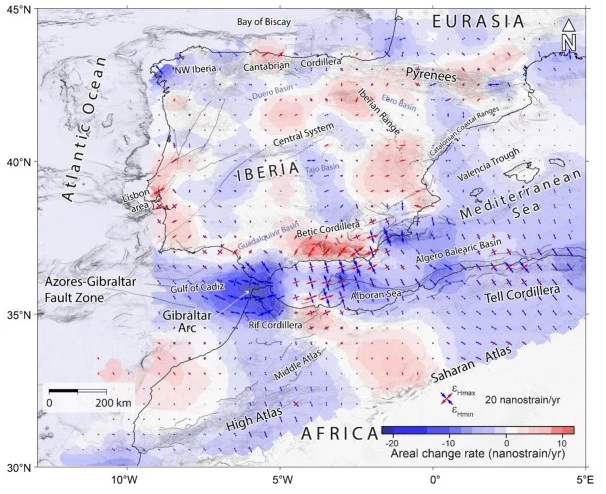
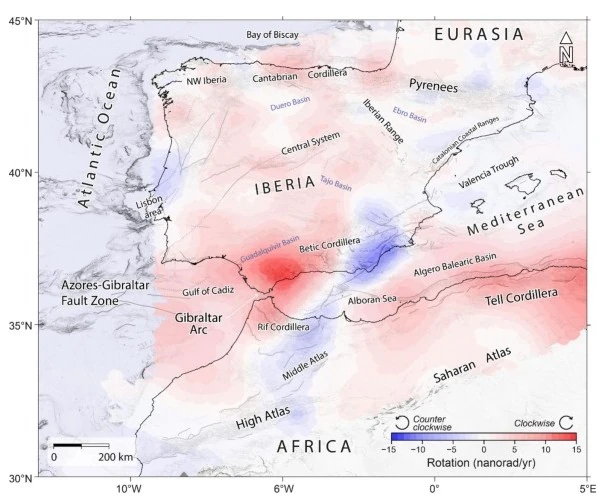
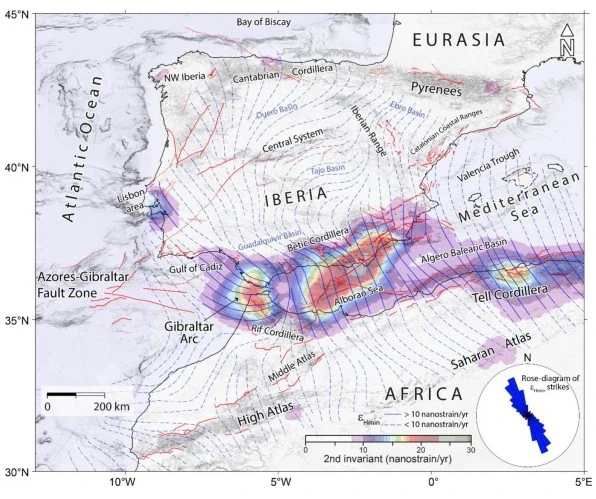
The findings confirm that low-deformation zones can still accumulate stress capable of generating earthquakes. The work refines the mechanical picture of the western Mediterranean, showing that plate interaction is not confined to a single boundary but distributed across several crustal blocks of differing strength.
The Gibraltar Arc acts as a transition zone linking Atlantic transpression to Mediterranean extension, while Alboran and Algero-Balearic domains accommodate mixed strike-slip and normal faulting associated with crustal thinning. Stress-field orientations derived from earthquakes closely match those predicted by GNSS-based strain rates, confirming internal consistency between the two independent datasets.
By quantifying deformation in a region of slow convergence and structural complexity, the study delivers one of the most detailed current models of continental kinematics in the western Mediterranean.
The authors note that their results support ongoing updates to seismic-hazard frameworks for Spain, Portugal, and Morocco through integration of geodetic and seismological observations.
Although the overall rates are low, the distributed nature of strain implies that future moderate-magnitude earthquakes may occur across a broad area rather than along a single fault zone.
References:
1 New insights on active geodynamics of Iberia and Northwestern Africa from seismic stress and geodetic strain-rate fields – Asier Madarieta-Txurruka, Juan F. Prieto, Joaquín Escayo, Federico Pietrolungo, José A. Peláez, Jesús Galindo-Zaldívar, Jesús Henares, Federica Sparacino, Gemma Ercilla, José Fernández, Mimmo Palano – Gondwana Research – January 2026 – https://doi.org/10.1016/j.gr.2025.08.020 – OPEN ACCESS

I'm a dedicated researcher, journalist, and editor at The Watchers. With over 20 years of experience in the media industry, I specialize in hard science news, focusing on extreme weather, seismic and volcanic activity, space weather, and astronomy, including near-Earth objects and planetary defense strategies. You can reach me at teo /at/ watchers.news.

Lots to ponder there, thank you.
Ever taken a world map, centred and marked along the 30 degree meridian, overlaid the last 25-30 years of quakes >M4.5?
See the circular distribution of quakes and geophysical topographic stress patterns (parallel and at 90 degrees) centred approximately in Guyana and 180 degrees away, approximately in Sulawesi?
It’s all symmetric, right the way across both hemispheres, even earthquake-zone stress cracks joining the two halves, one of those being across the Mediterranean and of interest to this article.
There is clearly a turning force about these two centroids.
Now consider the suggestions of the ‘S’-shape signatures on that map, in-terms of rotating a sphere.
My regards, fellow Watchers.