• Global Astronomy Month 2012

    People are uniting this April for Global Astronomy Month 2012, a planetwide celebration of astronomy designed to bring people together through star parties, music and artistic performances, web observing events, and more. Global Astronomy Month 2012 (GAM 2012) in

  • New research cast doubts on accepted Moon origins theory

    In the new research, published online today in Nature Geoscience, geochemists led by Junjun Zhang at the University of Chicago in Illinois, together with her colleague at the University of Bern in Switzerland, looked at titanium isotopes in 24 separate samples of

  • Venus, Jupiter and the crescent Moon alignment this week

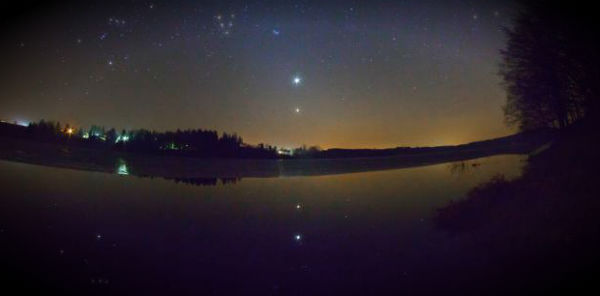
    On March 24th, 25th and 26th, Venus, Jupiter and crescent Moon will appear side by side again in the western sky at sunset. Best time for observing the sky show is before the sky fades completely black. These bright objects are extra-beautiful when they are framed by

  • Earth’s equinoxes and solstices

    An equinox occurs twice a year, when the tilt of the Earth’s axis is inclined neither away from nor towards the Sun, the center of the Sun being in the same plane as the Earth’s equator. The term equinox can also be used in a broader sense, meaning the date when such a

  • Sunspot 1434 unleashed M1.3 solar flare

    Sunspot 1434 located in the southern hemisphere, produced a rapid M1.3 Solar Flare at 20:39 UTC on March 17, 2012. A Type II Sweep Frequency Event with a velocity of 1140 km/s was detected as well. Analysis of the M1.3 flare is ongoing to determine if it was